This map plots the settings and references in Any Human Heart
To start exploring, click a red pin


 General view and High Street, Oxford, England between 1890(1890) and 1900 - Credit:
Photoglob Zürich, reprinted by Detroit Publishing Co
Oxford in the 1920s was a University town of course, but also a car town. The development and subsequent success of the Morris Motor Company nicely balanced the scholarly world of the colleges.
 1927 Morris Cowley - Credit:
Arpingstone
The city is filled with historic buildings and beautiful greenery, numerous popular walks and parks. The Botanic Garden is the oldest in Britain. Such scenic surroundings prompted the poet Matthew Arnold to describe Oxford as the ‘city of dreaming spires'.

 Radcliffe Camera, Oxford - Credit:
DAVID ILIFF
The University of Oxford comprises 44 colleges and private halls. There are more than 100 libraries housing countless tomes and volumes, but the largest is the Bodleian library system, which includes 40 libraries in all. The iconic Radcliffe Camera is its most striking architectural manifestation.
Official academic dress would still have been a requirement in LMS's day. It was only during the 1960s that the practice of wearing it full-time started to fade out.
Oxford was very much a literary university, with Oscar Wilde, Lewis Carroll, CS Lewis and JRR Tolkien all recent alumni.
Oxford will always be renowned for grandeur – in architecture, academia and atmosphere – a truly impressive place.
 Tom Quad, Christchurch in the snow - Credit:
Toby Ord

 Piccadilly Circus, looking up Shaftsbury Ave, circa 1949 - Credit:
Chalmers Butterfield
London is, among many other things, a literary city. Within a few miles of the Tower of London, Westminster Abbey (home of Poet's Corner, where many famous writers are buried), Big Ben, St Paul's Cathedral and Buckingham Palace, hundreds of great writers have worked and lived. William Shakespeare, Samuel Pepys, John Milton and Charles Dickens were followed by many other extraordinary creative talents.
When LMS arrived in London, its literary scene was thriving. The Bloomsbury Group, a set of writers, philosophers and other intellectuals, was at the height of its fame.
The printing press had also become much more efficient, with the 1930s and 1940s seeing the Platen Printing Press churn out several thousand impressions per hour. News, novels and other printed publications were more readily available than ever. Fleet Street was becoming synonymous with the newspaper industry.
 WW2 Blitz Damage - Credit:
US Government
London has long been a fashion capital, and never more so than in the Roaring Twenties. The Prince of Wales, who would become LMS's nemesis, was a fashion icon, admired and emulated much like today's film stars.
The city was hard hit by World War 2. It was subjected to intensive aerial bombardment, night after night, which left much of it in ruins and many civilians homeless or dead. LMS's experience would have been typical.
 Underground to Wood Lane to anywhere: International Advertising Exhibition at the White City, November 29 to December 4, 1920. - Credit:
trialsanderrors' photostream
 The Bahamas... - Credit:
jpatokal
Where better to be posted during WW2 than the Bahamas? It's a perfect paradise of sun, sea and sand, with English as its official language.
Some seven hundred islands make up the Bahamas, along with more than 2,000 uninhabited islets. Peppered with palm trees, parrots, pigeons, dolphins, sharks, manatees, turtles and myriad more exotic wildlife, the islands boast an eclectic variety of fauna and flora.
 Palm Tree, Nassau - Credit:
Albert Bierstadt
The Bahamas were the first point of landfall for Christopher Columbus in 1492, although the islands were never colonized by the Spanish. The name comes from the Spanish for 'Shallow Water'. The Bahamas were made a British crown colony in 1718.
The capital, Nassau, lies at the heart of the islands, with the Exumas stretching out in a southeasterly direction and Grand Bahama Island and The Abacos to the north. The large island of Andros, with the Andros Barrier Reef, lies to the west of Nassau.
 Map of the Bahamas - Credit:
United States Central Intelligence Agency's World Factbook
Nassau is the biggest city in the Bahamas. It is part of New Providence island and is connected to Paradise Island by two bridges. In Nassau, Georgian architecture sits alongside more modern buildings. There is a natural harbour, which would have been used by LMS and his crew during their stint on the island.
English speaking, the people of the Bahamas are predominantly of African origin (c.85%). Over half the population lives on New Providence Island.
The islands gained independence from Britain in 1973 but remain part of the British Commonwealth, with an appointed Governor-General who represents the head of state, Queen Elizabeth II.
 Parliament of the Bahamas, located in downtown Nassau, is the meeting place of the two houses of the Bahamian Parliament. - Credit:
UpstateNYer
 Manhattan, New York City - Credit:
user:AngMoKio
 Times Square as it is today - Credit:
Terabass
New York, New York...
It is iconic, it has often been described as the most important city in the world, and it is home to some of the most significant buildings on the planet. Indeed, the Manhattan skyline is instantly recognisable.
LMS mentions several key landmarks and locations, including the beautiful art-deco Chrysler Building, Central Park and Madison Avenue. Times Square, the heart of Broadway theatre, also features in his journal, as does nearby Long Island.
 Chrysler Building - Credit:
DavidShankbone
Manhattan is just one of the five boroughs that make up New York City, the others being the Bronx, Brooklyn, Queens, and Staten Island. Lowever Manhattan is home to Wall Street, while Midtown holds the United Nations and Grand Central Station, and Uptown Manhattan boasts Harlem and Columbia University.
Through LMS, we can peer into the art scene of New York at the time. New York was (and remains) an artist's mecca. The Abstract Expressionist Movement in the 1950s is well recorded in Any Human Heart; many of the artists he cites were among the movers and shakers of the art world at the time.
 Central Park - Credit:
Fritz Geller-Grimm
 Osun river in Osun state, Nigeria - Credit:
Alex Mazzeto - Jurema Oliveira (talk) 18:13, 16 November 2009 (UTC)
Osun, named after the River Osun, is a land-locked state in the southwest of Nigeria. Its capital is Osogbo.
Osun State University comprises six different campuses, including ‘Ikire’ – perhaps the one William Boyd has in mind when he sends LMS to lecture at ‘Ikiri’ University. The six campuses are located at Osogbo, Okuku, Ikire, Ejigbo, Ifetedo, and Ipetu-Ijesha.
Nigeria is a vast country, irrigated by the River Niger. It is rich in biodiversity, with coastal plains, tropical rainforest, swamp and savannah.
The country is also very rich in oil, which has been a source of great conflict and corruption for many years.
The official language of Nigeria is English (along with Yorùbá – a Niger-Congo language.)
 Yoruba drummers - Credit:
Melvin "Buddy" Baker from St. Petersburg, Florida, United States
 Naira notes - Credit:
Chippla Vandu
The currency changed from the old Pounds, Shillings and Pence system (£sd) to Naira (NGN) in 1973 – the last country to abandon the old currency system. LMS lived in Nigeria from 1969 until 1975, so would have experienced the use of both. Two Naira subsequently equalled £1.

 Political map of the 36 States of Nigeria - Credit:
Domenico-de-ga, translated and adapted by xandar
Sainte-Sabine is a commune located in southwestern France, in the Dordogne department in Aquitaine. It was created after the Born-de-Champs and Saint-Sabine communes merged in 1974 and is now referred to as Sainte-Sabine-Born.
LMS also mentions visits to the Valley of the Lot and Puy-l'Évêque, both found in the Lot department in the Midi-Pyrénées region.
 The Lot Valley - Credit:
Phillip Capper from Wellington, New Zealand
The Lot valley is a hidden treasure, whilst Puy-l'Évêque, with its historic streets and pretty terraced houses, retains remnants of its prosperous past in dyeing and nail-making.
This picturesque part of France is home to the Cahors Vineyards. And the Lot department is renowned for its fine food, from tasty truffles to gorgeous goose and delectable duck confit.
 Puy-l'évêque - Credit:
Pierre Hanser
Lot takes its name from the Lot River, which flows through the southern part of the department, although the Dordogne also flows to the north and the Cele in the centre.
 Lot River, Cahors - Credit:
Bernd Gehrmann (de:Benutzer:BerndGehrmann),
The village of Glympton is a small civil parish approximately three miles north of Woodstock in Oxfordshire.
An impressive address close to the Natural History Museum and Harrods.
The capital and largest city in France, Paris epitomises culture and artistic style. Perched on the banks of the River Seine, the northern-based city has many notable landmarks, including the Pont des Artes (Bridge of Arts), seen in the photograph and the Pont Neuf (New Bridge), located behind it.
Also in the picture is the French Institute, on the right, at the end of the Pont des Artes. The famous Notre-Dame de Paris Cathedral towers are seen in the distance behind these landmarks.
 Paris panorama - Credit:
Benh LIEU SONG
Of great significance in the history of Paris was the Industrial Revolution in the 1840s, which changed the face of the city forever.
South-western Biarritz meanwhile, is just a five-hour train journey from the capital and is similarly famous, but for its beautiful coastline rather than artistic architecture. A surfer’s paradise, the large town of Biarritz remains an intensely popular holiday destination today.
 Grande Plage, Biarritz - Credit:
Jaakko Sakari Reinikainen (ulayiti)
 Plaza Mayor, Madrid - Credit:
Source: Self-made, I release it into the public domain.
Segovia is located just north of Madrid, which is the capital of Spain and the country's largest city.
 Segovia - Credit:
McPolu at http://www.flickr.com/photos/21277285@N00/223200262/
Seville meanwhile, is the artistic, financial and cultural capital of the south.
 Adriatica Building, Seville - Credit:
Anual
Algeciras is shown at the bottom of the map by the coloured marker and boasts one of the largest ports in Europe (pictured). It is also the biggest city in the Bay of Gibraltar.
 Port of Algeciras - Credit:
Alex Proimos from Sydney, Australia
LMS certainly visited the best European destinations…
 Hotel Normandy, Deauville - Credit:
Pinpin
Deauville, in the Basse-Normandie region of northwestern France boasts the ‘queen of the Norman beaches’ and is filled with impressive hotels and a Grand Casino.
The Normandy and Royal Hotels and Casino opened between 1911 and 1913 and in 1923 the famous wooden boardwalk, the ‘Promenade des Planches’, which borders the sea, was constructed.
Deauville is somewhere the international upper-class continue to enjoy as a holiday retreat and is more than just a seaside resort – it is the French seaside resort. It could not hold the unofficial title of ‘Parisian Riveria’ otherwise…
Vichy is famous for the alleged healing powers of its thermal springs, the result of the various dormant volcanoes in and around the area. The city enjoyed a surge of visitors during the 1930s, who all flocked to use the thermal baths.
 Vichy city hall - Credit:
User:thbz
Meanwhile, the Art Nouveau-style Opéra attracted all the key musical players to the venue and for music in France, Vichy was the place to be.
During the Second World War Vichy was occupied by the Nazi Germans (between 1940-1944).
Lyons is located in the Rhône-Alpes area, between Paris and Marseille, and is an established UNESCO World Heritage site. It is famous for food, silk and cinema, amongst many other things…
 Lyons - Credit:
GIRAUD Patrick/Original uploader was Calips at fr.wikipedia
Grenoble lies nestled at the base of the French Alps and is surrounded on three sides by mountains. Key sites include the ancient Bastille fortifications, which offer great views of the area, the Palace of the Parliament of Dauphiné, the Museum of Grenoble and the Archaeological museum of Saint-Laurent.
 Grenoble - Credit:
Simdaperce
Meanwhile, Geneva is Switzerland’s second most populated city and is at the epi-centre of finance and diplomacy. It houses the headquarters of the United Nations and the Red Cross and is where the Geneva Conventions were signed.
 Geneva views - Credit:
MadGeographer
Hyères is located in the provence of Toulon and includes the Castle of Saint Bernard, perched upon a hill.
 Hyeres castle - Credit:
Denis Biette
Between the old town and the sea lies the pine-covered hill of Costebelle, which overlooks the peninsula of Giens.
 View from Berliner Dom in the direction of Potsdamer Platz. - Credit:
Bleppo
The German city of Berlin is the country’s capital.
It could very much be described as a ‘cultural capital’, although politics, media and science (particularly medicine) are also key aspects of what makes Berlin the city it is.
Amongst the notable architecture of the city is the Brandenburg Gate, which now appears on German Euro coins. It is an iconic landmark of Berlin.
At the time LMS was writing, the Friedrichstraße was renowned in Berlin – a bit of a legend in 1920s societal circles.
Kildonnan, is a village located in Inverness-shire in Scotland, just west of Edinburgh.
 Bandol, France - Credit:
Melendil
The popular seaside resort of Bandol is synonymous with fine wine, branded some of the best in France. With its picturesque beaches, cliffs and creeks, Bandol has always attracted the tourists – from Thomas Mann and Aldous Huxley to Brigitte Bardot…and of course, LMS.
 The Eiffel Tower, Paris - Credit:
Taxiarchos228
The city of Amsterdam is the Netherland’s largest and is home to historic canals, as well as being the former home of Vincent van Gogh, to whom a museum is dedicated. Other famous attractions in Amsterdam include , the Rijksmuseum and Stedelijk Museum, along with the Anne Frank House.
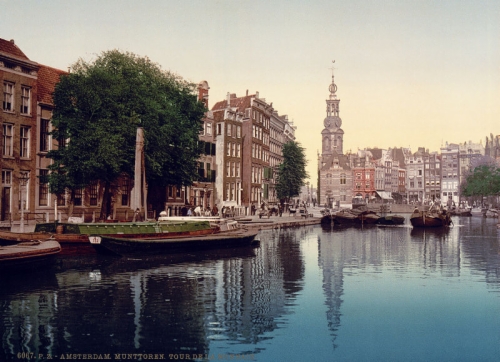
Of course, the capital city, which is the Netherlands’ financial as well as cultural capital, is also renowned for its red-light district and cannabis coffee shops…
Meanwhile, Belgium’s capital city has a history of drawing in those of a creative persuasion and was home to various Impressionist painters in the past.With more than 80 museums, Brussels boasts an impressive range of artwork and other historical memorabilia. The streets are also lined with beautiful medieval architecture, monuments and boulevards.
 The Congress Column in Brussels - Credit:
http://www.flickr.com/photos/infomatique/
Both Dutch and French are spoken in the city, with French having become increasingly popular during the 19th and 20th centuries. As the administrative centre of the EU, Brussels is therefore also referred to as the Capital of Europe.
London – home to LMS for a large part of his life, is saturated with history, culture and literature… Indeed, from Dickens to Shakespeare, Pepys to Woolf, many of the greats have lived and worked in the UK city – many more then and since.

Palace of Westminster. - Credit:
Tony Moorey
Brimming with beautiful buildings, London is home to the famous Tower Bridge, Westminster Abbey, the Palace of Westminster, Big Ben and Buckingham Palace, to name but just a few of its sites.
As Samuel Johnson once said: “You find no man, at all intellectual, who is willing to leave London. No, Sir, when a man is tired of London, he is tired of life; for there is in London all that life can afford.”
Monte Carlo in Monaco is well known and loved for its casino culture (Le Grand
 View of Monaco - Credit:
I, Katonams
 Monaco map - Credit:
United States Central Intelligence Agency's World Factbook.
Nearby La Spezia meanwhile, was described by Ernest Hemingway as follows – “The roads are wide and the houses high and yellow” – and in the novel ‘Sir’, it is referred to as “the blue city of dreams and love.”
The town is part of the Italian Riveria and subsequently is a beautiful place to visit, ‘guarded’ as it is by the castle located at the entrance of the Gulf of La Spezia.
 La Spezia - Credit:
William Domenech
LMS journeyed to La Spezia specifically to see Percy Bysshe Shelley’s abode – Casa Magni (pictured), which was in actual fact, a boathouse of some vintage.
 Casa Magni, Shelley's house at San Terenzo - Credit:
Drawn by Captain Daniel Roberts
The writer however, who shared his home with his wife Mary Shelley, tragically met his end in the scenic surroundings, drowning in the Bay of Spezia on July 8, 1822…
 The Leaning Tower of Pisa - Credit:
Softeis
The city of Pisa, best known perhaps for the infamous Leaning Tower of Pisa, is located in central Italy – in Tuscany. It contains many other historic sites however, including churches, bridges and palaces.
Another claim to fame for Pisa is the fact it was the birthplace of none other than the early physicist, Galileo Galilei.
Siena/Sienna, also in Tuscany, is another popular tourist destination and is now a UNESCO World Heritage Site.
 Piazza del Campo in Siena - Credit:
Massimo Catarinella
Many artists have enjoyed Sienna over the years nd it retains a collection of Renaissance and High Renaissance artwork there still.
Also, no doubt drawing in the visitors, is the food found in Sienna and its famous Palio horse race, which is a bi-annual occurrence.
 Rome's Colosseum, (L-R) Monument to Vittorio Emanuele II, Piazza della Repubblica, Castel Sant' Angelo, Trevi Fountain, dome of St. Peter's Basilica and an aerial view of city centre. - Credit:
Oliver-Bonjoch, Andreas Tille, Pasgabriele, NormanB, Ra Boe, Roberto Larcher, collection by DaniDF1995
Moving on to Rome, the Eternal City is resplendant in awesome architecture, choc-a-bloc with churches and steeped in rich Roman history – such as the Romulus and Remus legend of how the city was created.
From the creative genius of its artists, to Emperors, popes and so much more besides, Rome has produced and inspired many and around every corner reveals another snapshot of bygone eras.
Think of Bordeaux and one thing should immediately spring to mind – wine.
Whether a wine aficionando or not, any visitor to this French city must surely appreciate the sheer scale of wine production Bordeaux is famous for the world over. Around 850 million bottles, both red and white, come from the city each year, which also hosts the Vinexpo wine fair.
Bordeaux is more than its wine however and as a ‘City of Art and History,’ is a UNESCO World Heritage city – well frequented by tourists and the film industry alike because of its 18th century architecture.
 Bordeaux collage - Credit:
En-bateau, image replacement by Alchemica (talk)
 Supermarine Spitfire Mk.PR.XIX - Credit:
Adrian Pingstone
Lisbon is synonymous with politics, culture and economics and holds the title of one of the world’s oldest cities, with a history dating back to the fifth century. The Moorish people took control during the eighth and then the Crusaders came along in 1147, claiming Lisbon back for the Christians and subsequently converting it into a hub of political, cultural and economic activity.
 Lisbon - Credit:
Osvaldo Gago
Although Portugal’s capital city in name, legally and unusually, Lisbon's title has never been made official by way of a statute or in writing, but simply through constitutional convention.
During WW2, Lisbon remained a neutral port and therefore home to many war refugees fleeing Nazi Germany.
Like many of the places visited by LMS, it is packed with beautiful architecture – in Lisbon Romanticism, Gothic, Baroque and many more are juxtaposed alongside one another to great effect.
The port city of Southampton, located in the south of England, is located near the famous New Forest.
In 1912, the doomed passenger ship, the RMS Titanic, sailed from its docks and there is a commemorative statue in Southampton in memory of those on it. Southampton was also where the Supermarine Spitfire was designed and developed.
WW2 saw the city suffer greatly from bombing, particularly because of its importance as a commercial port and industrial city.
 Bidart coastline - Credit:
Gruson-Daniel
The small hill-top town of Bidart is situated beside the sea and is the epitome of peace and tranquility. Nearby Biarritz bustles with activity (see earlier bookmark), but in Bidart, visitors can relax away from the busyness on beautiful beaches and under the same glorious shining sun.
 Meteora, central Greece - Credit:
Takeaway at the English language Wikipedia
Philosophy, the Olympic Games, gods, godesses, literature, art and architecture... all this and more makes up the creatively rich country known as Greece/Hellas - the Hellenic Republic.
Ancient Greece and the remnants of it, still feature prominently when it comes to the Grecian lifestyle and the same was of course true when LMS would have visited.
Home to Homer, author of The Iliad and The Odyssy, Greece enjoyed the talents of many major literary figures. From the ancient period of Greek literature to the Byzantine and then modern, a number of great works originated from the country, which was to shape literature as we now know it in the western world.
Greece is also synonymous with philosophy, with great thinkers such as Plato and Socrates making their mark during their own lifetime and far beyond.Those who came before Socrates, were known as 'Presocratics', although very little of their work has survived down through the ages.
Although images of sunny beaches may come to mind first, the mainland of Greece is in fact mostly mountainous, the highest mountain being Mount Olympus, which stands at 2,917m (9,570 ft).
With the twelfth longest coastline in the world however, Greece does of course boast beautiful scenery, (including beaches!) with a scattering of idyllic islands, including Crete, the Cyclades and many others.
Geographically, Turkey lies to its east, with Albania, the Republic of Macedonia and Bulgaria to the north.The coast has also played an important role in the Grecian economy over the years, with a high reliance on the country's shipping industry.
The bustling port of Nassau is located in New Providence, the most densely populated island in the Bahamas of which it is the capital.
Christopher Columbus brought New Providence under Spanish control during his journeys of discovery, but the tropical islands seemingly held little allure for the Spaniards and they relinquished their control.
More than 360 islands make up the Exuma district, the biggest being the Great Exuma, which is linked to Little Exuma by bridge. The Tropic of Caner runs nearby.
Switzerland is a notoriously neutral country and, landlocked as it is at the heart of Europe, it is perfectly placed to make the most of this, establishing strong links with its neighbours.Such links forged mean it is now one of the world's wealthiest countries, achieved predominantly through its great success in banking.
Lucerne is described as one of many of Switzerland's many enticing towns - LMS, however, may not have shared the same opinion after his stint in the area... Aside from banking, sports and Switzerland also go hand in hand - it is as popular in the summer as it is in the winter, with its Alpine peaks and lengthy lakes a great draw for tourists.
Egypt’s capital, Cairo, is also known as ‘The City of a Thousand Minarets’ due to the wealth of Islamic architecture within and is located in the north of Egypt, bordering the River Nile.
Naples meanwhile, is found on Italy's west coast and is well known for its history, art, culture, architecture, music, and gastronomy. Mount Vesuvius and the Phlegraean Fields are located nearby... One of the oldest cities in the world, the centre of Naples is also Europe's largest.
An interesting fact about Peebles - it now "has the highest shoe shop to population ratio in the UK..."It has been a market town, functioning woollen mill town and now a successful high street town on the Scottish Borders.
 Colourful Reykjavik rooftops... - Credit:
Bjørn Giesenbauer
Reykjavik or the 'Bay of Smokes', so called because of the steam rising from its hot springs, is now a renowned spot for nightlife.
As Iceland's capital, it is the largest city in the country and an increasingly popular place to visit. It is not, as many might believe, encased in constant ice and snow....
Located on the French Riveria, Cannes is the stomping ground of the rich and famous, the well to do and those who just like (and can afford) luxury...
It is filled with shops, restaurants and hotels which offer the very best in what they sell and its reputation subsequently precedes it...
The Biafran War was also referred to as the Nigerian Civil War and took place between July 6, 1967 and January 15, 1970.
As with any civil unrest, political problems were at its heart, but these were suitably flanked by religious arguments, economic upset and general cultural problems.
The key aim of the conflict was to establish a Republic of Biafra in south eastern Nigeria.
The war ended in 1970 when, after a million civilians were killed in the conflict or died from hunger, Biafra rejoined Nigeria and a ceasefire was agreed.