


 Portuguese Troops in Mozambique - Credit: Joaquim Coelho
The Mozambican War of Independence began in 1964 and lasted for ten years. To put it in context, most British colonies in Africa (other than Rhodesia) had been granted independence in the early 1960s. Portugal did not give up Mozambique until 1975. However, unlike the other European powers who had made their "scramble for Africa" in the 19th century, Portugal had held Mozambique as a colony since 1505.
Portugal was already fighting a colonial war in Angola when the Mozambique Liberation Front (FRELIMO), a political party formed two years earlier, initiated an insurgency with the support of the Soviet Union, China and Cuba. A protracted conflict ensued, with FRELIMO capturing small areas of territory but focusing on guerrilla operations and urban terrorism. They used landmines to great effect. Portugual increased its military strength in the country from 8,000 to 50,000 men in 1970, and pursued a variety of strategies over the years.
 Portuguese Propaganda in Mozambique - Credit: Joaquim Coelho
The colonial army maintained control over most of the country during the decade of fighting, but at great cost to Portugal. On 25 April 1974, a peaceful left-wing coup d'état in Lisbon, the Carnation Revolution, led to a ceasefire in Mozambique. Portugal ceded power to FRELIMO, with formal independence granted on 25 June 1975. 300,000 white Portuguese left the country overnight, causing the local economy to collapse.
FRELIMO rapidly established a one-party state allied to the Soviet bloc, and outlawed rival political activity. The new government gave shelter and support to South African (ANC) and Zimbabwean (ZANU) liberation movements, provoking the governments of Rhodesia and later apartheid South Africa to foster and finance an armed rebel movement called the Mozambican National Resistance (RENAMO). In 1977, civil war erupted, and lasted for 15 years. This conflict, Rhodesian and South African intervention, and central economic planning by the Marxist leadership, left the country in chaos. About one million people died in the civil war and millions more fled abroad or to other parts of the country.
FRELIMO formally abandoned Marxism in 1989, and a new constitution provided for multiparty elections and a free market economy. A UN-negotiated peace agreement between FRELIMO and RENAMO ended the fighting in 1992.

 Polana Hotel - Credit: F Mira

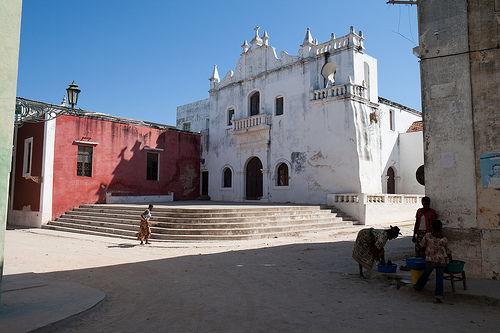 Mozambique Island - Credit: stignygaard
The fortified Ilha de Moçambique, now a Unesco World Heritage site, is a former Portuguese trading-post on the route to India. The island was a major Arab port (the name comes from one-time resident Musa Al Big) and boatbuilding centre long before Vasco da Gama visited in 1498. The Portuguese established a port and naval base as early as 1507. The Chapel of Nossa Senhora de Baluarte, built in 1522, is considered the oldest European building in the southern hemisphere.
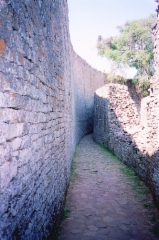 Great Zimbabwe - Credit: ctsnow, Flickr
Great Zimbabwe is near Masvingo, in Southeastern Zimbabwe.
 Chimanimani Mountains - Credit: Darell Plowes
Whilst most of the range is in Mozambique, much of the Zimbabwean side is now protected within the Chimanimani National Park.

 St George's College - Credit: Henry Trotter
St George's College, is a private Catholic school in Harare (Salisbury). It is recognised to be one of the best secondary schools in Africa.
‘St. George's College [is] a ritzy boys' high school for the country's elite. It is located right next to the President's house and the National Botanical Gardens.’ - Henry Trotter, ex-teacher.
For the past 113 years of its existence, St George’s College has had every reason to be proud of its alumni: war heroes and Rhodes Scholars, priests and artisans, lawyers and engineers, doctors and teachers, farmers, academics and sportsmen.
 St George's emblem - Credit: permission from B Tiernan, Headmaster
Peter Godwin is listed on the school's website under 'Notable Alumni'.
 Shangani Patrol - Credit: Henry Justice Ford
During the First Matabele War, the Britsh South African Police destroyed the Ndebele capital of Bulawayo, forcing King Lobengula to flee. A BSAP column was dispatched in pursuit. They set up camp on the south bank of the Shangani river on 3 December 1893.
A dozen men, under the command of Major Allan Wilson, were sent across the river to reconnoitre. Shortly afterwards, Wilson sent a message back to say that he had located Lobengula and requested reinforcements. Twenty additional men were sent to join the Shangani Patrol.
 Alan Wilson Patrol Embroidered by the Mashaba Women's Institute. - Credit: Barbara Goss
At dawn on 4 December, the Ndebele attacked Wilson’s little force of men. The battle which followed between the thirty-four white men and ‘thousands’ of Lobengula’s warriors lasted all morning. Towards 11 o’clock the Ndebele called on the surviving patrol men to surrender, but they refused. About noon, the last of them died. The Ndebele, looking at the circle of bodies, stood for a moment and intoned words which were remembered with pride in Rhodesia: “They were men of men, and their fathers were men before them.”