This map plots the settings and references in Sophie's Choice
To start exploring, click a red pin

New York has always been a city with a large population of immigrants. In 1947, Flatbush, like much of the United States, found itself in a state of flux. It became a popular destination due to its low rents and accepting attitude towards a diverse working populace. It also provided, as an alternative to slum tenements, Victorian homes with owners seeking to make additional income by renting out individual rooms, offering a more hospitable environment to both tenants and owners alike.
As returning military servicemen searched for opportunities to restart their interrupted lives, people became much more mobile, and the younger generation began to seek alternatives to the lives they had known prior to World War II. New York became a magnet for the high influx of Jewish refugees, seeking an escape from the refugee camps of Europe following their liberation from the Nazi concentration camps. Flatbush became a haven for the Jewish population, and a Jewish center in Brooklyn.
This Old House: Victorian Flatbush

 Prospec Park - Credit:
GK tramrunner229
Prospect Park lies on the site of the Battle of Long Island, which took place during the American Revolution. It covers 585 acres, and was first conceived in 1860.

 Reformed Dutch Protestant Church Cemetary - Credit:
Jim.henderson
The Reformed Protestant Dutch Church is one of the oldest churches in Flatbush. Originally established and built in 1796, the Church was added to the National Historic Register in 1983.
 Manhattan Bridge - Credit:
David Torres
A suspension bridge that crosses the East River, connecting lower Manhattan with Brooklyn at Flatbush Avenue. Originally built in 1909, it is 6,855 feet long.

During the 1940s, one of New York's biggest attractions was Coney Island. Providing beautiful beaches, amusement rides, and a general air of entertainment that was so desperately needed after the war, Coney Island became a regular getaway, not only for the returning GIs flocking to the Flatbush area, but for the immigrant population as well. Coney Island provided a great weekend escape for everyone.

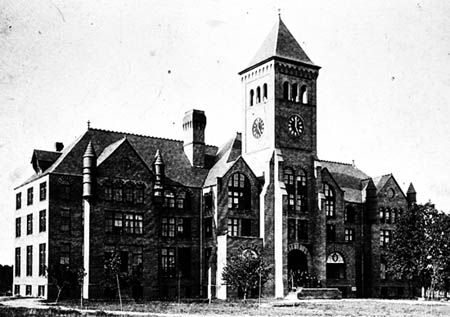
The Phi Beta Kappa fraternity was an honor society, promoting the advancement of the liberal arts. First established at the College of William & Mary in 1776, the Phi Beta Kappas were also the first Greek-letter fraternities, as well as one of the oldest undergraduate fraternities in the United States.
Duke University was established in 1837, as a private school. It is located in Durham, North Carolina. With a Methodist and Quaker background, it is founded on private research, as well as extensive academic and athletic programs. Styron went to Duke University in 1943. After service in the war, he returned to Duke, completing his schooling in 1947.
Cracow fell one week after the invasion of Poland, which began on September 1, 1939. The invasion provoked Britain to declare war on Germany and led to the onset of World War II. It was initiated by the Fourteenth German Army, and ultimately saw Cracow become the capital of the Nazi Government in Poland.
 Cracow Central Marketplace - Credit:
Pko
Cracow (also spelled Krakow) has grown up around the site of a Stone Age settlement on Wawel Hill. The first written record of the city dates back to 965, when it was described as a busy trading centre. It grew quickly, becoming one of the most important cities in Poland.
Cracow also developed into a center for academic and artistic excellence, emphasising the importance of cultural and educational pursuits through the establishment of universities and other cultural centres.
During World War II, the invading Nazi military established Cracow as one of the key centers of Nazi Government outside Germany. Cracow was divided, and the Cracow Ghetto was established for the city's Jewish residents. The ghetto was eventually liquidated, and the residents were sent to extermination camps.
 Cloth Hall - Credit:
Chepry (Andrzej Barabasz)
The Sukiennice was a center of international trade during the golden age of the Renaissance in Poland. Referred to in English as Cloth Hall or Drapers' Hall, this amazing building held the city market where international trade negotiations took place. Here highly valuable commodities such as silk, spices, and leather were traded, and negotiations for the export of salt from the Wieliczka Salt Mines were held. Today the structure is a big tourist draw. It houses the Sukiennice Museum, which holds one of the largest collections of 19th century Polish art in the world.
 Auschwitz Concentration Camp -- Poland - Credit:
Trialsanderrors
Auschwitz is commonly associated with the worst horrors of the Holocaust. Situated in Poland, it was the largest and most infamous concentration camp created by the Nazi regime. The complex known as Auschwitz-Birkenau was made up of several smaller camps, and housed a range of political prisoners, gypsies, homosexuals and Jews.
Auschwitz II - Birkenau was an extermination camp, specifically set up for the obliteration of the Jewish race. It was equipped with gas chambers capable of killing thousands of people at a time, and furnaces where many of the bodies were incinerated.
Auschwitz - Birkenau Memorial Website
Auschwitz Gate to Hell Website

 Dolomites - Credit:
Flickr upload bot
The Dolomites form part of the Italian Alps, in North-Eastern Italy. Until the end of World War I, the border between Italy and the Austro-Hungarian Empire ran through this region.
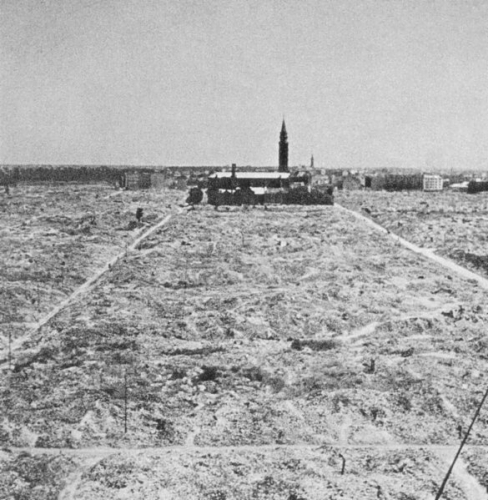
Between July and September of 1942, 254,000 to 300,000 Jews were deported from the Warsaw Ghetto to the Treblinka extermination camp. Due to the large numbers all being deported at the same time, and the rumors that started to surface following these deportations, it became apparent that deportation meant a death sentence.
These rumors convinced the residents of the Warsaw Ghetto that they had nothing to lose; their only alternative was to fight. In early 1943, an uprising occurred in the Warsaw Ghetto. It led to massive casualties on both sides and disquieted the Nazi party sufficiently that the order was given to wipe out the Warsaw Ghetto completely. Not only were all remaining residents of the Ghetto to be liquidated, but the Ghetto itself was razed.
Photographs from the Warsaw Ghetto

 The Final Solution Letter from Eichmann - Credit:
Conscious
The Final Solution of the Jewish question was the result of a conference organized and sponsored by Adolf Eichmann.
The Wannsee Conference was held in January 1942, with ranking individuals of the Nazi party in attendance, though there is no record of Hitler himself attending. The 'Final Solution' became the euphemism for the extermination of all people of Jewish descent. It was from this "solution" that a new term would be coined: genocide.

 Rowan Oak - Credit:
UGArdener
Stingo's literary hero William Faulkner (1897-1962), whose novels are largely set in the American South, lived in Oxford, Mississippi. He called his house Rowan Oak after the rowan tree, which represents peace and security.
The Sound and the Fury on Book Drum