This map plots the settings and references in A Tale of Two Cities
To start exploring, click a red pin


 Paris, 18th Century
Paris was still a mediaeval and Renaissance city of narrow, overcrowded streets with pillow-sized paving stones all coated in a stinking acidic black mud--the coagulating mess of refuse left to rot on streetcorners and stable sweepings--through which carts and carriages drove wildly without regard for pedestrians or tradesmen.
The many noble residences--majestic, ornamented stone buildings some 6-7 stories high--in the Faubourg St. Honore, along the Champs Elysees, and in the Faubourg St. Germain, had been appropriated by the state, their interiors looted, and stood either empty or rented out, floor by floor--the richer living on the lower floors and the poorer at the top.
 Paris, 1791 - Credit: Pierre-Antoine Demachy
Political clubs and coffeehouses abounded.
The mob ruled, attacking private houses, burning books, smashing statuary, meting out murderous summary justice.
The city's churches, convents and monasteries were an early casualty of Revolutionary zeal. Ancient stone churches were demolished or turned into armaments factories or warehouses, their bells melted down for cannon, their clergy turned out into the street. On the Left Bank, the many walled cloisters and convents were turned into prisons or abandoned.
In 1789 there was one prison in Paris with 9 prisoners; by 1796, there were over 60 prisons, all filled, with only one sentence handed down.
At the centre loomed La Guillotine, in the Place de la Republique, where at the height of the Terror some 40 individuals were guillotined each day while les tricoteuses, knitting and singing, looked on in glee.
 City of London, c.1750 - Credit:
Samuel Scott
London in the late 18th century was a robust and rambunctious place with all classes and trades--aristocrats, merchants, workers and poor--rubbing coat-tails in a Hogarthian panorama. By 1800, it was the greatest metropolis in Europe, with a population of 1.1 million.
The Great Fire of 1666 reduced much of the city to ash, so the next century saw unprecedented building work, making it a rambling amalgamation of the Tudor, Restoration and Georgian building, development and neglect, shopfronts and rooming houses.
The better end of town, the West End, was full of neo-classical dwellings only recently completed, with building sites and builder's rubbish everywhere. Beyond, the rest was neither new nor pristine...
For London was home to the industries which had made the city rich--global banking and mercantile interests--as well as being the centre of government, home to the Judiciary, and a great port.
Old London's slums had the most notorious reputation: the 'Mint'--a place of uninhabited ruins, leaning precariously over their foundations. There was the Almonry too, called 'the Devil's Acre', and St. Giles, called the Rookery or Little Dublin because of its predominately Irish population. Soho was home to the large population of French emigres who'd fled the Revolution, while St. Katherine's was known for its Indian and Asian population.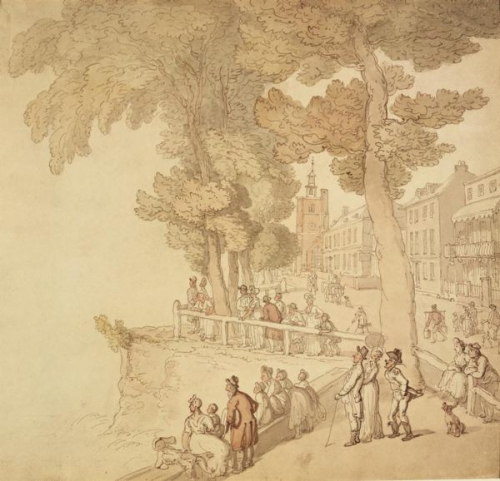
The names of the streets evoke most effectively this London: Dark Entry, Cat's Hole, Pillory Lane--mazes of streets with evil reputations and a gin shop on every corner, into which wayfarers were said to vanish and never emerge.
The roads and streets were clay poured onto grit--with a central gully to serve as an open sewer--turning to sludge-soup in heavy rain.
Visitors were often by struck by the beauty and magnificence of the great monuments such as St. Paul's Cathedral and Westminster Abbey, and the "tumult and blaze", the noise and coal smoke and fog--a dull grey blanket hanging perpetually over the city, which could be smelled and tasted on the wind from as far away as 50 miles.
 Cock Lane - Credit:
Mackay, Charles (1852(1852)) "Haunted Houses
Alright; no sniggering up the back of the class please. This is the true tale of the ghost of Scratching Fanny from Cock Lane.
The year is 1762 and one of the most entertaining and intriguing places to be in London is a small three story house in Cock Lane, near St Paul’s Cathedral where séances are being held to communicate with the ghost of Fanny Lynes. The apparent apparition made angry scratching noises and knocked on the walls to answer questions relating to the cause of her death. The séances were conducted by the owner of the house, Richard Parsons through the medium of his sleeping 12 year old daughter Elizabeth. They were theatrically assisted by Parsons’ servant, Mary Frazer, who asked the questions and interpreted the ghostly answers.
Fanny had lived in the house with her partner, William Kent. Fanny’s “ghost” accused Kent of murdering her with arsenic in her evening tipple. However it seems that Fanny actually died of smallpox and the ghost was proven to be a hoax aimed at ruining Kent after his successful legal action against Parsons for an outstanding debt. Parsons was prosecuted for the fraud. However, enough questions remain to ensure the legend, if not Scratching Fanny herself, lives on.
 Woolwich Dockyard from Shooter's Hill, c.1819 - Credit: Peter de Wint

 Notre Dame - Credit:
Yoyokits - Cekli.com
Notre Dame de Paris (Our Lady of Paris) is a Roman Catholic cathedral on the banks of the River Seine.
This stunning architectural creation took 182 years to build (1163-1345). It was seriously damaged during the French Revolution in 1793, and underwent extensive restoration during the 1800s.
It was the setting for Victor Hugo's famous book of 1831, The Hunchback Of Notre Dame.
Today it is a popular tourist attraction and a key landmark in Paris.
 Fleet Street today - Credit:
Mahlum
Whitefriars is named for a pre-Reformation house of the Carmelites (Whitefriars) that used to be located in the area. The area originally fell under the jurisdiction of the friars. The area’s residents continued to claim exemption from the city's jurisdiction long after the friars had moved on, but their anomalous status was abolished in 1697.
Hanging-sword Alley lay south of Fleet Street and ran east off Whitefriars. It has been built over since Dickens’ time. Even then, however, it would have been difficult to locate - its opening was a mere crack in the wall. The Hanging Sword house, from which the street took its name, can be traced to the 1560's.
For many years the alley hosted ‘Blood Bowl House’. In 1743 Captain George Morgan was returning home along Fleet Street in the early hours of the morning when he spotted a lost old lady. He offered to escort her home. She led him round the corner to Blood Bowl House where he was set upon by a gang, robbed and thrown into the Alley almost dead.
 The Tyburn Tree - Credit:
wikimedia commons
Tyburn was a village in Middlesex, close to London, with a long history as a place of execution. In 1571 the ‘Tyburn Tree’ was erected and first used to hang the Catholic Dr John Story, who refused to recognise Elizabeth I as rightful Queen. It was a wooden triangular frame held up on three legs, from which several criminals could be hanged at once. Many Catholic priests of the Elizabethan period were executed at Tyburn for high treason, to the full extent of the law. This meant being hanged, drawn and quartered. Executions were public and were a popular spectacle; large stands were even erected by the villagers for spectators. The bodies of the criminals were often displayed as an example to others, to be seen by travellers on the road into London.
 The Old Bailey, Known Also as the Central Criminal Court - Credit:
The Microcosm of London: or London in Miniature, 1808
The Old Bailey is London's Central Criminal Court. It is located just off Newgate Street, next to the site of Newgate Prison, just outside the former western wall of the City of London. This fortified wall was termed a "bailey".
The original medieval courthouse was destroyed in the Great Fire of London in 1666. In 1673 the Old Bailey was rebuilt as a three level Italianate brick building. In front of the courthouse was the Sessions House Yard, where people could gather. The ground floor, where the courtroom was located, was open on one side to allow fresh air to circulate, thus inhibiting the spread of gaol fever (typhus). Spectators had easy access, and trials attracted large crowds.
In 1737 the building was remodelled and enclosed, limiting access for casual spectators. This saw a rise in infections. In 1750, an outbreak of gaol fever led to 60 deaths, including the Lord Mayor and two judges. Subsequently, the judges spread nosegays and aromatic herbs to keep down the stench and prevent infection.

 The Old Bailey today - Credit:
TB Murray
In 1774 the court was again rebuilt, further controlling public access and improving security. In 1877, the courthouse and Newgate Prison were demolished to make room for a larger building, opened in 1907. This was heavily damaged by bombing in 1941 and rebuilt. Trials are still held in the building.
 Scene of Bethlem Hospital from
A Rake's Progress (c. 1732-35) - Credit:
William Hogarth
A reference to London’s Bethlehem Hospital, the oldest public hospital specialising in the treatment of insanity, whose origins dated back to the 14th century. Its name was soon contracted to Bethlem, which became in familiar speech the notorious ‘Bedlam’. Here, inmates not only suffered brutal ill-treatment, but, until long into the 18th century, were put on show for the amusement of fashionable society and for the profit of the proprietors.
For a penny per head, people could pay to see 'the play in Bedlam’, while hucksters sold fruit and nuts, and obliging keepers brought in beer for a small charge. It is estimated that the hospital brought in about £400 a year through this means. It was only in 1770 that the first restrictions were placed on visitors to Bedlam. From then on admission was granted only by special permission of one of the governors of the asylum.

Vauxhall Gardens was a privately-operated pleasure garden open between 1729 and 1859. Admission was charged and attractions included tightrope walkers, fireworks, hot air balloons and concerts. There were various pavilions and walkways, popular meeting points for romantic assignations. Food and drink were available, and crowds of 60,000 or more could be accommodated. The Gardens were popular amongst all classes.
The lease was eventually sold to developers and the land was divided into 300 building plots. However the site was cleared in the 20th century, and now holds a small park and a city farm.
 Ranelagh Gardens, 1754 - Credit:
Thomas Bowles
Ranelagh Gardens were public pleasure gardens in the village of Chelsea, just outside London.
They are now the site of the annual Chelsea Flower Show.
 St Dunstan-in-the-west, 1842 - Credit:
Thomas Shotter Boys
The Guild Church of St Dunstan-in-the-West stands on Fleet St, to the east of Temple Bar.
The church Dickens would have seen while writing the book was not the one in existence at the time of the French Revolution. The original church, built around 1000 AD, was rebuilt in 1831, when Dickens was 19. Further rebuilding was necessary in 1950, following WW2 bomb damage to the tower.
Temple Bar was the gateway that marked the western limit of the City of London, where Fleet Street becomes the Strand. It can be seen in the background of the painting. Today, the spot is marked by a dragon-topped stone monument in the middle of the street.
 Beauvais, 1835 - Credit:
W. and E. Finden in William Brockedon, Road Book from London to Naples
 Beauvais Cathedral - Credit:
Pepijntje, Wikimedia Commons
Beauvais is an ancient town in northern France that dates back to Roman times. It has an unusual Gothic cathedral, a bishop, and a traditional tapestry industry. Once an important stopping point on the route to Paris, it is now the location of the capital's "third airport" according to the likes of Ryanair.
Dr Manette's home town has twice been besieged by English armies.
Rue de l'École de Médecine is next to the Sorbonne in the 6th arrondissement.
This reference is a slight anachronism. The street was called rue des Cordeliers until 1790, well after Dr Manette lived there or indeed wrote this account.