
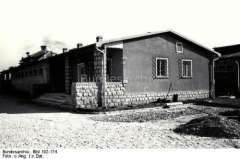
 WWI Brothels - Credit: Deutsches Bundesarchiv
Camp brothels were usually built as barracks surrounded by a barbed-wire fence, with small individual rooms for up to 20 female prisoners, controlled by a female overseer. Jewish males were not allowed in the brothels. Some VIPs paid extra for specialized services. Some of the women were forced to undergo sterilizations or abortions, often resulting in their death.
Brothels were also deployed in an effort to counter homosexuality. The German authorities saw homosexuality as a disease, and believed it could be cured by contact with women.

 Pushing up the daisies - Credit: countryboy1949
The daisy was one of the first flowers to regrow on a battleground.
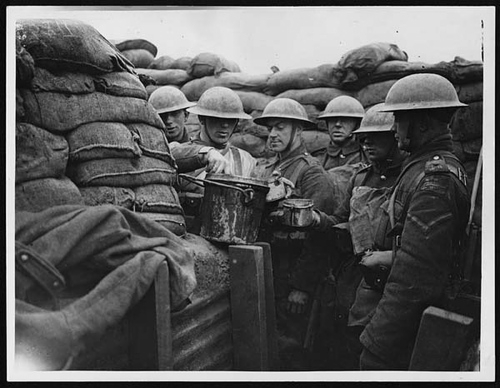 Dixie - Credit: John Warwick Brooke
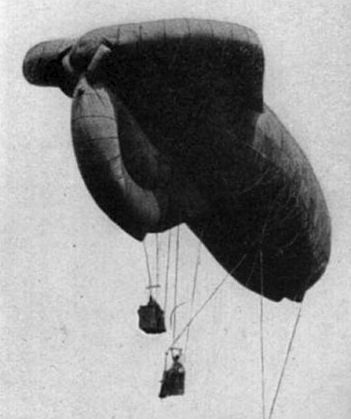 French WW1 Observation Balloon - Credit: Ray Williams
The misère ouverte, which roughly translates as "open (to view)", is a bid in the card game Solo Whist that involves laying all one's cards face up on the table, in the expectation of not winning any "tricks" (sets of cards the players try to obtain).
Napoleon, or Nap, is a straightforward trick taking game in which players are dealt five cards each; whoever bids the highest number of tricks chooses trumps and tries to win at least that many. It is a simplified version of Euchre, with many variations throughout Northern Europe.

Blighty was a slang term for Britain during World War I, but in this case Muller is talking (in the English translation) about a blighty wound.
A blighty wound was serious enough to send a soldier home, but not serious enough to kill them. Frequently, this type of wound was self-inflicted.
Ostracism was common in Germany during World War I. Citizens who did not support the war or refused to serve would be cut off from society. This could mean being ignored by friends or it could go as far as legal persecution. Most often, however, the offender would simply be looked upon with disapproval by peers.
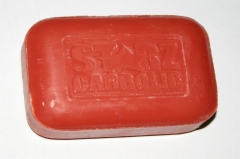 Bar of carbolic soap - Credit: SamBlob
Carbolic soap is a disinfectant soap made from carbolic acid, which is extracted from coal tar. The soap has a distinct bright red color and was used worldwide during much of the twentieth century.
Because of its anti-bacterial properties, the soap was used in operating rooms and hospitals, and as a deodorant. For these reasons, it was commonly used during World War I.
Most infantry boots in World War I were made of cowhide with iron heels, such as the 1917 “Trench Boot.” However, they were not waterproof and only laced up the foot.
The 1917 and 1918 American airman models quickly became the most common boots worn in the trenches. These were typically much better quality than those of the infantry.
It was extremely important to have good, dry footwear: trench foot was very common and could result in the complete disfigurement of the feet.
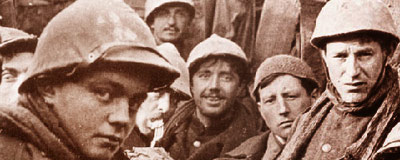
In Kantorek's letter to the young men, he calls them the "Iron Youth," implying that they are hard, strong, and resilient; a description that fails to take into account the horror of the war, trapping the men in a constant state of panic and despair.
The average age for enlisted men was 25, but soldiers as young as 14 or 15 also served.
For more information about the personal life of a WWI soldier, visit:
 Arthur Schopenhauer
 was one of the first people to state that the universe is not a rational place. Inspired by Plato and others, he developed an ascetic outlook, arguing that in a world filled with endless strife people ought to minimize natural desires for the sake of achieving a more peaceful frame of mind.

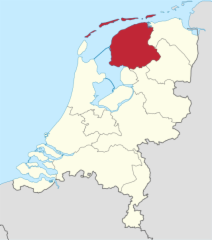
Frisia, a coastal region on the North Sea, is the homeland of Frisians, a Germanic people that speak a language that is a close relative of English. Frisians were traditionally known for raising cattle, catching fish, and making textiles.
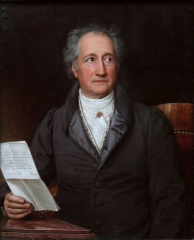
Johann Wolfgang von Goethe was a German writer, artist, biologist, theoretical physicist, and polymath who was born in 1749 and died in 1832. Goethe is considered one of the giants of German literature, and he was a major inspiration in music, drama, and literature. He also developed theories of evolution that would later be expanded by scientists such as Charles Darwin.
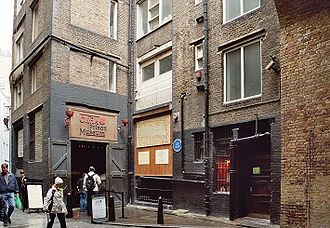 Clink Prison Museum - Credit: Sir James, Wikipedia
Founded in 1151, the Clink was one of the oldest prisons in England. Its name may have come from the clinking of prison chains or bolts.