

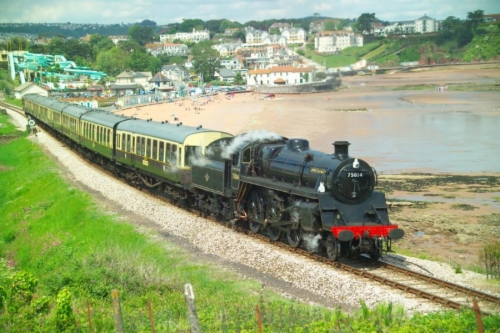
 Railway in Devon, England - Credit: freefoto.com
Wargrave would have been traveling on the Great Western Railway, which connected London with the southwest and west of England and with Wales.
References to the title “Justice” and the word “bench” reveal that Wargrave is a retired judge.
The Times is the London Times, a highly respected newspaper with a history going back to 1785 and still in publication today.
Events may be assumed to be taking place around 1938, when the novel was written.
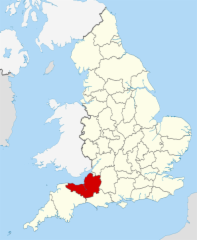
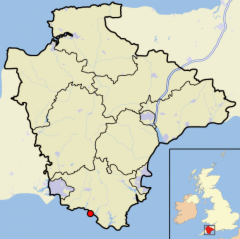
The story takes place on a fictional island off the coast of Devon (see Setting). It has been suggested that Burgh Island was the inspiration.
However there are significant differences. Indian Island is about a mile off the coast; Burgh Island is only 270 yards (250 meters) off the coast. Indian Island is inaccessible except by boat; Burgh Island can be reached on foot at low tide.
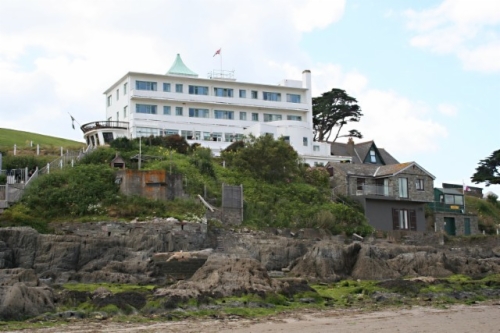
 Burgh Island Hotel, July 2009 - Credit: Tony Atkin
Burgh Island is home to the Burgh Island Hotel, which may have inspired Christie’s references to Hollywood stars and wild parties.
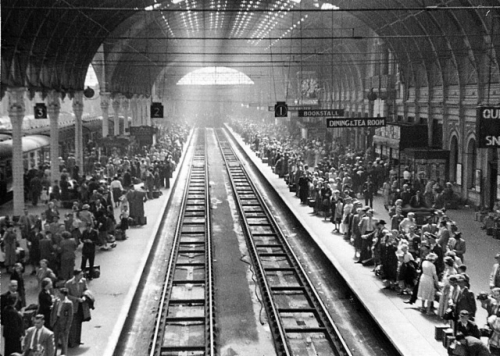 Paddington Station, 1953 - Credit: Ben Brooksbank
Paddington Railway Station is a large terminus in London, first opened in 1838. Agatha Christie referred to it again in her 1957 novel 4.50 from Paddington (alternate titles: What Mrs. McGillicuddy Saw! and Murder, She Said).
Paddington Bear is named for the station. The film clip below shows footage of the station in 1939, the year And Then There Were None was published.
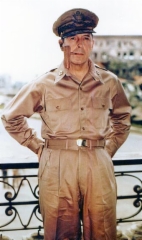
 Gen. Douglas MacArthur has nothing to do with And Then There Were None.
Christie's General Macarthur has no relation to the American General Douglas MacArthur, who became famous for his role in World War 2's Pacific Theatre, after the book was published.

 Morris 8 - Credit: suzanneandsimon
Dr. Armstrong's car could have been a Morris 8, as shown. Morris 8s were first manufactured in 1935; production was discontinued in 1948.
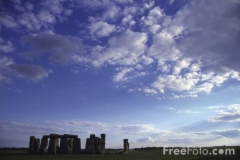 Stonehenge, Salisbury Plain, Wiltshire County, Southwest England - Credit: www.freefoto.com
Harley Street in London has been home to numerous medical practices since the 1800s.
My research suggests that the "Super Sports Dalmain car" is a Christie invention.
Plymouth is a port city on the coast of Devon, close to the border with Cornwall. It boasts a major Royal Navy base.
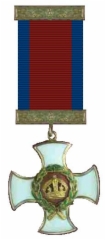 Distinguished Service Order - Credit: Robert Prummel
D. S. O. stands for "Distinguished Service Order," a British military decoration awarded for gallantry during war.
This is a British saying meaning "the final drink that renders someone drunk."
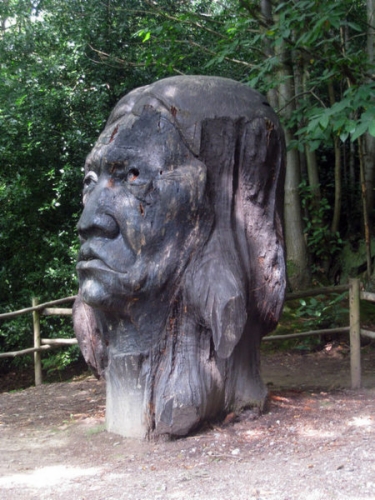 'Dances With The Wind In His Hair' - Credit: Oast House Archive
Original text: He remembered N____r Island as a boy. . . . It had got its name from its resemblance to a man's head--a man with negroid lips.
Revised text: He remembered Indian Island as a boy. . . . It had got its name from its resemblance to a man's head--an American Indian profile.
(Source: Sanders and Lovallo, The Agatha Christie Companion [New York: Delacorte Press, 1984], 182)
Interestingly, in the last few years the term "Indian" referring to the indigenous peoples of North America has, in turn, become offensive to some groups. "Native American" is usually the preferred term nowadays. This has resulted in yet another change to the novel--removal of the references to "Indian Island" and "Ten Little Indians" and insertion of "Soldier Island" and "Ten Little Soldiers." It's difficult to imagine that the term "soldier" will ever become offensive.
For a thoughtful discussion of the term "Indian," see this usage note.
The elderly seafarer is quoting Christ from the King James Version of the Bible:
Matthew 26:41: "Watch and pray, that ye enter not into temptation: the spirit indeed is willing, but the flesh is weak."
Mark 13:32-33: "But of that day and that hour knoweth no man, no, not the angels which are in heaven, neither the Son, but the Father. Take ye heed, watch and pray: for ye know not when the time is."
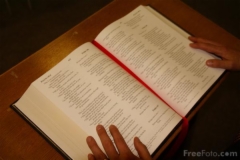
The phrase "the day of judgment is at hand" does not occur in the King James Bible. However, the Bible does include a number of references to the "day of judgment"--for example, Matthew 11:22, 24; 12:36 ("But I say unto you, That every idle word that men shall speak, they shall give account thereof in the day of judgment"); Mark 6:11; 2 Peter 2:9; 3:7; and 1 John 4:17.
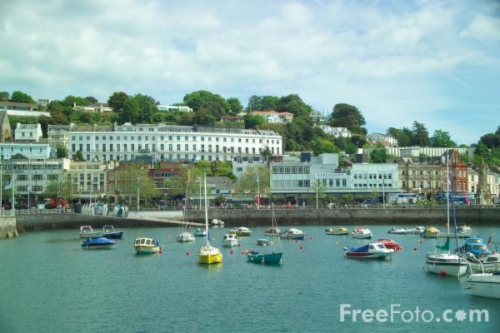
Cornwall is the county southwest of Devon.
Torquay is a town in Devon; it was Agatha Christie's birthplace.
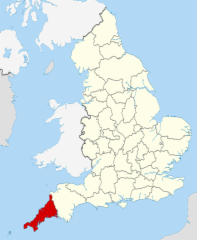 County of Cornwall, England - Credit: Nilfanion
The war in question is World War I since And Then There Were None was published in 1939, just prior to the commencement of World War II.
WWI was known as "The Great War."
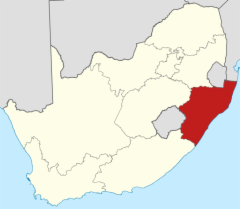 Map of South Africa with KwaZulu-Natal highlighted - Credit: Htonl
It is now KwaZulu-Natal.