
Regent's Park is both a royal park and a residential area in London, situated partly in the City of Westminster and partly in the borough of Camden.
Blackbirds in London was a highly successful revue, with performances by African American artists, produced on the London stage in 1926.
Its star was the cabaret-singer and dancer Florence Mills (1896-1927), who was already well known following her performance in Dover Street to Dixie (1923).
One of her best known songs was I'm a Little Blackbird looking for a Bluebird.
During the period that the revue was being staged, members of the cast mixed in high society, and many 'Blackbirds parties' were held in London.
Listen on Spotify to Clarence William's version of I'm a Little Blackbird Looking for a Bluebird;
Listen on Spotify to Duke Ellington's tribute to Florence Mills: Black Beauty


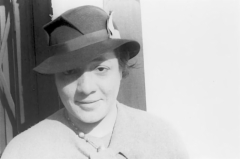
 Ada 'Bricktop' Smith - Credit: Carl Van Vechten
Chez Bricktop was a nightclub on the rue Pigalle in Paris, in existence between 1924 and 1961. It was owned by the legendary American singer and dancer Ada Smith (1894-1984) whose nickname was Bricktop because of her red hair.
Le Bal Nègre was a dance hall on the rue Blomet in Montparnasse. Initially a gathering place for immigrants from Martinique, it became a popular venue for black people from colonial countries and from the U.S.A.

 Savile Row street sign - Credit: Mike-fleming, Flickr
Savile Row is a street in London's Mayfair, renowned for its numerous bespoke tailoring businesses.
Warning Shadows is a silent German Expressionist film, made in 1922 without subtitles (which was unusual for that period).
Its full German title is Schatten: Eine Nächtliche Halluzination (Shadows: A Nocturnal Hallucination).
The film deals with the themes of shadows, reflections and the doppelgänger (the 'double'), which were popular themes in German cinema at that time.
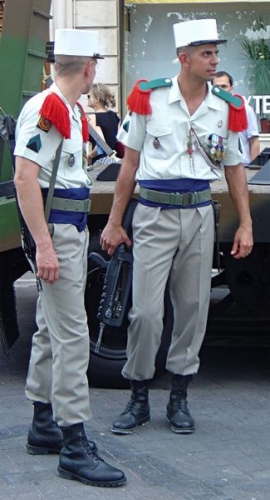
 Members of the Foreign Legion in ceremonial dress - Credit: David Monniaux, Wikimedia Commons
The French Foreign Legion, established in 1831, is a unit in the French Army open to both French citizens and foreign nationals. At the time of the book, it was based in Algeria, then a French colony.
The legion is renowned for the arduousness of its training program, which is designed to stretch recruits to the utmost, both physically and psychologically. Recruits are given new names, and any misdemeanours or crimes in their past are ignored, making the legion an attractive way of "starting over".
The Commercial Road lies in the East End of London in the borough of Tower Hamlets. It is not a wealthy area.
As the road travels eastwards, it becomes the East India Dock Road, leading to what were once known as the East India Docks.
Hansard is the name given to the published transcriptions of debates in the House of Commons and the House of Lords, the two chambers of the British Parliament.
Hansard is intended to be an accurate, although not verbatim, record of what is said during debates.
 A de Havilland DH.84 Dragon - a commercial aircraft of the 1930s - Credit: Starlingjon, Wikimedia Commons
Commercial passenger air travel developed in the wake of the First World War but was still in its infancy in the 1920s.
Although Evelyn Waugh has Charles Ryder travelling to Casablanca with Air France, this would not have been possible in 1926 as the company was not formed until 1933, through the merger of five smaller companies. It is possible, however, that such a service could have been provided by one of the precursor companies which included Air Union and Société Générale de Transport Aérien (SGTA).
Casablanca is a city located on the Atlantic coast of Morocco in North Africa.
Fez, in northern Morocco, ranks alongside Casablanca and Rabat as one of the country's most important cities.
It is divided into three sections: the old walled city (the Medina); new Fez (the walled Jewish quarter known as the Mellah); and the Ville Nouvelle, established by the French colonialists.
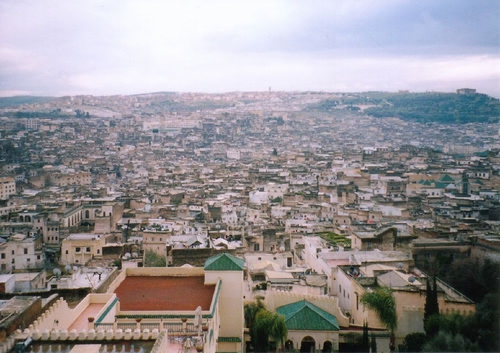 City of Fez - Credit: mtsrs, Flickr
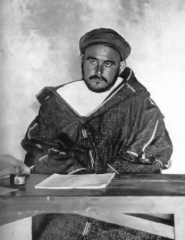 Abd el-Krim (1922) - Credit: Alfonso Sanchez-Portelo
Abdul Krim is Abd el-Krim (1882/3-1963), or to give him his full title, Muhammad Ibn 'Abd al-Karim al-Khattabi.
In the 1920s, he led a resistance movement against French and Spanish colonial rule in the Rif, an area of northeastern Morocco.
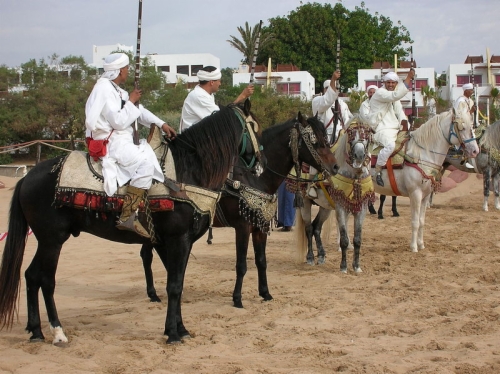 Berber warriors in a show in Agadir, Morocco. - Credit: Notwist, Wikimedia Commons
The term Moors is open to various interpretations:
Originally, it was used as an alternative term for the Berbers, the indigenous people of North Africa;
It may also be used to describe people of Moroccan origin who live in Europe, or to describe any person from North Africa. It is now often considered an offensive and pejorative term.
The predominant religion in North Africa is Islam which forbids the consumption of alcohol and other intoxicants; hence, the Consul's comment that they don't hold with drink.
Rabat is the capital city of Morocco, situated on its Atlantic coastline;
Tangier is a city in northern Morocco, which became a popular destination for Europeans and Americans from the 1920s onwards.
Franciscans belong to any one of the three orders founded by St. Francis of Assisi (1181/82-1226); each of these orders lives according to a set of regulations known as The Rule of St. Francis.
The term most commonly refers to the Order of Friars Minor which may itself be divided into three groups: Franciscan friars, Capuchins and Conventual Franciscans.
 A depiction of Our Lady of the Seven Dolours - Credit: unknown artist
An oleograph is a coloured print in imitation of an oil painting.
In the Catholic Church, the Seven Dolours (sometimes known as the Seven Sorrows) are seven tragic events in the life of the Virgin Mary, who is sometimes known as Our Lady of the Seven Dolours.
A popular devotion* amongst Catholics is the practice of saying one Our Father and seven Hail Marys for each of the seven dolours.
In works of art, Our Lady of the Seven Dolours is often represented with seven swords piercing her heart.
* a prayer which is not part of the Catholic Church's liturgy
 A rather naughty name for a beer? - Credit: Zubro, Wikimedia Commons
D.T.'s stands for Delirium tremens, the condition which may arise when a heavy drinker withdraws abruptly from alcohol.
Symptoms of Delirium tremens include visual and tactile hallucinations, confusion, agitation, diarrhoea, fever, rapid heart rate and raised blood pressure.
Cirrhosis of the liver is the replacement of healthy liver tissue by lumpy scar and connective tissue, a process which leads eventually to the loss of liver function.
It may be caused by a range of factors, one of which is alcoholism.
Robert Adam (1728-1792) and James Adam (1732-1794) were Scottish-born brothers, both architects who designed in the neo-classical style.
Their work in London includes Portland Place in Marylebone, Fitzroy Square in Fitzrovia, and Kenwood House in Hampstead.
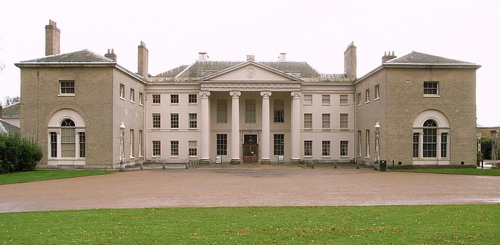
 Kenwood House, Hampstead - the central portion of which was designed by the Adam brothers - Credit: Steve Cadman, Flickr
Green Park is a Royal Park in London which lies between Hyde Park and St. James Park:
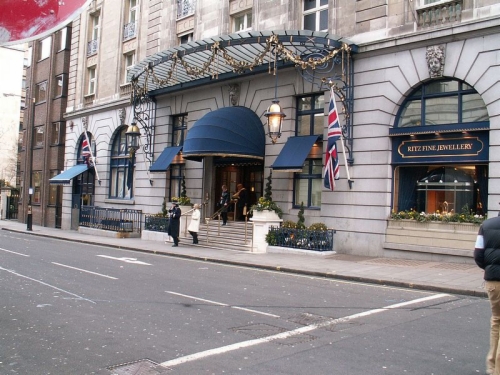 The Ritz Hotel, London - Credit: Dickbauch, Wikimedia Commons
The Ritz is a prestigious London hotel which opened in 1906. It is situated on Piccadilly, overlooking Green Park.
The hotel's eatery is now known as The Ritz Restaurant, but presumably at the time of Brideshead Revisited it was known as The Ritz Grill.
In The Acceptance World (the third novel in Anthony Powell's twelve-novel sequence, A Dance to the Music of Time), set in the 1930s, the narrator accepts an invitation to gnaw a cutlet at the Grill.
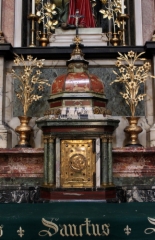 Tabernacle on the Lady Altar, Birmingham Oratory - Credit: James Bradley, Flickr
In the Catholic Church, a tabernacle is a lockable box in which the bread consecrated during Mass (which represents the body of Christ) is stored.
Special rituals are observed by Catholics during Holy Week (the week leading up to Easter); one of these is to leave the tabernacle open and empty on Good Friday until the resumption of Mass on the evening of Holy Saturday.
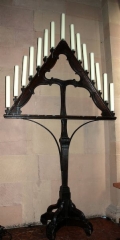 The triangular candelabrum known as a 'hearse' which is used for Tenebrae services - Credit: Bhuck, Wikimedia Commons
In the Roman Catholic Church, Tenebrae (Latin for 'shadows' or 'darkness') is the name given to certain ceremonies which take place during the last three days of Holy Week: Maundy Thursday, Good Friday and Holy Saturday.
The climax of these ceremonies is the gradual extinction of 15 candles, after which the church is left in darkness.
Tenebrae is also the name given to Holy Week services in other Christian denominations.
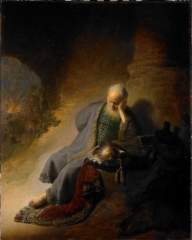 Jeremiah lamenting the destruction of Jerusalem - Credit: Rembrandt
Quomodo sedet sola civitas is the Latin version of the opening lines of the Bible's Book of Lamentations, attributed to the prophet Jeremiah.
The full text of Chapter 1, Verse 1, reads as follows:
Quomodo sedet sola civitas How doth the city sit solitary,
plena populo that was full of people!
facta est quasi vidua how is she become as a widow!
domina gentium she that was great among the nations
princeps provinciarum and princess among the provinces,
facta est sub tributo how is she become tributary!
The event being lamented is the fall of Jerusalem in 586BC, after its conquest by Nebuchadnezzer. Readings, chantings, and choral settings of the work have been incorporated into the Tenebrae services which take place during the Holy Triduum, the three days of Holy Week that precede Easter.
Listen to the words of the Lamentations in the form of Gregorian chant:
Listen on Spotify: The Kings Singers
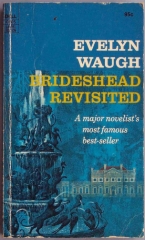 An edition of 'Brideshead Revisited' - Credit: CHRIS DRUMM, Flickr
Father Brown is a character in a series of short stories by G.K. Chesterton.
This particular quotation comes from a story entitled The Queer Feet.
On the dust jacket of the original 1944 edition of Brideshead Revisited, Evelyn Waugh described the purpose of the novel as nothing less than an attempt to trace the working of a Divine Purpose in a pagan world. In his prologue to a revised version, published in 1960, he described the theme of Brideshead Revisited as the operation of divine grace on a group of diverse but closely connected characters. The quotation from Queer Feet, therefore, may be seen as encapsulating the central theme of the novel: Waugh's belief in God's inestimable power to instigate, and restore, faith; thus offering salvation to sinners.
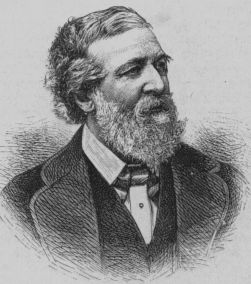
Renaissance man is usually depicted as a highly educated individual with a broad understanding of many fields, including both the arts and the sciences.
Charles Ryder is identifying with men of the Renaissance, as portrayed by the poet Robert Browning (1812-1889) in works such as Paracelsus (1835), My Last Duchess (1842), and The Bishop Orders his Tomb at St. Praxed's Church (1845). As the subjects of these poems are very diverse in nature, the meaning of Charles Ryder's identification is open to interpretation.
 Galileo Galilei (1636) - Credit: Justus Sustermans
Galileo Galilei (1564-1642) was an Italian mathematician, physicist and astronomer, often described as the Father of Modern Science.
He published accounts of his telescopic studies (hence, the reference to Galileo's tube) which argued the sun was the centre of the universe, contradicting the prevailing earth-centred viewpoint.
Velvet is a soft, smooth fabric with a very dense pile. In the 16th Century, particularly fine velvet began to be produced in the Italian city of Genoa. Genoan velvet was noted for particular designs created by contrasting cut and uncut pile.
Click here to see an example of Genoan velvet.