
 'Mercury' in 'Tom Quad' - Credit: Charles D.P. Miller, Flickr
'The House' is the name sometimes given to Christ Church College, Oxford; it derives from the ancient description of the college as 'The House of Christ'.
'Mercury' is the fountain in 'Tom Quad', the quadrangle named after the bell 'Great Tom', which is housed in the tower above the entrance to the college.
The statue of Mercury presently in the fountain is a copy of one by the sculptor Giambologna (1529-1608), and is thought to have been placed there in 1928 (after the events of 'Book 1' of Brideshead Revisited). The head of the original statue, which dates from the time the fountain was built in 1695, is now kept in the Upper Library at Christ Church.
Traditionally, college 'hearties' (sporty types) would throw 'aesthetes' (artistic, sensitive types) into the fountain; hence, the reference to Anthony Blanche being 'in Mercury'.
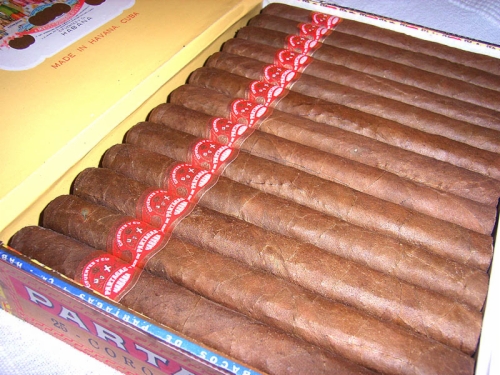
 Partagás Coronas - Credit: M Turner, Wikimedia Commons
When Brideshead Revisited was written, high quality Partagás cigars were manufactured only in Cuba. They are now also made in the Dominican Republic.
A cabinet is a square Spanish-cedar (Cedrela odorata) box in which large numbers of cigars (usually 15 or more) are packed. Cigars presented in this way may be referred to as 'cabinet selection'.
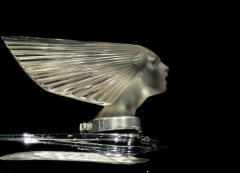 Lalique 'Victoire' car mascot - Credit: Ingrid Taylar, Flickr
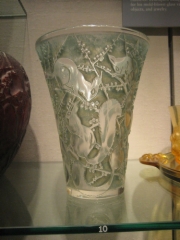
 Lalique vase (1934) - Credit: Claire H. Flickr
René Jules Lalique (1860-1945) was a renowned French designer and maker of sophisticated glassware that has, over the years, achieved iconic status.
He designed in both the Art Nouveau and Art Deco styles, and produced a range of items, including perfume bottles, jewellery, clocks, lighting, vases and car mascots.
The company he founded is still in business today.


Ravenna is a city in northeast Italy, not far from the Adriatic coast.
During its chequered history, it has come under the control of many different factions. It was the seat of the Byzantine government in Italy during the 6th Century.
It is also the site of 8 early Christian monuments which have been designated as World Heritage Sites.

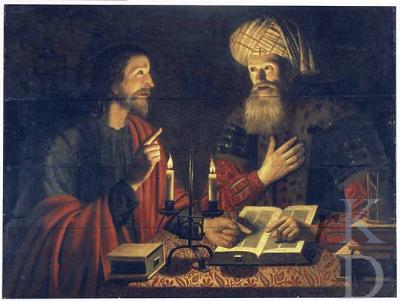
 'Christ talking with Nicodemus at night' (between 1616 and 1645) - Credit: Crijn Hendricksz Volmarijn
It is not clear whether this is a joke or a serious reference.
There is a saint called Nicodemus, venerated by the Roman Catholic and Eastern Orthodox Churches, but there is no evidence to connect him with Thyatira (Akhisar in modern-day Turkey) or with any incident involving goatskin!
His feast day is August 3rd, which does not fit the reference in the text to the 'Easter vacation'.
Does anyone have more information about this?
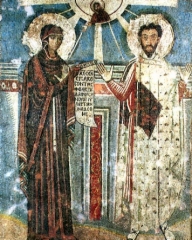 9th. century Greek mosaic, Thessalonika - Credit: unknown
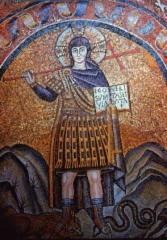 6th. century Italian mosaic, Ravenna - Credit: unknown
The Byzantine Empire (also known as the Eastern Roman Empire) is the name given to the Roman Empire between the 5th Century and the Fall of Constantinople in 1453).
Byzantine Art is the art associated with that empire, as well as the art of countries, such as Bulgaria and Serbia, that had strong links with it.
Generally, the themes of Byzantine Art are either religious or imperial.
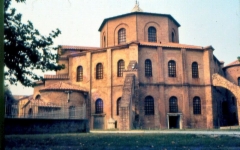 Basilica of San Vitale - Credit: Madaki, Wikimedia Commons
 Mausoleum of Galla Placidia - Credit: Gunther Hissler, Wikimedia Commons
The Mausoleum of Galla Placidia (c.430) and the Basilica of San Vitale (548) are two of the early Christian monuments at Ravenna.
They have both been designated World Heritage Sites. Their rather mundane exteriors belie the beauty of some of their internal art work.
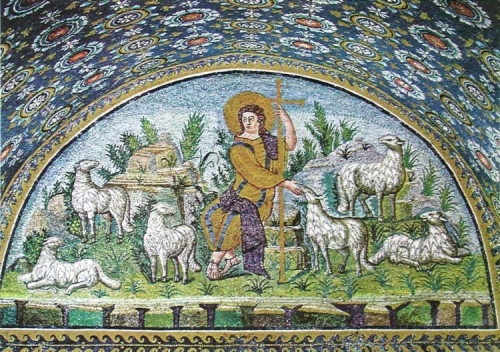 The 'Good Shepherd Mosaic' in the Mausoleum of Galla Placidia - Credit: unknown
 All Souls College, Oxford - Credit: Steve Cadman, Wikimedia Commons
As will be seen, Charles Ryder's father is a man of certain eccentricities, and the same could be said of the college he 'sat' for!
All Souls is an Oxford college whose full title is: The Warden and the College of the Souls of all Faithful People deceased in the University of Oxford.
It accepts no undergraduate students, but generally has about a dozen Examination Fellows who are accepted into the college on the basis of their success in an entry examination which has been described as 'the hardest exam in the world'.
The examination has been held annually in September since 1878 and is open to graduates who obtain first class degrees.
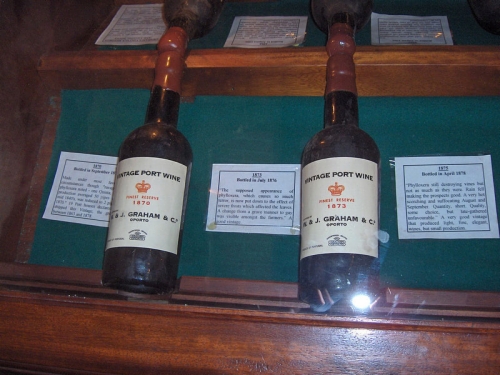 Vintage Port wines - Credit: Georges Jansoone, Wikimedia Commons
Douro is a region of Portugal, famous for the production of Port wine.
Port is a fortified wine (one to which a spirit has been added) which has been made in the region since the late 17th Century. The fortification agent used is a grape spirit known as aguardente, usually referred to in English as 'brandy'.
The original purpose of the brandy was to prolong the life of the wine and preserve it during travelling. Traditionally, port is made with 4 parts wine to 1 part brandy.
Douro region of Portugal:
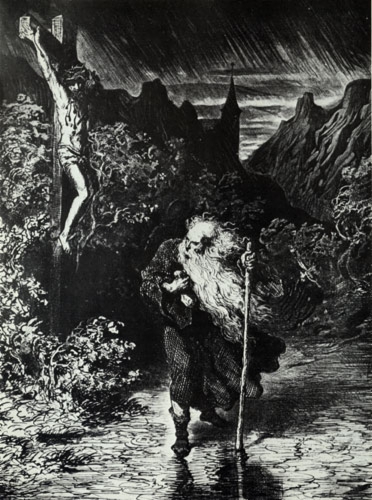 The Wandering Jew - Credit: Gustave Doré
The figure of the Wandering Jew has appeared in many legends since Medieval times and has taken different forms in different cultures. He was said to have taunted Jesus on his way to the crucifixion, and so been condemned to walk the earth until the Second Coming.
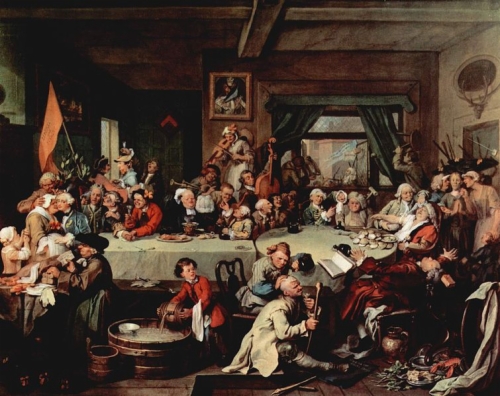 'An Election Entertainment' by William Hogarth - Credit: William Hogarth
William Hogarth (1697-1764) was a highly versatile English painter, printmaker and cartoonist, whose work often satirised contemporary society. He is also well-known for incorporating a moral message in his work; this is evident in the two series of engravings known as A Harlot's Progress and A Rake's Progress.
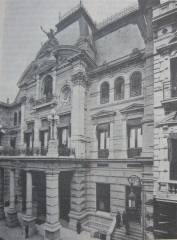 Jockey Club, Buenos Aires (c.1910) - Credit: unknown
The Argentinian Jockey Club, founded in 1882, was a body concerned with the control of horse-racing, but it also promoted social activities.
The Jockey Club at Buenos Aires, founded in 1887, is in the affluent Recoleta area of Buenos Aires, and is still operating.
The reference to the 'big table' may imply that the gambling game being played is the Punto banco version of the card game baccarat, sometimes known as 'big-table' baccarat.
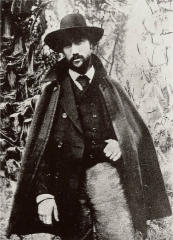

Marcel Proust (1871-1922) was a French novelist, essayist and literary critic, best known for his 7-volume, semi-autobiographical novel, À la recherche du temps perdu (sometimes translated as In Search of Lost Time, sometimes as Remembrance of Things Past).
In Search of Lost Time on Book Drum
André Gide (1869-1951) was a wide-ranging and sometimes controversial French author who wrote novels, critical works, autobiography and travel books. He won the Nobel Prize in literature in 1947.
 Jean Cocteau and Coco Chanel - Credit: unknown
Jean Cocteau (1889-1963) was a highly versatile and innovative French poet, novelist, dramatist, film-maker and scriptwriter.
He moved in the most avant-garde of literary and social circles and included amongst his personal acquaintances: Marcel Proust, André Gide, Maurice Barrès, Serge Diaghilev, Pablo Picasso, Marlene Dietrich, Coco Chanel and Édith Piaf.
Sergei (often known as Serge) Diaghilev (1872-1929) was a Russian ballet impresario and art critic who founded the Ballets Russes (Russian Ballets), a touring ballet company which performed in Europe and the U.S.A. between 1909 and 1929.
Anthony Blanche being 'on closer terms' with Cocteau and Diaghilev hints at homosexual relationships; Diaghilev was openly homosexual and Cocteau is generally believed to have been homosexual.
Throughout Brideshead Revisited, references to homosexuality are kept vague. It is only very subtly implied that the relationship between Charles Ryder and Sebastian Flyte is a physical one. This may have been due to the sensitivity of the issue in the period in which the novel was written; homosexual acts were illegal under British law until the passing of the Sexual Offences Act in 1967.
Evelyn Waugh's membership of the Roman Catholic Church might also have made him wary of portraying homosexual relationships in his work. Interestingly, however, he clearly had no qualms about his very frank portrayal of Anthony Blanche's homosexuality.
Ronald Firbank (1886-1926) was a British novelist whose works include Caprice (1917) and The Flower Beneath the Foot (1923).
As a young man Waugh appeared to admire his work, and later acknowledged that he was influenced by it stylistically.
However, Selina Hastings (one of Waugh's biographers) notes that he appeared to have grown out of his taste for Firbank's work, having said in an interview in 1962, 'I think there would be something wrong with an elderly man who could enjoy Firbank'. [Evelyn Waugh: A Biography (p.209)]
Capri is an island off the coast of Italy in the Gulf of Naples.
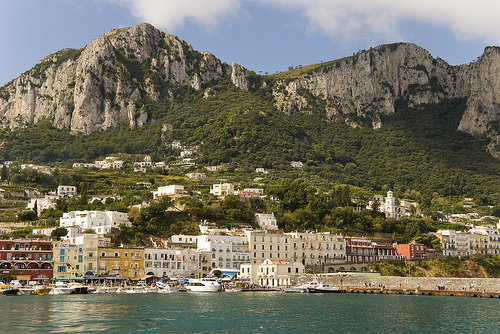 Isle of Capri - Credit: S.J. Pinkney, Flickr
From the early nineteenth century onward, Capri became a popular haunt for poets, writers and artists, as well as other affluent and well-known visitors.
During the early years of the twentieth century, the Russian author Maxim Gorky spent some time there, as did Norman Douglas, the author of the novel South Wind. In fact, the island setting in that novel is a lightly fictionalised version of Capri.
In the early part of the 20th Century, Capri had an unusually tolerant attitude to homosexuality and was popular amongst gay men and women, an aspect of island life satirised by the novelist Compton Mackenzie in two novels: Vestal Fire (1927) and Extraordinary Women (1928).
In the 1950s, Capri became even more fashionable as a celebrity retreat, and it remains popular today.
Listen on Spotify: Isle of Capri
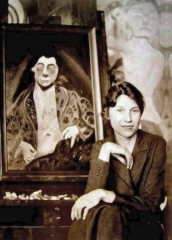
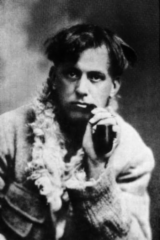
'Black art' (or more commonly 'the black arts') is another name for witchcraft or occultism; Cefalù is a city in Sicily.
It is likely that Waugh has in mind the commune and 'magic school' known as The Abbey of Thelema, set up by Aleister Crowley and Leah Hirsig at Cefalù in 1920.
Location of Cefalù:
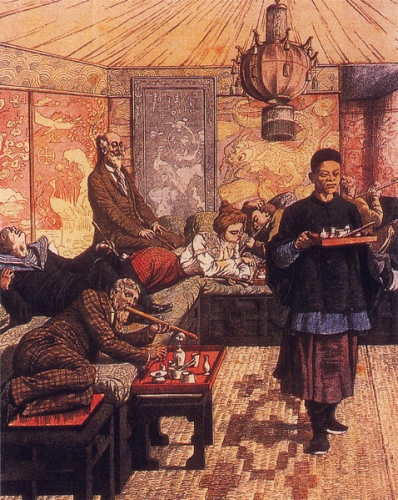
In the 19th and early 20th Centuries, many addictive substances, such as opiates and cocaine, were constituents in various medications.
Medical use of these substances could lead to addiction, and recreational use could occur under the guise of medical use.
Addiction to laudanum (a mixture of opium and alcohol) was a recognised feature of 19th Century Britain, and was written about as early as 1821 by Thomas de Quincey in his Confessions of an English Opium Eater. Opium was also smoked from the 1800s onwards, in both Asian and European countries.
There is also evidence for the use of marijuana in French society as early as 1844, and for the use of cocaine and marijuana in American society in the early 20th Century.
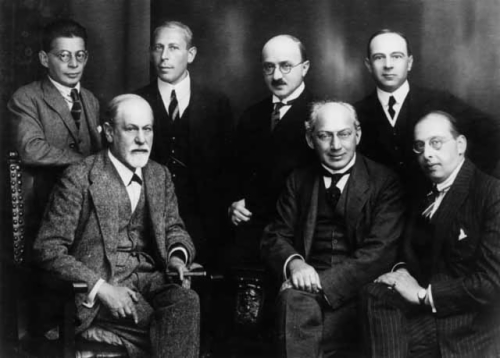
The theories and practice of Sigmund Freud, the founder of psychoanalysis, were familiar to certain sections of society during the early 1920s.
Freud suggested that children between approximately the ages of 3 and 5 pass through a psychic developmental stage during which they experience unconscious sexual desires for the parent of the opposite sex and a corresponding desire to get rid of the same-sex parent, who is their 'rival'. He used the term Oedipus complex to describe this constellation of feelings in both boys and girls, although Carl Jung preferred 'Electra complex', for the female experience.
The Interpretation of Dreams on Book Drum
Freud practised psychoanalysis in Vienna, where he and a group of like-minded followers formed the Vienna Psychoanalytical Society in 1908. James Strachey and Alix Strachey (the brother and sister-in-law of Lytton Strachey, an important member of the Bloomsbury group,) are said to have been analyzed by Freud in Vienna in the early 1920s.*
*Noted by Phyllis Grosskurth in her 1986 biography of Melanie Klein (p.123).
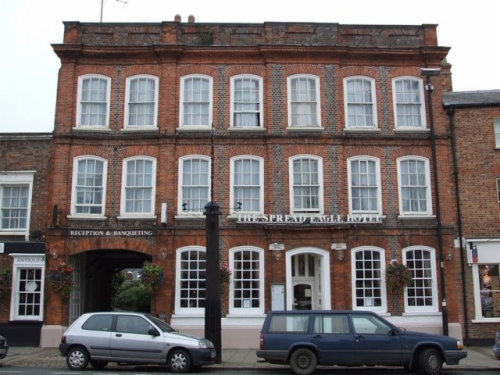 The Spread Eagle Hotel at Thame - Credit: Rob Farrow, Wikimedia Commons
Thame (pronounced tame) is a small town about eight miles east of Oxford.
During the 1920s, Evelyn Waugh used to frequent a famous Thame hotel, the Spread Eagle, run by the flamboyant John Fothergill and renowned for the quality of its cuisine. The sign outside was designed by the artist Dora Carrington, who had a relationship with Lytton Strachey of the Bloomsbury circle.
An Innkeeper's Diary, Fothergill's account of his time at the Spread Eagle, was published in 1931.
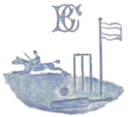 Crest of the Bullingdon Club - Credit: Spiers and Son (1852)
The Bullingdon is an Oxford University dining club, founded in 1789 as a cricket and hunting club. Its members are renowned for their rumbustious and destructive behaviour whilst under the influence of excessive alcohol.
In Evelyn Waugh's satirical novel Decline and Fall (1928), the Bullingdon is thinly disguised as the Bollinger club (Bollinger being a well-known make of champagne).
The British Prime Minister, David Cameron, and the Chancellor of the Exchequer, George Osborne, are both former members of the Bullingdon, as is Boris Johnson (Mayor of London).
 Princess Mary and Viscount Lascelles - Credit: Bain News Service
The Alexandra cocktail mentioned here probably refers to a Brandy Alexandra (sometimes known as a Brandy Alexander). It is said to have been invented on the occasion of the marriage of Princess Mary (Victoria Alexandra Alice Mary Lascelles, née Saxe-Coburg and Gotha), the only daughter of King George V and Queen Mary, to Viscount Lascelles, on 28 February, 1922.
A Brandy Alexandra consists of brandy, cream, and the dark version of the chocolate liqueur, Crème de Cacao.
It was a modification of a cocktail known as an Alexander, which was made with gin, cream, and light Crème de Cacao.
Alexandra is also the name given to another kind of cocktail, which is made using Tia Maria, rum, cream and cocoa cream.
There are various different recipes available for these cocktails, which reflect the confusion that has arisen with the similarly-named drinks.
One recipe for a Brandy Alexander (Brandy Alexandra)
Watch a Brandy Alexander (Brandy Alexandra) being made:
 A copy of 'Antic Hay' (1948) - Credit: Jonathan 229, Flickr
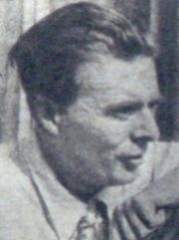 Aldous Huxley - Credit: unknown
Antic Hay (1923) was the second novel of Aldous Huxley (1894-1963), the English novelist, short-story writer and poet.
It is a comic novel with a serious theme, about a group of bohemian artistic and intellectual characters during the period of upheaval and disillusionment following the First World War.
The title is taken from a line in Edward II, a late sixteenth century play by Christopher Marlowe, where 'antic hay' means 'absurd dance'.
 Garsington Manor (1865) - Credit: Henry Taunt (1842-1922)
Garsington Manor, in the village of Garsington near Oxford, was the country home between 1914 and 1928 of Lady Ottoline Morrell and her husband, the Liberal M.P. Philip Morrell.
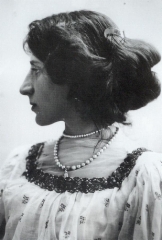 Lady Ottoline Morrell - Credit: George Charles Beresford (1864-1938)
Lady Morrell (1873-1938) was a renowned society hostess and patron of the arts who helped and befriended writers such as Aldous Huxley, Siegfried Sassoon, T.S. Eliot and D.H. Lawrence. She also had many friends amongst the group of artists, writers and intellectuals known as the Bloomsbury Group.
She is believed to be the inspiration for the character of Hermione Roddice in Lawrence's Women in Love and, possibly, for Lady Chatterley in his Lady Chatterley's Lover.
Aldous Huxley's first novel, Crome Yellow (1921), is considered to be a thinly-disguised version of life at Garsington.
Peckwater is the name of an elegant quadrangle in Christ Church College, Oxford.
Undergraduate rooms in Peckwater Quadrangle are highly sought after by students, because of their size, high ceilings and oak panelling.
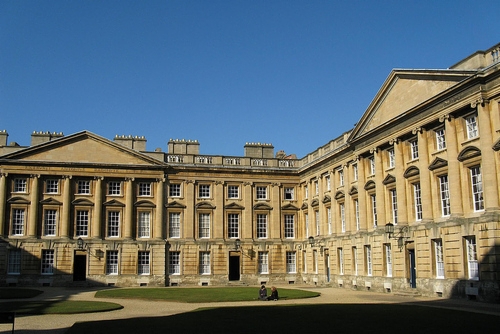 Peckwater Quadrangle, Christ Church College - Credit: Charles D P Miller, Flickr
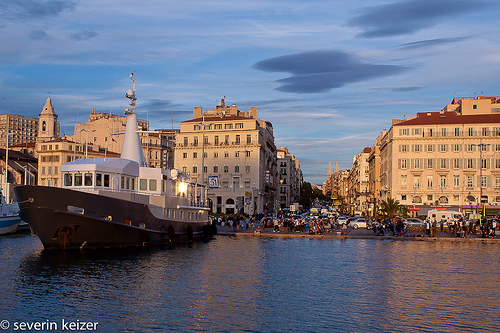 The 'vieux port' at Marseille - Credit: Severin Keizer, Flickr
Marseille is the oldest city in France, situated on its southern Mediterranean coastline. The vieux port ('old port') is a natural harbour which has been in maritime use for many centuries.
 Château de Vincennes, Paris - Credit: Matt Perdeaux, Flickr
Although there is a Château de Vincennes in what is now a Paris suburb, there does not appear to have been a Duc de Vincennes.
At different points in its history, the château has been (amongst other things) a royal hunting lodge, a porcelain factory and a prison.
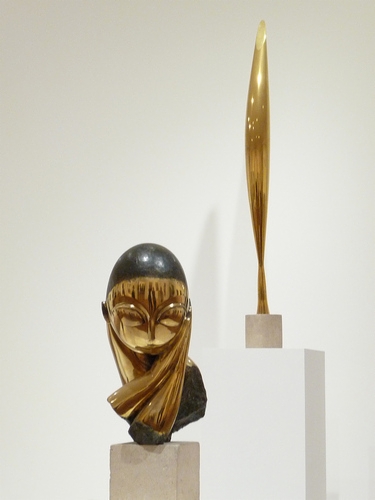 Two sculptures by Brâncusi - Credit: Art Poskanzer, Flickr
Constantin Brâncuşi (1876-1957) was an innovative and sometimes controversial Romanian sculptor.
After leaving his native Romania he worked in Paris, where he moved in avant-garde literary and artistic circles alongside Pablo Picasso, Ezra Pound and Man Ray.
Among his most important works are three sculptures that commemorate Romanians who died in the First World War; these are displayed in Târgu Jiu, a town near to where he was born.
 George du Maurier - Credit: unknown
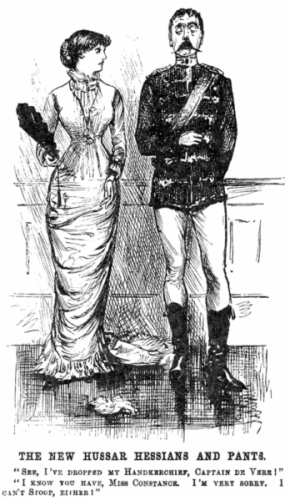 A cartoon by Georges du Maurier (1878) - Credit: George du Maurier
Mrs Ponsonby-de-Tomkyns was a character created by the famous Punch cartoonist, Georges du Maurier (1834-1896), the grandfather of Daphne du Maurier.
Du Maurier was also the author of a highly successful novel entitled Trilby, which was published in 1894.
The Prince de Portallon, like the Duc de Vincennes, appears to be an entirely fictional character.
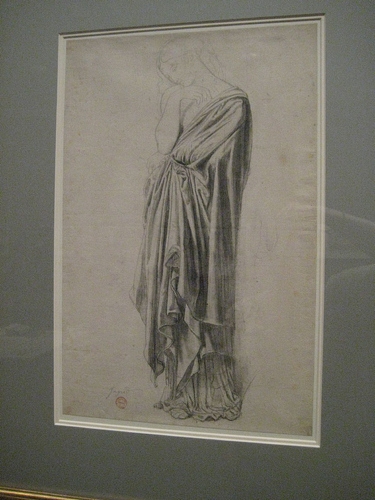 Study for the figure of Stratonice by Ingres (1834-40) - Credit: Claire H., Flickr
Jean Auguste Dominique Ingres (1780-1867) was a French artist who is particularly well known for his portraiture, both painted and drawn.
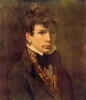 Ingres by David (c.1800) - Credit: Jacques-Louis David
 The Grande Chartreuse Monastery, deep in the Chartreuse Mountains (see central grassland area) - Credit: Evpok, Wikimedia Commons
Green Chartreuse is a French liqueur made by the Carthusian monks of the Grande Chartreuse Monastery in the Grenoble area since the early 18th Century.
It is based on an original 1605 recipe for an 'elixir of life', and is said to contain 130 different herbal extracts.
The history of the Grand Chartreuse monks and the manufacture of the liqueur is lengthy and troubled. The monks were expelled from their monastery on two occasions: once in 1793, at the time of the French Revolution; and again in 1903, by the French Government. After both expulsions, they were able to return and resume manufacture of Green Chartreuse.
Today, the liqueur is still manufactured under the supervision of the monks, although it has been relocated to a factory in the nearby town of Voiron.
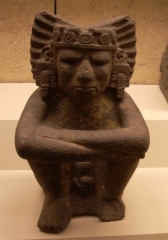 Sculpture of the Aztec god of fire - Credit: Simon Burchell, Wikimedia Commons
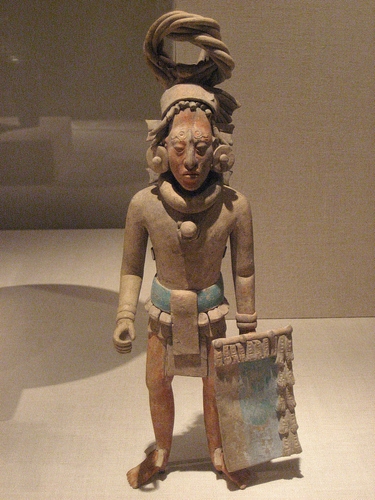 Aztec sculpture - Credit: Yamaira Muniz, Flickr
The Aztecs is the collective name given to a number of ethnic groups who inhabited parts of Mexico and Central America during the 14th-16th Centuries.
Their civilisation was destroyed following the colonization of the Americas by the Spaniards.
Aztec Art includes pottery, sculpture, jewellery and pictures; it is very intimately bound up with the culture's worship of various gods.
 Lama Sherab Gyaltsen rinpoche - Credit: Klaus Schaarschmidt, Wikimedia Commons
A lama (not to be confused with a llama, an animal indigenous to South America!) is a Tibetan Buddhist monk who has achieved a particularly high level of spiritual development and is a teacher of the religion's doctrine.
Lamas are often believed to be the reincarnations of previous lamas or holy men, although not all lamas fall into this category.
The Dalai Lama is the leader of a particular sect of Tibetan Buddhists.
Listen to what is said to be a rare recording of the Dalai Lama chanting:
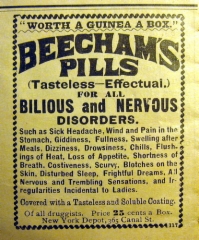 Advertisement for Beecham's Pills - Credit: Donald, Flickr
Beecham's Pills acted as a laxative, although they were marketed originally as a remedy for a range of ailments.
Made primarily from aloe, ginger and soap, they were invented by Thomas Beecham (1820-1907) and sold for the first time in 1842.
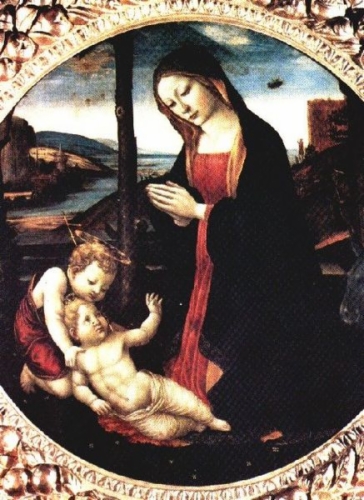 The Madonna with St. Giovannino - attributed to Ghirlandaio - Credit: Domenico Ghirlandaio
The Quattrocento is the name given to the artistic and cultural events of Italy in the fifteenth century, a period also known as the early Renaissance.
It is a term derived from mille quattrocento, Italian for one thousand four hundred (1400AD).
Florentine painters of this period include Jacopo da Sellaio, Lorenzo di Credi, Domenico Ghirlandaio and perhaps most famous of all, Sandro Botticelli.
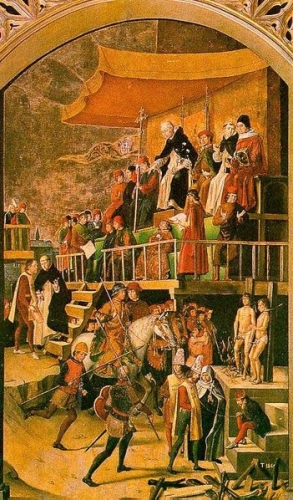 Saint Dominic presiding over an auto-da-fé by Berruguete (c.1495) - Credit: Pedro Berruguete
The Medieval Inquisition attempted, from the end of the 12th century onwards, to combat deviation from the Christian faith through the setting up of tribunals.
In 1478, the Spanish royal family set up the Spanish Inquisition, otherwise known as The Tribunal of the Holy Office of the Inquisition. Its purpose was to ensure Catholic orthodoxy in Spanish kingdoms by suppressing and punishing heresy.
The term auto-da-fé (act of faith) was given to the ritual of public penance demanded of heretics.
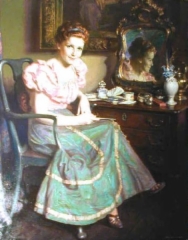 Lady Diana Cooper (c.1920) - Credit: unknown
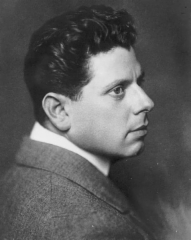 Max Reinhardt (1911) - Credit: Nicola Perscheid (1864-1930)
The Reinhardt nun is a reference to a character in a play entitled Das Mirakel (The Miracle), co-written by Karl Vollmöller and Max Reinhardt.
In the play, a nun runs away from her convent with a knight, and has several adventures which lead to her being accused of witchcraft. Meanwhile, the statue of the Virgin Mary in the convent chapel comes alive and takes her place.
The Miracle was produced on the London stage and on Broadway in 1924; it was produced again in London in 1932.
Lady Diana Cooper, a friend of Evelyn Waugh, appeared in both the New York and the London productions, in 1924 and 1932. On first viewing the 1932 production, Waugh is reputed to have said, "it is as full of blasphemy as an egg is full of meat." However, this did not stop him going on tour with the play, as company for Lady Diana, with whom he had something of an infatuation.
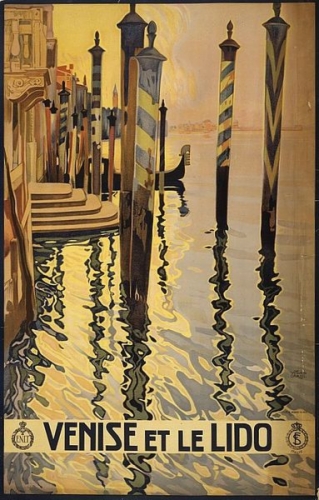 1920's travel poster for Venice and the Lido - Credit: Vittorio Grassi (1878-1958)
The Lido de Venezia (Venice Lido) is a sandbank in the Venetian Lagoon, one edge of which is a stretch of sandy beach used by tourists from the nearby hotels.
One of these hotels, the Grand Hotel des Bains, was the setting for Thomas Mann's novel Death in Venice, as well as the location for the film version of the novel, directed by Visconti.
The Lido is also the location of the Venice Film Festival, which takes place annually in late August or early September.
Juliette Récamier (1777-1849) was a renowned French society hostess whose salons attracted important literary and political figures of the period.
The attitudes referred to by Anthony Blanche are an allusion to the fact that she sat for several well known artists and sculptors, including Jacques-Louis David, François Gérard and Antonio Canova.
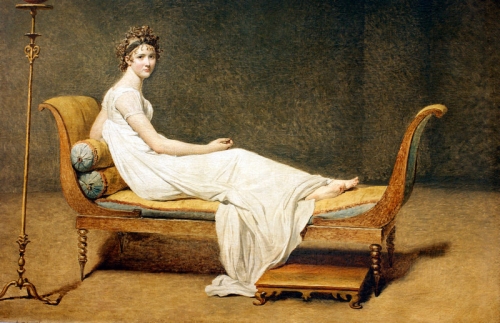 Madame Récamier by David - Credit: Jacques-Louis David
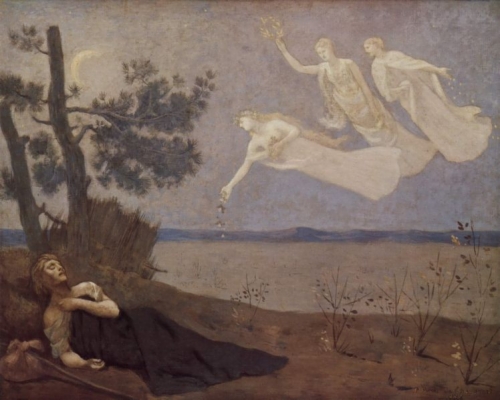 Example of Symbolist art ('The Dream' by Puvis de Chavannes) - Credit: Pierre-Cécile Puvis de Chavannes
Maurice Maeterlinck (1862-1949) was a Belgian playwright, poet and essayist, whose works were written in French.
He is considered part of the Symbolist movement, which had its origins in the work of the French poet, Charles Baudelaire, and those poets whom Baudelaire influenced, such as Paul Verlaine and Arthur Rimbaud.
Maeterlinck's plays include Princess Maleine (1890) and Pelléas and Mélisande (1892).
A Celtic play is probably one associated with what is sometimes called the 'Celtic Revival' in literature and art, whereby there was renewed interest in the traditions of Ireland, Scotland and Wales (the Celtic nations).
In Irish literature, the revival is strongly associated with the work of writers such as William Butler Yeats, John Millington Synge, Sean O'Casey and Augusta, Lady Gregory.
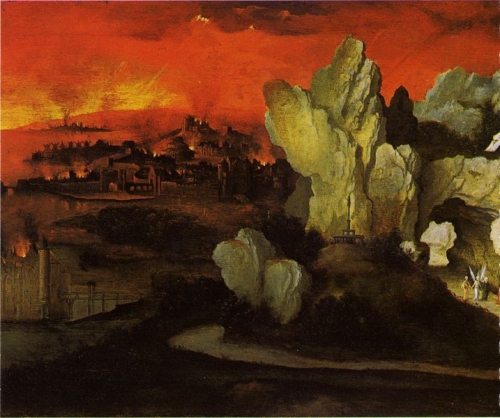 Landscape with the burning of Sodom and Gomorrah - Credit: Joachim Patinir (1480-1524)
Sodom and Gomorrah are two cities mentioned in the Bible; they are said to have been destroyed by God because of the wickedness of their inhabitants.
Nowadays, a reference to 'Sodom and Gomorrah' implies some sort of association with evil or depravity.
The term sodomy is derived from Sodom.
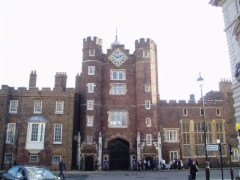 St. James Palace, London - Credit: Steve Cadman, Wikimedia Commons
As would have been normal for aristocracy of the period, the Flyte family have a home in the country (Brideshead Castle) and a home in London (Marchmain House).
St. James's is a smart area of central London. It holds several royal residences, including St. James's Palace and Clarence House. There are also many upmarket commercial enterprises in the area, such as auction houses, art galleries and wine merchants, as well as a concentration of gentlemen's clubs.
 Self portrait by John Everett Millais - Credit: John Everett Millais
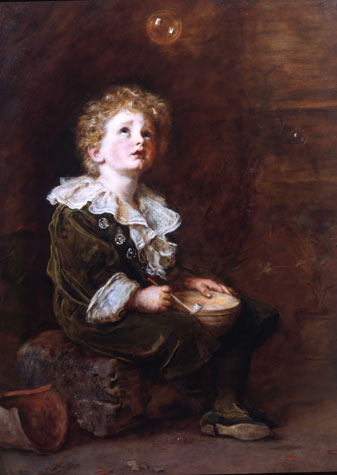 'Bubbles' (1886) - Credit: John Everett Millais
Bubbles is a painting by Sir John Everett Millais, orginally entitled A Child's World.
It became particularly well known to the public through its use in the advertisements of the Pears soap company
 Trifle - Credit: Benjah-bmm27, Wikimedia Commons
Mavrodaphne (sometimes written mavrodafni) is both a Greek grape variety and a type of wine made with that grape.
The dessert wine undergoes a maturation process and develops an unusual, rich reddish-brown colour.
Apparently, John Fothergill of the Spread Eagle Inn at Thame (referred to in bookmark p.57) was renowned for his Mavrodaphne Trifle.
Recipe for a traditional English trifle (to give it the 'Brideshead touch', just substitute Mavrodaphne for the sherry).
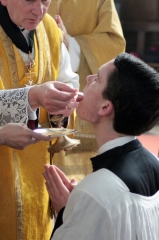 The receiving of Holy Communion - Credit: James Bradley, Flickr
Holy Communion (sometimes known as the Eucharist) is a religious practice in most Christian churches.
It is essentially a re-enactment of the Last Supper of Christ with his disciples, and involves the symbolic sharing of bread and wine.
Corporate Communion is Communion received as a group.
Change ringing is a form of bell-ringing, using a set of tuned bells, that does not attempt to produce a melody.
It consists simply of a series of mathematical patterns, known as changes.
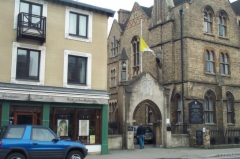 St. Aloysius, Oxford - Credit: Kaihsu Tai, Wikimedia Commons
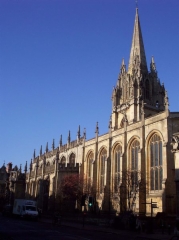 St Mary's Church, Oxford - Credit: Alf, Wikimedia Commons
All these places of worship are located in the city of Oxford, They represent a range of denominations:
St. Columba's roots are in the Protestant tradition; St. Aloysius, Blackfriars, and Pusey House are Catholic places of worship; St. Barnabas and St. Mary's have traditionally been in the Anglo-Catholic tradition.
John Henry Newman and John Keble, prominent figures in the Oxford Movement (which sought to introduce a more Catholic form of worship into the Anglican Church during the 19th century), have strong associations with St. Mary's.
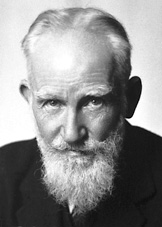 George Bernard Shaw (1925) - Credit: Nobel Foundation
George Bernard Shaw (1856-1950) was an Irish writer best known as a playwright, although he was also a novelist and short-story writer.
Three of his plays: Widowers' Houses (1892), Mrs Warren's Profession (1893) and The Philanderer (1898) were published in one volume in 1898, under the title Plays Unpleasant.
All three of these plays dealt with major social issues of the day, and may be viewed as critiques of a capitalist, patriarchal society. The latter two, in particular, aroused a fair amount of controversy and were subjected to censorship.
 'Lady into Fox' (a picture named after Garnett's novel) - Credit: sammydavisdog, Flickr
Lady into Fox (1922) is a novel by David Garnett (1892-1981).
It is an unusual and enigmatic story of a newly-married man whose wife turns into a fox, after which he continues to try to maintain their relationship.
It was well-received in its day, winning the James Tait Black Memorial Prize in 1922, and the Hawthornden Prize in 1923.
Mass is the name given to a Roman Catholic Church service whose central feature is the Eucharist or Holy Communion.
The Old Palace on St. Aldates is the site of the Oxford University Catholic Chaplaincy.
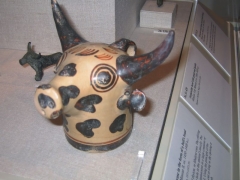 Minoan terracotta vase in form of a bull's head (c.1450-1400 BC) - Credit: talmoryair, Wikimedia Commons
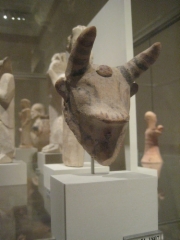 Cypriot bull mask (c.750-480 BC) - Credit: Claire H., Flickr
Presumably, Sonnerscheins is an antique dealers or auction house. Does anyone know?
Throughout history, and in many cultures, the bull (both real and symbolic) has had religious and mystical significance.
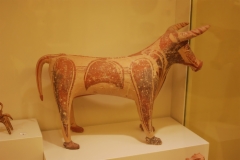 Terracotta bull from Heraklion Archaeological Museum - Credit: Jorge-ll, Flickr
During the mid-19th century, the village of Barbizon in France was the focal point for a group of painters known as the Barbizon School, of which Théodore Rousseau and Charles François Daubigny were noted members.
 Landscape by Rousseau - Credit: Théodore Rousseau
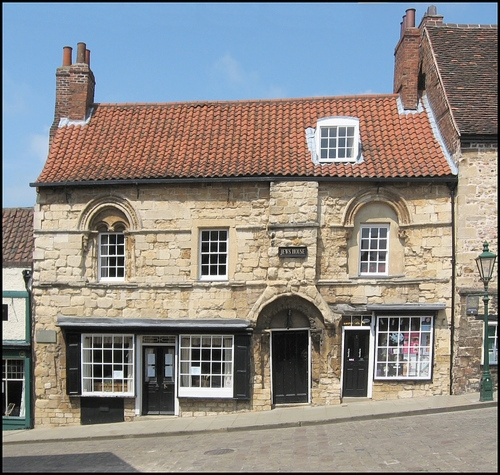 Jews House, Lincoln - home of Bellaset, a Jewish woman executed in 1287 for 'clipping' coins - Credit: Brian, Flickr
Jews throughout Europe became money-lenders because the practice of usury (charging interest on lent capital) was considered a sin by the Catholic Church, and because they were excluded from most professions.
Their persecution reached its peak during the Medieval period, and Jews were expelled from England in 1290, during the reign of Edward I.
Following their return in the mid-17th century, Jewish people gradually became better integrated into British society and were eventually able to follow a range of professions which had previously been closed to them. Nevertheless, they remained closely associated with money-lending, particularly following the rise of Jewish bankers such as the Rothschild family.
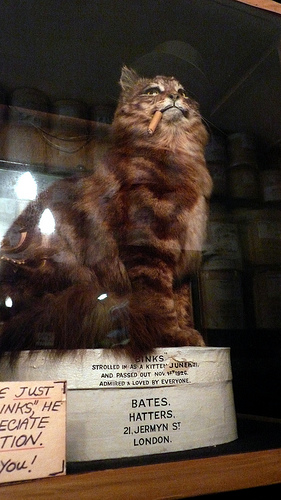 A stuffed cat at 'Bates Hatters', Jermyn Street - Credit: Cory Doctorow, Flickr
Jermyn Street in London is best known for its many gentlemen's outfitters, particularly its shirt-makers.
Although there is little hard evidence that Jermyn Street was a centre of money lending, it is possible to find several incidental references:
In Chapter 4 of E.W. Hornung's novel, Mr. Justice Raffles, there is a reference to Raffles and his sidekick, Bunny Manders, going together to the jaws of Jermyn Street to visit the moneylender Mr Dan Levy;
Chapter 8 of The Picture of Dorian Gray by Oscar Wilde includes the following reference to money lenders in Jermyn Street:
... there were several very courteously worded communications from Jermyn Street money-lenders offering to advance any sum of money at a moment's notice and at the most reasonable rates of interest;
In a list of businesses of the City of Westminster to be found on the borough's website, it is noted that a money lender delightfully called Victor Honour was in business in Jermyn Street between 1875 and 1925.
(A note of hand is a written promise to repay a debt)
 Cyperus papyrus plant - Credit: Liné1, Wikimedia Commons
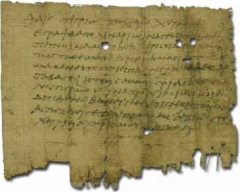
Papyrus is a paper-like material, made from the plant Cyperus papyrus.
As early as 3000BC, it was manufactured by the Egyptians from the abundant growth of the papyrus plant in the Nile Delta.
Eventually, papyrus was superseded by parchment and vellum, made from animal skins.
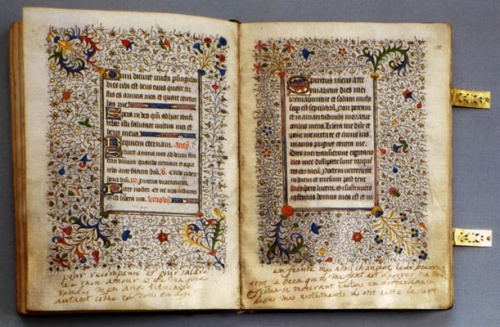
Lombardic was the language of a Germanic people who settled in Italy in the 6th Century. The language declined from the 7th Century onwards and had virtually died out by the 11th Century.
However, Lombardic in this context probably refers to the type of script used.
A breviary is a book of Catholic prayers, hymns and other religious material. It is usually intended for officers of the church, such as bishops, priests and deacons.
The word is also used to describe similar books used by Anglican or Lutheran denominations.