
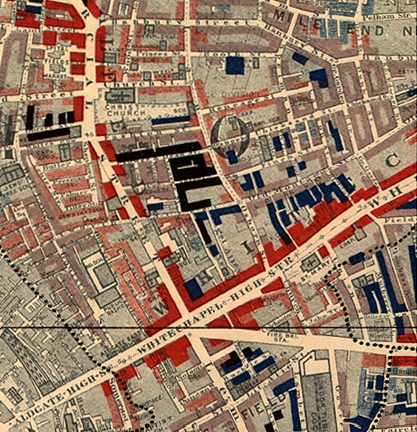
 Economic Map of London showing Chicksand St, 1889 - Credit: Charles Booth
Chicksand Street lies just north of Whitechapel in London's East End. It adjoins the famous Brick Lane. The Booth map pictured shows plenty of black around Chicksand Street, indicating a very poor neighbourhood (black represents the "lowest class...occasional labourers, street sellers, loafers, criminals and semi-criminals").
Mile End New Town was a parish covering this area until its abolition in 1921. Mile End Old Town was located further to the east, as is the modern district of Mile End.
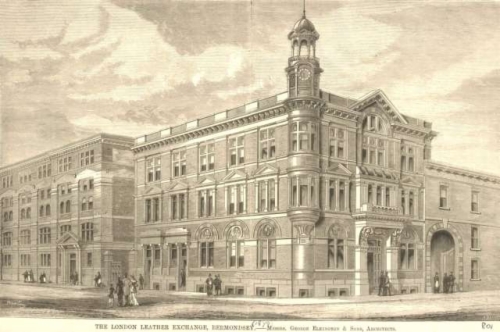 The Leather Exchange, Bermondsey, 1879
Either a fictionalization or a mistake by Stoker. There is a Jamaica Road in Bermondsey, but no Lane.
Bermondsey, in south London, was a slum in the first part of the nineteenth century, but was redeveloped in subsequent years. A number of important industries, including leather tanning, were located in Bermondsey.
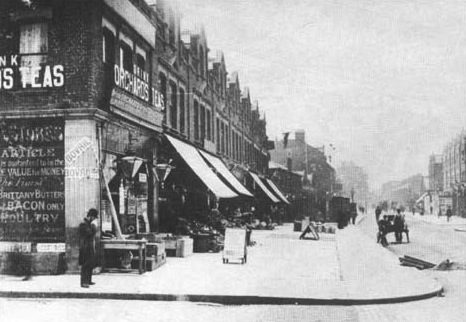 Poplar High Street, 1912
Poplar is an area of East London on the north bank of the Thames, location of some of the capital's historic docks. It lies just to the east of Bermondsey, across a bend in the river. Today, it finds itself in the shadow of the skyscrapers of Canary Wharf to the south.
Historically, fresh food was kept cool using ice harvested in winter and stored in caves, pits or icehouses. Systems of artificial refrigeration were first developed in the 18th century: it was discovered that when volatile liquids evaporate they draw in heat from the surrounding air, rapidly cooling nearby matter.
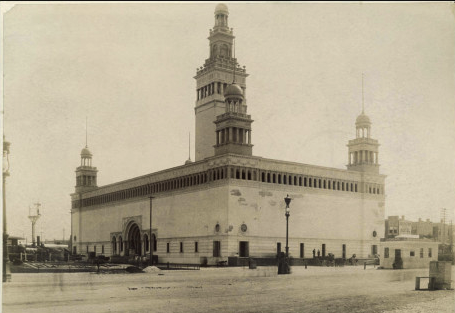 The Cold Storage Building at the World’s Columbian Exposition, 1893
In the 1850s, Scottish Australian engineer James Harrison developed an ether liquid-vapour compression refrigeration system which was adopted by meat packers and breweries. The race was soon on for a refrigeration system that could be fitted in ships for the transport of meat; the first successful installation came aboard the Dunedin in 1882. Carl von Linde's work on ammonia-based refrigeration cycles played an important part in extending the commercial adoption of refrigeration systems.
A cold storage building was constructed at the 1893 Columbian Exposition in Chicago, boasting the latest ice-making machinery, five storeys and a skating rink. The hazards of this new technology became clear when the grand building caught fire and collapsed, killing 17 firemen.
The earliest cold storage buildings in London were constructed around the docks (such as Poplar) and the Smithfield meat market towards the end of the 19th century. An article in the Adelaide Advertiser (1902) describes the new cold storage building at Poplar with "a storage capacity of 150,000 carcasses of mutton" (of particular interest to Australian exporters), rail connection, hydraulic lifts and a "special cable from the borough of Poplar generating station" to supply the electricity.
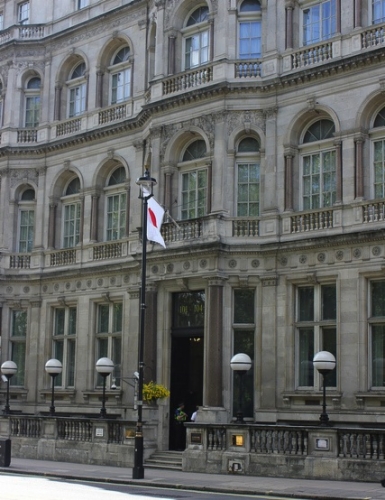
 101 Piccadilly - Credit: Joe Allen
The Junior Constitutional Club was a gentlemen's club at 101 Piccadilly. It was formed in 1887 following over-subscription of the Constitutional Club, and like its older sibling it was politically aligned with the Conservative party. It was, briefly, one of the largest clubs in London, with 10,000 members by 1890.
This reference would have quickly dated Dracula for London readers, however, because despite its initial popularity the club had closed by 1904, just seven years after the book's publication. The building is now the Japanese Embassy.
Interior photograph of the Junior Constitutional Club
The luxurious Berkeley Hotel stood on the corner of Piccadilly and Berkeley St, opposite the site of the coming Ritz. It was undergoing extensive remodelling at the time of Dracula's publication:
in the year of grace ‘97 the old hotel was much altered, the restaurant almost doubled in size, and the Berkeley may now, in its latest development, be said to be the blonde beauty among London hotels.
- Lieut.-Col. Newnham-Davis, 1899
It was purchased by Richard D’Oyly Carte in 1900, becoming part of the Savoy Group. In 1972, the Berkeley moved to a new building in Knightsbridge.
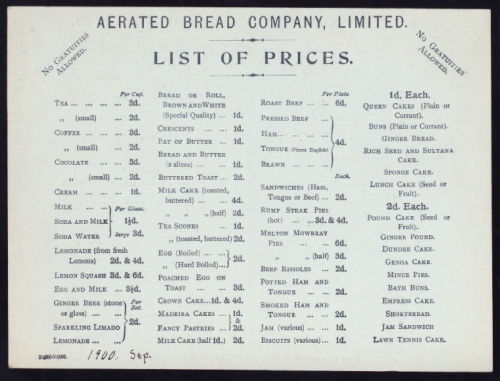
 ABC Tea Shop in Fleet Street
The Aërated Bread Company was both a bakery and a chain of tea shops. Like Lyons Corner Houses, ABC Tea Shops were considered suitable for unaccompanied ladies to frequent, and so became popular as London's population of working women grew.
The company was founded in 1862 with a new bread-leavening technology that made use of carbon dioxide instead of yeast. The company was acquired by Allied Bakeries in 1955, and the name was finally phased out in the 1980s.
Malvolio is Olivia’s deluded and much-mocked steward in Shakespeare’s Twelfth Night. The reference is to Act 3 Scene 4:
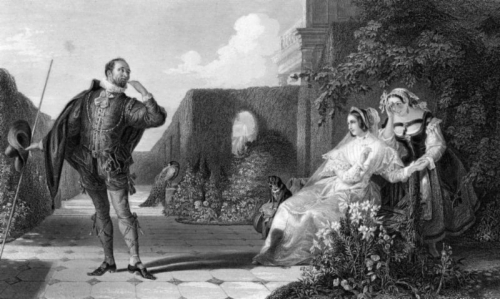 Malvolio courts Olivia, while Maria watches in amusement - Credit: wikimedia commons
Where is Malvolio?
MARIA
He's coming, madam; but in very strange manner. He
is, sure, possessed, madam.
OLIVIA
Why, what's the matter? does he rave?
MARIA
No. madam, he does nothing but smile: your
ladyship were best to have some guard about you, if
he come; for, sure, the man is tainted in's wits.
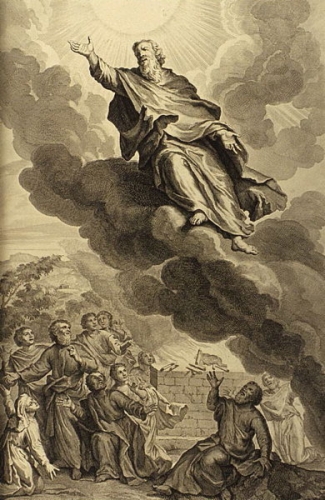 God took Enoch, 1728 - Credit: Gerard Hoet
Enoch was the father of Methuselah and great-grandfather of Noah. The reference Renfield has in mind is this:
And Enoch walked with God: and he was not; for God took him.
Genesis 5:24
The passage seems to imply that Enoch did not die in the normal way, but was raised to Heaven by God. The Book of Enoch is considered part of the bible by the Ethiopian Orthodox Church. It describes Enoch's visits to Heaven.
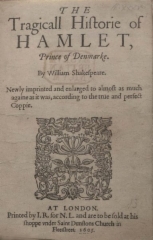 Cover of Hamlet, 1605 - Credit: wikimedia commons
This is a line from Shakespeare's Hamlet, spoken by Hamlet in Act 3 Scene 4:
So, again, good night.
I must be cruel, only to be kind:
Thus bad begins and worse remains behind.
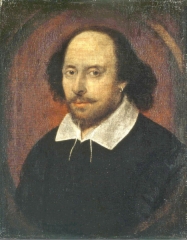
And now we're back to Shakespeare’s King Lear, and once again Act 3 Scene 4:
But mice and rats, and such small deer,
Have been Tom's food for seven long year
That makes four consecutive Shakespeare quotes - from three different plays - all from Act 3, Scene 4. What is Bram Stoker up to?! Is it a code?

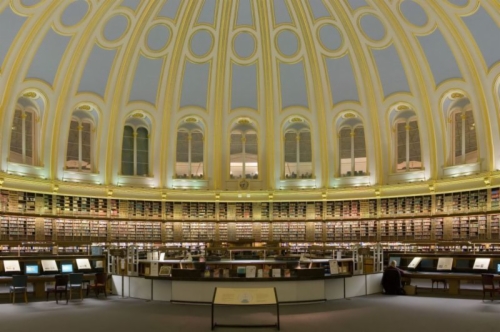
 The British Museum Reading Room - Credit: Eneas
The British Museum was founded in 1753 as the first national public museum. Today, with a permanent collection of around 8 million items, it is one of the world's greatest museums of human history and culture. It is located on Great Russell St, London.
The museum is best known for treasures such as the Rosetta Stone and the Elgin Marbles, but it does also hold various ancient medical texts:
Medical Tablets from the Library of Ashurbanipal
However it is more likely that Van Helsing was headed for the British Library, which was at the time a department of the British Museum. The Library, now at St Pancras, contains a multitude of medical texts, such as:
Medieval Medical Manuscripts in the Harleian Collection
Leyden Medical Dissertations, 1593-1746
 Trephining - Credit: Hieronymus Bosch
A trephine is a surgical instrument for cutting out discs of bone, generally from the skull. It has a circular, saw-like blade. Trephining, or trepanning, is the act of cutting a hole in the skull, often to relieve pressure or enable cranial surgery.
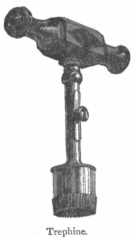 Trephine - Credit: Chambers, 1908
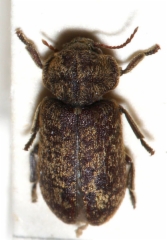
 The Death-Watch Beetle - Credit: Sarefo/wikimedia commons
 Death's-head Hawk Moth - Credit: Orin Zebest
Acherontia atropos is one of three species of Death's-head Hawk moth. It is a particularly large moth, with a wingspan of up to five inches.
The species name is heavily connected with death. In Greek mythology, Atropos was one of the three goddesses of Fate and Acheron was the river of pain in the Underworld. The moth is completely harmless, but the skull pattern on the thorax has caused it to be associated with evil and misfortune.
"Sphinges" is the plural of sphinx, and refers to the hawk moth family, Sphingidae.
