Noah and the dove, 1st century catacomb - Credit: Shakko/Wikimedia Commons
This is a reference to the biblical story of Noah and the ark. Noah sent a dove out from the ark to determine whether the flood waters sent by God to cover the world had abated yet. The dove returned with an olive branch, showing Noah that the water was receding:
Also he sent forth a dove from him, to see if the waters were abated from off the face of the ground;
But the dove found no rest for the sole of her foot, and she returned unto him into the ark, for the waters were on the face of the whole earth: then he put forth his hand, and took her, and pulled her in unto him into the ark.
And he stayed yet other seven days; and again he sent forth the dove out of the ark;
And the dove came in to him in the evening; and, lo, in her mouth was an olive leaf pluckt off: so Noah knew that the waters were abated from off the earth. (Genesis 8:8-12)
 The Premature Burial, Antoine Wiertz, 19th century - Credit: wikimedia commons
In European folklore, vampires were often reported as sleeping in their coffins, with blood around their mouth and the left eye open. The vampire would often be wrapped in its funeral shroud, and its teeth, hair and nails may have grown, though the body is dead. Corpses suspected of being vampires were described as bloated and purplish in hue (appearing to be full of blood), with little or no decomposition and a healthier appearance in general than would be expected. The belief therefore arose that vampires hunted their prey at night and returned to their coffins to sleep during the day.
In reality, these fears may have arisen from a lack of understanding of the decomposition process. Decomposition can vary depending on temperature and soil composition, with some bodies appearing to decay quicker than others. Gases in the corpse cause the body to swell, and the increased pressure forces blood out from the nose and mouth, as well as giving the body a bloated and ruddy appearance.

 Graveyard - Credit: Che/Wikimedia Commons
Dracula himself does not return to his grave at daybreak, but seems instead to sleep in a substitute coffin; a long wooden box. Dracula’s sleeping habits may reflect an undead creature’s preference for a bed better suited to the dead. In some forms of the vampire myth these unholy creatures are burned or repelled by the light of day, which is why they need to seal themselves in coffins during daylight hours. This does not seem to be the case with Dracula, who is only weakened during the day. Dracula also sleeps in newly dug earth; as Van Helsing later explains, this is because vampires need to sleep on the soil of the consecrated ground (graveyard) in which they were buried. This seems odd, as other holy things repulse vampires, but perhaps the earth has been corrupted by the vampire's presence.
The use of coffins, connection to graveyard soil, and hatred of daylight are all vampire features that vary considerably in fiction. At extreme ends of the scale in recent fiction are the vampires of True Blood, who ignite in the sun and must sleep in dark, sealed places, and the vampires of Twilight, who simply avoid direct sunlight (it gives away their true nature) and never sleep.
 Odysseus and men blind the cyclops, 6th century BC cup - Credit: Bibi Saint-Pol/Wikimedia Commons
 The Judas Kiss, Gustave Doré, 19th century - Credit: wikimedia commons
 Woodblock print of a Basilisk, 1642 - Credit: wikimedia commons
The basilisk is a legendary monster that was said to have the power to kill with its stare. It is created from the egg of a snake or toad, hatched by a cockerel. This is the reverse of the cockatrice, which was said to be hatched from a cockerel’s egg, hatched by a snake or toad. It is usually depicted as a reptile with a cockerel’s crest or head.
The basilisk appears in Harry Potter and the Chamber of Secrets as a giant serpent with a lethal stare.
Stenography is the art of shorthand, a set of symbols which allow the stenographer to quickly record speech as it is spoken.
 Kent County Lunatic Asylum (now flats) - Credit: llamnudd on Flickr
In Victorian times, mentally ill people were placed into lunatic asylums, where they would be held, studied and sometimes experimented upon in the hopes of furthering scientific knowledge of the mind. The Victorian definition of insanity might include many illnesses, conditions and types of behaviour that today are better understood or treatable, such as post-natal depression or epilepsy. Antisocial or immoral behaviour might also sometimes be considered ‘insane.’
Patients were not considered to have the same rights as ‘sane’ people, and the asylums could be brutal, depressing places. Victorian lunatic asylums often feature in modern horror fiction. Find out more about lunatic asylums here.
 Top Hat (Austin Lane Crothers) - Credit: US Library of Congress
 Alexandra Fyodorovna and Nicholas II of Russia, 1894 - Credit: wikimedia commons
Victorian gentlemen’s fashion involved dressing smartly: a long-sleeved shirt, waistcoat and long coat, trousers and a tall, silk top-hat. The height of the hat reflected the social standing, wealth and importance of the man (hence the famous towering hat of Abraham Lincoln). Cravats, pocket-watches, gloves and walking sticks added personal statements to the outfit.
More information on Victorian men’s clothes.
Women’s clothes were designed to cover the whole body, as proper ladies were expected to be modest and demure. Dresses were long, covering neck, arms and ankles, with a cuirassed bodice or corset that provided a slim shape. A bustle (framework under the dress) could be used to give the skirt a wide, full shape. Big, colourful hats, gloves, fans and parasols were used to accessorise the outfit.
More information on Victorian women’s clothes.

 Victorian dresses - Credit: Storye book/Wikimedia Commons
 Othello and Desdemona, Théodore Chassériau, 19th century - Credit: wikimedia commons
Desdemona is a character from Shakespeare’s tragedy Othello.
Desdemona, a Venetian beauty, falls in love with Othello, a Moor in service of the Venetian Republic, despite their racial differences and the prejudices of her society.

 A Phonograph - Credit: Norman Bruderhofer/Wikimedia Commons
Dr. Seward is using phonograph cylinders– cylinder shaped objects with a recording engraved on the outside surface – to record his diary. These can then be played back on a phonograph, an old sound-playing device.
Modern technology and discovery, such as the phonograph, telegraph, typewriter, guns, medical drugs, and blood transfusions, feature throughout the book. The Victorian age was one of rapid advancement and invention, bringing a new confidence in the abilities of man and in the conquering power of science. However, superstitious fears and beliefs were also prevalent, in an era famous for both Darwin and its mediums. Dracula plays on these ideas, showing characters from a world of science and invention thrown into supernatural peril. When modern technology fails, they must turn their hopes to weapons of faith and superstition instead.
“Ah, it is the fault of our science that it wants to explain all; and if it explain not, then it says there is nothing to explain.” – Van Helsing, page 204.
 Prairie in Iowa - Credit: National Park Service, US Federal Government
A prairie is a form of temperate grassland, usually found in North America. ‘The prairies’ refers to the huge area known as the Great Plains of the United States and Canada.
 Hiva Oa, one of the Marquesas Islands - Credit: Sémhur/Wikimedia Commons
The Marquesas are a group of islands in French Polynesia, located in the southern Pacific Ocean.
Lake Titicaca is a large lake in South America, on the borders of Peru and Bolivia.
 Lake Titicaca - Credit: Vico ricab/Wikimedia Commons
Nuremberg is a city in Germany.
 Nuremberg - Credit: Mb1302/Wikimedia Commons
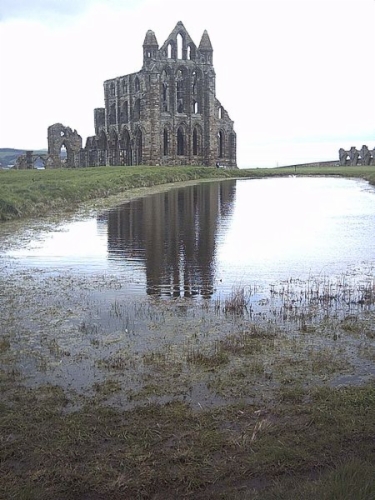 Whitby Abbey - Credit: Nez202/Wikimedia Commons
Whitby Abbey is a ruined abbey on the East Cliff of Whitby, North Yorkshire. It was founded in the 7th century AD, sacked in the 9th century by Viking invaders, re-founded in the 11th century, and was finally destroyed by Henry VIII during the 16th century Dissolution of the Monasteries, leaving only ruins behind. The ruins are now preserved by English Heritage and open to the public as a tourist attraction. It remains a striking landmark in a town that has inspired many more strange, spooky and gothic stories.
Marmion (1807) is an epic poem written by Walter Scott.
 Jet Mourning Jewellery - Credit: Detlef Thomas/Wikimedia Commons
Deciphering Whitby dialect: ‘Feet-folks’ refers to tourists who walk rather than ride in carriages. ‘Fash masel’ means ‘fuss myself.’ ‘Creed aught’ means ‘believe anything.’ For more translations, refer to the Glossary.
York and Leeds are two cities in Yorkshire.
Whitby is famous for its jet, a semi-precious black mineraloid formed from the fossilised remains of decaying wood. It has been mined and used to make jewellery since the Bronze Age, and was particularly popular in the 19th century after Queen Victoria used it for mourning jewellery. Jet continues to be sold in the town today.
In Shakespeare’s The Merchant of Venice, Gratiano says, “I am Sir Oracle, And when I ope my lips let no dog bark!” (Act 1 Scene 1)
The aurora borealis is a phenomena visible in the far north.
An aurora is a natural light display, best seen in the polar regions, caused by the collision of charged particles directed by Earth's magnetic field.
In the Northern latitudes this is called aurora borealis after the Roman goddess of the dawn, Aurora, and the Greek name for the North wind, Boreas. It is also known as the Northern Lights.