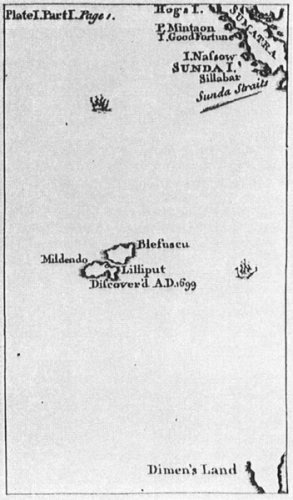
 Lilliput - Credit: Herman Moll (1654? – September 22, 1732
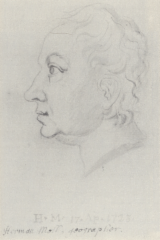
Herman Moll (1654? – September 22, 1732), a professional cartographer, drew all the maps in the original publication of Gulliver's Travels.

In the 17th century in England, life expectancy was only about thirty-five years, so it was common to make faster beginnings. It was quite normal to enter college in the mid-teens.
Swift attended Trinity College when he was fourteen.
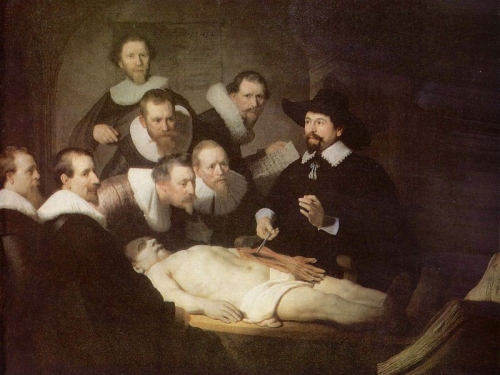
Surgery was not yet recognized as a true branch of medicine. It involved the use of the hands, which made it a branch of mechanics. It was associated with barbers since cutting flesh was considered to be similar to cutting hair as far as skills and social position were concerned.
"Mrs." is an abbreviation for "Mistress", the feminine form of "Master" or "Mister".
In the 18th century, Mister and Mistress were used only for those of high birth who would be employers of servants. Mister and Mistress did not indicate the married state at the time. By referring to the woman he married as Mrs. Mary Burton, Gulliver was not implying that she had been divorced or widowed, merely that she was of comfortable social station.
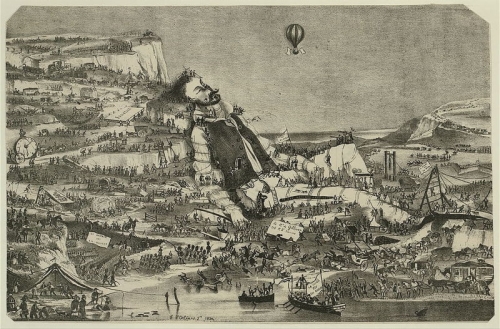
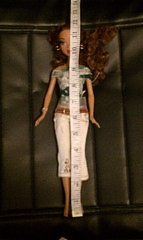
 Barbie is twice the size of a Lilliputian - Credit: Charlene Leatherman
This is a Barbie-like doll that I own. It is 12 inches tall. That makes the Lilliputians half the size of a Barbie doll.
Isaac Asimov annotated the 1980 edition of Gulliver's Travels, and made the following comment about the 6" people Swift created:
As it turns out, everything on the island is on the scale of one to twelve; that is, the island's inches are equilivant to our feet. Since the Lilliputian whom Gulliver first sees is very nearly six inches high, we can assume that Gulliver is very nearly six feet tall...
However, 1/12 is not the true measure of the size of the Lilliputians. They are 1/12 as tall as we are, but also 1/12 as wide and 1/12 as thick. The total volume of one of them, and therefore the total weight, is 1/12 x 1/12 x 1/12, or 1/1,728 of ourselves.
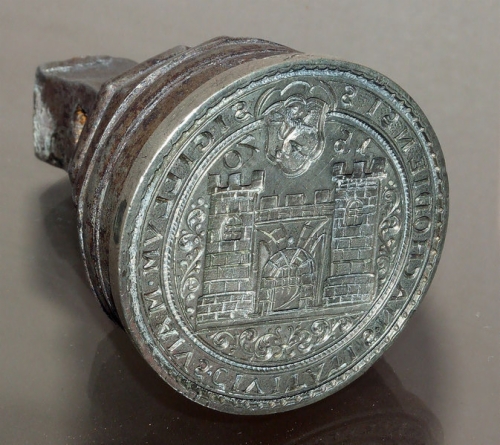 Signet - Credit: Kozuch
In Gulliver's day, literacy was rare, so few people could sign their name on important documents. Instead they would make a unique impression in wax with a personal ring or stamp.
The impression was a seal or a signet. The king's seal was called the Signet Royal.
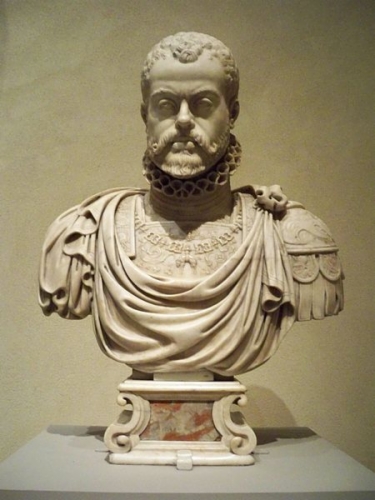
 King Phillip II - Credit: Matthew G. Bisanz
It was not beautiful, and in the case of Charles II, the last Hapsburg king of Spain, the "Austrian lip" was so pronounced and the lower jaw stuck out so far that he could not chew his food properly; it had to be cut into small pieces for him.

Nevertheless, because the Hapsburgs reigned as Holy Roman Emperors and had greater social standing than any other European monarchs, this physical distortion took on a kind of aristocratic distinction.


Skyresh Bogolam supposedly represented Daniel Finch, Earl of Nottingham (1647 - 1730), who was first lord of the Admiralty (1681 - 1684) under Charles II. He was a Tory who frequently opposed the policies of Robert Harley, Earl of Oxford, the Tory leader during Queen Anne's reign. His opposition annoyed Swift.