Russian literature blossomed in exile, as most of St Petersburg and Moscow's literati moved to Berlin and Paris. Among the writers to come to prominence after 1917 were Ivan Bunin , Nina Berberova, Gaito Gazdanov, Georgii Ivanov, Zinaida Gippius, Vladimir Khodasevich and Joseph Brodsky. Many of the writers did not realise at first that they would never return to Russia, and that Berlin would not just be a temporary home while they sat out the upheavals back home. For many, Berlin was only the first stage in the long journey that exile would become.
Much of the work produced at this time dealt with the themes of separation from the homeland and the alienation felt in a new environment, as the writers and poets struggled to hang onto their Russian identity. On page 216 Nabokov describes the Berlin emigre crowd rather disparagingly as "hardly palpable people who imitated in foreign cities a dead civilisation". Nabokov immortalised Russian emigre life in Berlin in his 1930 book The Defence, a thriller about chess.
Berlin was a magnet for Russian writers for several reasons: not only was German interest in Russian literature high, but the German publishing industry (including the publishing houses named here by Nabokov: Orion, Cosmos and Logos) was the best-organised in the world. Germany was near to Russia, life there was cheap, and the German authorities were generous with emigre visas. In addition, the Russian intelligentsia was interested and well-versed in, German philosophy and culture and Berlin was at the time one of the most cosmopolitan, culturally dynamic centres of film, theatre, literature and music in Europe.
By the mid 1920s however, Russian emigre life had shifted from Berlin to Paris. Nabokov probably moved to Paris because of his wife Vera's Jewishness.
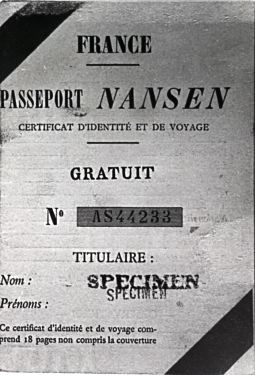
Nansen Passports were the first refugee travel documents. Named after Norwegian scientist and polar explorer Fridtjof Nansen who designed them in 1922, they were issued by the League of Nations to stateless refugees in the early twentieth century, in this case Russian émigrés. Approximately 450,000 Nansen passports were issued.
Rul' (meaning 'rudder' in Russian) had a circulation of 40 000 in Berlin, reflecting that city's large Russian émigré population. Nabokov omits to mention in Speak, Memory, that his father founded and then edited the paper until his assassination in 1922.
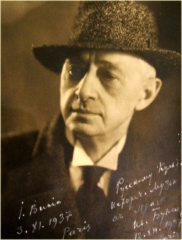
 Ivan Bunin - Credit:
Ivan Bunin (1870-1953) was the first Russian to win the Nobel prize for literature, in 1933. Nabokov was a great admirer of Bunin's, who was himself a translator of literature as well as a poet and a writer of short stories.
Nabokov concludes his autobiography with yet another fine example of his boundless self-esteem: V.Sirin was the young Vladimir Nabokov's pseudonym when he lived in Berlin and contributed to the émigré paper Rul'. Later on, in Look at the Harlequins, the main character, Vadim Vadimych, who bears a close resemblance to the author, adopts the pen name "V.Irisin", almost an anagram of V.Sirin.