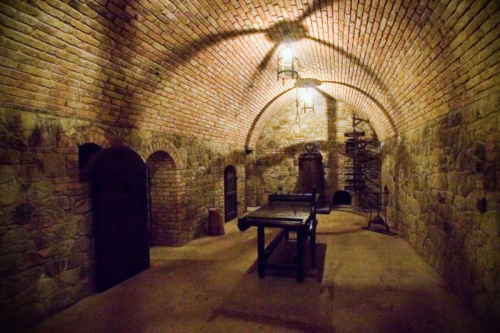
 The Torture Chamber at the Castello di Amorosa. - Credit: David Ball
 Pregnancy - Credit: Sean McGrath

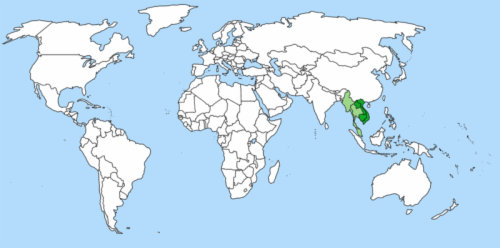

Indo-China is a region in South East Asia which was colonised by the French in the 19th and 20th Centuries. Initially it consisted of a federation of four areas, formed in 1887: Tonkin, Annam and Cochinchina (North, Central and South Vietnam respectively), and Cambodia. The country of Laos became included in 1893.

 Indo-Chinese Tiger - Credit: Ltshears
Our narrator’s mother is described as the daughter of a tea-planter; the French began to survey areas where tea was grown from the 1880s and soon established a number of plantations. The terrain and wildlife would have appeared suitably exotic when viewed from fin de siècle Paris; the mention of a man-eating tiger reinforces this. French control of Indo-China ended in 1954, with the signing of the Geneva Agreements.
A Conservatoire is a school or place of higher education which gives special attention to the teaching of music, preparing students for a professional career. The Conservatoire de Paris was established in 1795 and is still in existence, now offering instruction in dance and drama as well as music. Louis XIV of France had created The Royal School of Singing in 1669, which then went through various changes before evolving into the presently named institution after the French Revolution. By the 1940s, it was one of the most prestigious schools of its kind in the world – a status it still enjoys. Entrance to students is granted by exam, and on the general condition that some form of undergraduate diploma has been already achieved. Proficiency in the French language must also be demonstrated.
Despite a 300 year dominance by the Japanese Wokou, the most powerful pirates to exert control over East Asian waters have been Chinese, especially during the 17th – 18th Centuries. The junk ships they favoured could be very large and extremely well equipped with weapons, and the acquisition of them was a significant part of the pirates’ activity.
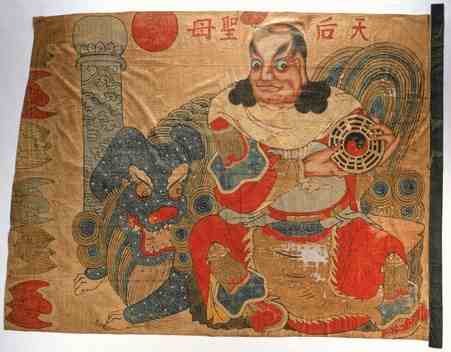
They also preyed on coastal villages, demanding money and other goods; a single fleet could consist of 10,000 men. As with most waves of piracy, their demise was brought about due to naval efforts; the Qing forces succeeded in halting most activity by the 1820s. There were however, some fleets still in existence until the 1870s, despite strong efforts from both the Royal and United States Navies to quash them.
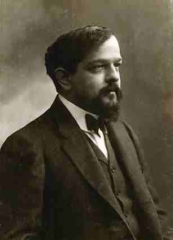
Claude-Achille Debussy (1862-1918) was a French composer. He became a student at the Conservatoire de Paris at the age of ten. A pianist, he enjoyed experimenting with his compositions, which raised eyebrows amongst his tutors and contemporaries. He was influenced by Wagner – an interesting fact, given our narrator’s evident love for ‘Tristan und Isolde’. His relationships with women were often rather dramatic; one lover bore a lodged bullet in her spine for the rest of her life following a failed suicide attempt after he abandoned her.
His ‘Preludes’ are two collections of twelve pieces for a solo pianist; the first was published in 1910, and the second, 1913. A Prelude is a short piece of music which is either created to stand alone, or act as a form of introduction to a longer piece of work – much like a Preface in a book. Debussy’s experimental style is demonstrated in these pieces; in ‘Brouillards', for example, the left hand of the pianist plays only the white keys, and the right hand, mainly black.
 Calla Lily - Credit: Fir0002
 Fire Opal - Credit: Didier Descouens
Overall – a very heady choice for a wedding ring.
Catherine de Medici (1519 – 1589) was the Italian born Queen Consort of France through her marriage to King Henry II. Upon his death, the crown passed first to their eldest son, Francis II, who quickly died. The next king, Charles IX, was only ten years old, meaning Catherine became regent on his behalf. Having had no political influence during her marriage, she now presided over a country about to collapse into civil war. When Charles died in 1574, Catherine continued to influence the next king, her son Henry III. The turmoil in the country was constant, much of it due to religious differences. Catherine’s decisions have been viewed as ruthless, such as in the case of the St. Bartholomew’s Day Massacre of 1572. Some have since viewed her with more circumspect, and as Henry IV was to later say, “Was she not compelled to play strange parts...in order to guard as she did, her sons...I am surprised that she never did worse.” It is always worth remembering that the actions of Kings are rarely judged as harshly as Queens...

Catherine died at the age of 69, probably from pleurisy. Having been reburied once, in 1793 her remains (and those of other monarchs) were thrown into a mass grave by a mob during the French Revolution. The Valois dynasty, which she had tried so hard to protect, fell eight months after she died, when Henry III was stabbed to death.
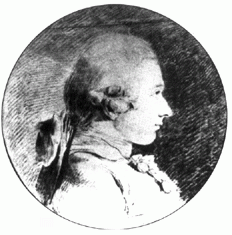
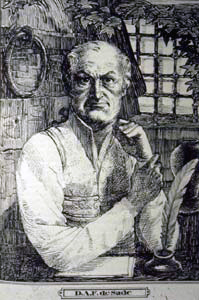
The year before Carter published 'The Bloody Chamber', she wrote 'The Sadeian Woman', a thesis which re-appraised the writings of the Marquis de Sade (1740-1814) from a feminist viewpoint. Many academics have discussed the links between the two texts, and it has often been argued that de Sade provided some influence on the character of the Marquis in this story. He was, inarguably, a fascinating figure. Perhaps best known for being the progenitor of the term 'sadism', he was also an aristocrat, revolutionary, sexual libertine, atheist, philosopher, writer and, according to Carter, "old bastard". His best known works include 'Justine', 'Juliette' and 'The 120 Days of Sodom'; much of his writing was published anonymously, due to its graphic pornography, violence and blasphemy. It is estimated, however, that he spent up to 32 years of his life in prison. His notoriety has overshadowed many other aspects of his life and character which show a far more multi-faceted man than the dissolute maniac he is often portrayed to be. During the French Revolution, for example, he openly supported the Republic and declared himself 'Citizen Sade'. Despite his aristocratic background, he succeeded in being elected to the National Convention and avoided the fate of so many others belonging to his class. Although he openly admired Marat, he became critical of Robespierre, and was horrified by the Reign of Terror (1793-4). De Sade was passionately opposed to the death penalty - unusual for his time - once writing, "The law which attempts a man's life [capital punishment] is impractical, unjust, inadmissible. It has never repressed crime--for a second crime is every day committed at the foot of the scaffold." In 1801, Napoleon Bonaparte personally ordered de Sade to be incarcerated, which he was, without trial. In 1803 he was declared insane and sent to the Charenton asylum, where he remained until his death at the age of 74. This late period of his life was portrayed in the 1995 play and 2000 film 'Quills'; while not historically accurate in many respects, the piece discusses issues of censorship, liberty, creativity and insanity around the roguish figure of the Marquis. The well known 1963 play 'Marat/Sade' by Peter Weiss is also set at the asylum during this time.
Quotes (1) by the Marquis de Sade
Quotes (2) by the Marquis de Sade
Extracts from 'The Sadeian Woman'
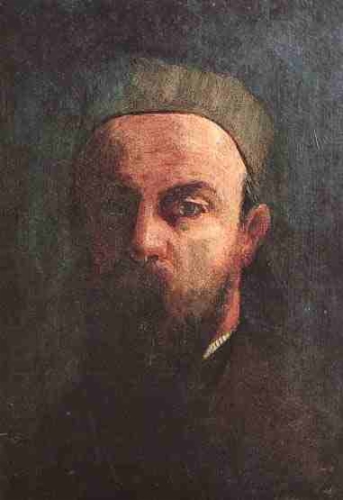
Odilon Redon (1840-1916) was a French artist. Known best as a Symbolist painter, he also worked in other media, such as etching and sculpture. He began drawing in early childhood, and began formal instruction at the age of fifteen. He served in the army during the Franco-Prussian War, after which he produced a dark series of works called his ‘noirs’. Extremely modern looking and often disturbing, they were created via charcoal and lithography. In his later career, he turned more towards colour, favouring both pastels and oils.
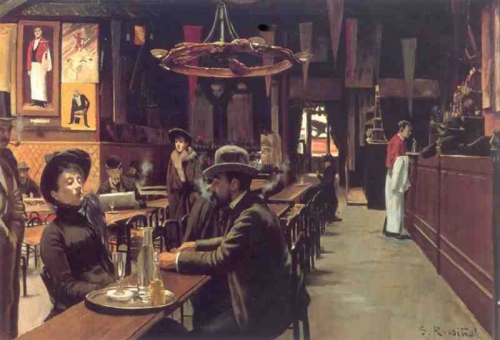
Montmartre is the hill in the North of Paris upon which the Basilica de Sacré Cœur is situated. From here, the views of the city are wonderful, and give one a chance to reflect upon the luminous bohemian history of the area. Is there anywhere else that can boast Pissarro, Van Gogh, Toulouse-Lautrec, Degas, Matisse, Renoir, Picasso and Modigliani as former residents? By the 1890s, the area was the artistic hub of Paris, with many of these artists – and associated models, lovers and hangers-on - living and working together in close quarters.
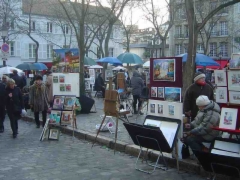
 Place du Tertre - Credit: David Monniaux
Montmartre is not what it used to be – the film Amélie (2001) painted an idealised, charming version of the place now – but it still retains a village-like atmosphere and there is plenty nearby to see: the Espace Dali (a permanent exhibition devoted to the great man), Le Moulin de la Galette (a lovely restaurant with a windmill on it) and the Moulin Rouge (they still do the can-can) which is situated in Pigalle (that’s the red light district, kids). There is also the Place du Tertre, where many artists gather in the morning, set up their easels and sketch portraits of tourists for a small fee; it is a sweet nod to Montmartre’s artistic past.
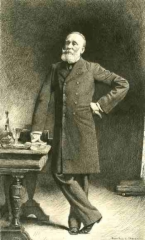
Pierre Puvis de Chavannes (1824 – 1898) was a French painter. In 1890 he re-founded and was President of the Société Nationale des Beaux-Arts (National Society of Fine Arts), a salon and annual
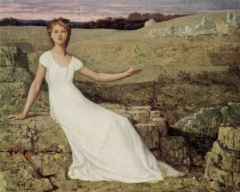
exhibition for prominent artists of the day (Auguste Rodin was Vice-President). De Chavannes' work is viewed as Symbolist in style, and he worked both on easels and in the form of murals. As a young man he studied under Eugène Delacroix; later, he was mentor to both Georges de Feure and Maurice Utrillo.
Absinthe is an anise flavoured, highly alcoholic spirit which was extremely popular in French bohemian circles from the 19th Century. It consequently had a strong cultural effect; many artists claimed it as a muse, due to its perceived psychoactive qualities. It featured in well known paintings by Degas, Manet and Picasso, and the writers Guy de Maupassant, Baudelaire, Rimbaud and Oscar Wilde were also avid drinkers. It was banned in most of Western Europe and the USA by 1914, due to the image it had gained of being addictive and harmful. The hallucinogenic effects have been disputed by modern scientists, although some have argued that the combination of herbs used in the making of the drink could cause some of the feelings described by consumers.
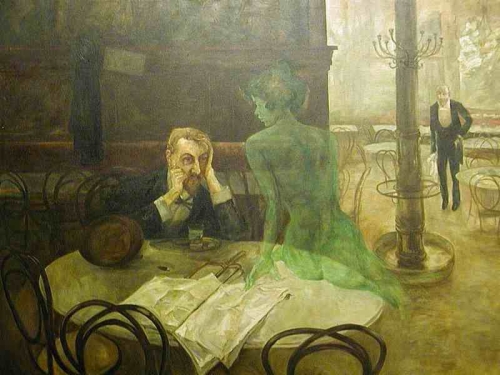
The ‘spirit’ believed to live in absinthe was known as ‘The Green Fairy’. She was cheekily portrayed by Kylie Minogue in the 2001 film ‘Moulin Rouge!’
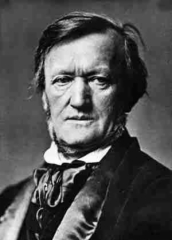
‘Tristan und Isolde’ is a German opera by Richard Wagner, which premiered in Munich in 1865. It is based on the Arthurian story ‘Tristan and Iseult’. The names of the characters were Germanised by Wagner, but the general synopsis is the same. Isolde, an Irish princess, and Tristan, a Cornish knight, fall in love while en route to Cornwall where she is promised in marriage to his uncle, King Marke. This happens by virtue of a love potion which they both drink; originally prepared by Isolde, she intended it to kill Tristan in revenge for a previous betrayal. The theme of love and death being mirrors of each other culminates in the opera’s final aria, the Liebestod. King Marke comes to know of the affair between the two, but ultimately seeks to unite them. The third and final act of the opera takes place in Brittany, the same place that our narrator travels to following her marriage.
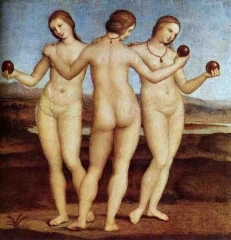
The Three Graces, or Charities, were a trio of beautiful goddesses in Greek mythology. Fathered by Zeus, their names were Aglaea (‘Beauty’), Euphrosyne (‘Joy’) and Thalia (‘Abundance’). Their mother was usually said to be Eurynome, a goddess of pastures and water meadows. Homer described them as being attendants of the goddess Aphrodite; they were also associated with nature, fertility, beauty and charm, and were said to inspire artistic abilities in mortals.
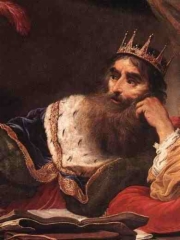
Croesus was the ruler of Lydia (part of modern Turkey) from 560 – 547 BC. He has always been synonymous with great wealth, in part because he is said to have been the first king to mint gold coins. He also profited from trade and various conquests. Herodotus wrote that his riches were such that he told departing guests to take as much gold as they could carry. His life and reign ended when he was defeated by the Persians, led by their king, Cyrus the Great.
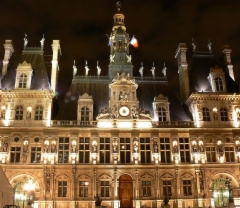 Hotel de Ville, at night. - Credit: [email protected]
You can take a virtual tour of this fascinating building by following this link.
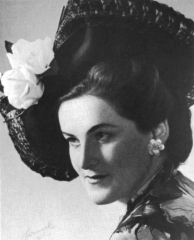
‘Liebestod’ is the title of the final aria, sung by the heroine, in the opera ‘Tristan und Isolde’. This was not Wagner intended: he originally called this piece ‘Verklaerung’, meaning ‘Transfiguration’, and thought of the prelude as the Liebestod. As she sings, Isolde describes her vision of the dead Tristan coming back to life in front of her, where his body lies.
It means ‘Love-Death’, a combination of the German words ‘Liebe’ and ‘Tod’ respectively. It describes the lovers’ consummation in death, to a degree that could never be achieved in life. Undeniably erotic, it has also become a literary term; it can be seen in ‘Romeo and Juliet’, or in ‘Wuthering Heights’ when the ghosts of Cathy and Heathcliff are seen together by a little boy.
The debate surrounding the ‘definitive’ version of the aria is popular among opera lovers. The Swedish soprano Birgit Nilsson was much admired for her ‘effortless’ version.
Listen to Birgit Nilsson's 'Liebestod'.
Baz Luhrmann chose the haunting final bars of the aria as the soundtrack to his 1996 ‘Romeo + Juliet’, when the bodies of the lovers are taken out of the church. That version was by the great Leontyne Price, not a singer ordinarily known for her interpretation of Wagner. It is, nonetheless, a spine chilling performace, and it can be heard below in the clip on the left. The more recent performance on the right is sung the German soprano Waltraud Meier, who has played many Wagnerian roles during her career.
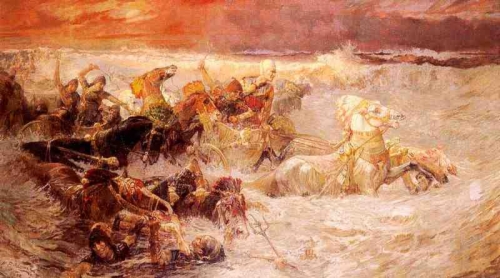
The Parting of the Red Sea is a familiar story within literary consciousness. It is told in the Book of Exodus in the Bible, and describes how the sea divides into two after Moses holds his staff over the water. This allows the people he is leading, the Israelites, to escape, and their pursuers, the Egyptians, are drowned. The Hebrew words for ‘Red Sea’ are ‘Yam Suph’; some scholars have proposed that as this can be translated instead as ‘Sea of Reeds’, there may actually have been no body of water involved in the event the tale describes.
This is a phrase taken from Psalm 23 in the King James version of the Bible, and describes means being given more than enough for ones needs. It is quite often used, in a variety of contexts, to describe having ‘plenty’ of something. The exact verse is addressed by the speaker to God and is:
Thou preparest a table before me in the presence of mine enemies: thou anointest my head with oil; my cup runneth over.
This psalm is also the basis of the well know hymn ‘The Lord is my Shepherd’.
A ‘trousseau’ comes from an old French word relating to ‘trousse’, meaning ‘bundle’. It describes the possessions a young woman would collect for her marriage, such as clothing, jewellery, lingerie, table linen and quilts. She would store these in a hope chest; often a girl would receive these items over a period of time as gifts from her family, sometimes hand made by female relatives. This was still fairly common practice until the 1950s, although occasionally women today begin assembling specially chosen items to see them through their wedding and honeymoon.
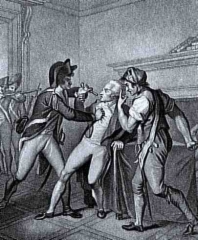
The Reign of Terror was a period of violence which began soon after the onset of the French Revolution. It lasted from the 5th of September, 1793 until the 27th of July, 1794, and is well known for the mass executions which took place, mainly of the nobility, at the hands of the Jacobins. Most of these killings were performed publicly with the guillotine; victims included Queen Marie Antoinette, the Duke of Orleans, Princess Élisabeth of France, and the former mistress of Louis XV, Madame du Barry. The well known chemist, Antoine Lavoisier, who discovered both oxygen and hydrogen, was also killed. The King, Louis XVI, had already been executed on the 21st of January 1793. Others, such as the Girondists, were killed for their political beliefs, and many more who simply fell under suspicion and never received trials. The Terror was largely pushed by Maximilien Robespierre, a powerful and influential member of the Committee of Public Safety (the de facto government at the time). He ultimately fell from grace and was himself guillotined on the 28th of July, 1794.
The Executive Directory was the French political regime which commenced on the 2nd November 1795, and is considered to be another phase of the French Revolution. Its structure was to have five Directors holding executive power to ensure the smooth running of the state, due to the demise of the National Convention. It was not a popular regime; many people were troubled by the bloodshed and violence of the Terror, which led the Directory to rule harshly – even disregarding the constitution – to try and maintain a tenuous grip on power. They were overthrown in a coup d'état on the 9th November 1799 by Napoleon Bonaparte.
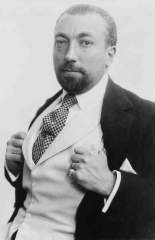
Paul Poiret (1879-1944) was a hugely influential French fashion designer. He began his career in 1896, working for the older designer Jacques Doucet. His own House was established seven years later; he was one of the first designers to adopt the marketing techniques we now know as ‘branding’. Indeed, he branched out into the manufacture of perfume and home styling, as so many of our contemporary fashion houses do today. He was also involved in what can be considered as the first fashion photography shoot, depicting the clothes artistically in their own context. He served during World War
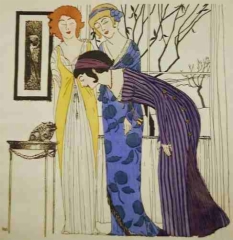 Poiret Designs, 1908 - Credit: La Couturière Parisienne
One, appropriately in uniform production, but by 1919 his company was on the verge on bankruptcy. His famous ‘kimono’ style was not fashionable anymore, and though his flair for design had always been modern and visionary, he was no natural tailor, and the workmanship of the clothes was often rather poor. It is significant though, that his emphasis on ‘draping’ the body with clothes helped liberate women from the corsets they had been wearing for centuries.
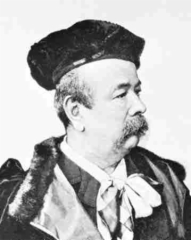
Before starting his own company, Poiret had spent some time designing for the House of Worth. Established in Paris in the 1850s by Charles Frederick Worth, an Englishman, it similarly anticipated the ‘pret-a-porter’ evolution of the fashion industry. The house was the first to introduce branded labels sewn into the clothing; they also became known for luxury fragrances, especially ‘Je Reviens’ (1932). Charles Worth’s early apprenticeships with textile merchants gave him an excellent awareness of fabrics, as well as a love of luxury. His burgeoning career in France was well timed; with Napoleon III restoring a sense of royalty, and the end of the long years of the Revolution, there was a renewed desire for extravagance and
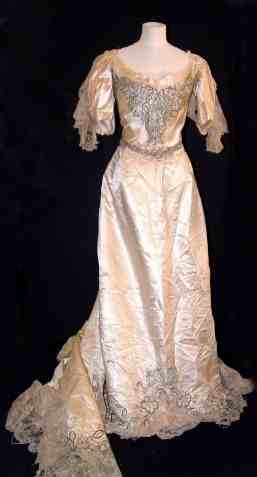 Dress by Worth - Credit: Edmund Patrick
opulence. Accordingly, Worth used expensive materials and adornments in his designs, and often incorporated elements of historical dress. He also emphasised a good fit on his clients’ figures; many wealthy women would travel from afar to order an entire wardrobe of new clothes from the House of Worth. The designer also dressed stage actresses and singers of the day, including the great Sarah Bernhardt and Lillie Langtrey, as well as Napoleon's wife, Eugénie.
The House of Worth has been resurrected to great success very recently with Martin McCarthy as head designer.
Russian leather has long been considered one of the most luxurious leathers in the world. It is usually made from calfskin, though the hides of adult cows and goats are also sometimes used. Its distinctive smell is caused by the birch oil which is impregnated into the leather after it has dried. Its reddish colour is achieved through dying the skin with sandalwood, and sometimes cochineal.
As a fluent German speaker, it is highly possible that Angela Carter was familiar with the work of Heinrich Heine, who in 1842 wrote, “The future smells of Russian leather, of blood, of godlessness and of much whipping”. This warning certainly evokes Milord’s evil tendencies, as well as his wealth; throughout the story, our narrator refers to the scent of the leather almost as a signature of her husband.
Cuir de Russie is a well known fragrance by Coco Chanel, and was originally created in 1927.
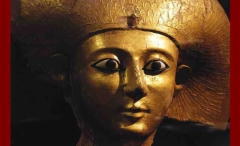 Queen Sitdjehuti's Sarcophagus - Credit: Hans Ollermann
A favourite brand of Sir Winston Churchill, these cigars were first manufactured from 1875, rising to international prominence in 1903 when acquired by the firm Rodríguez, Argüelles y Cia in Havana, Cuba. This was down to the marketing efforts of the company owner, Jose ‘Pepin’ Rodriguez Fernandez, who made himself well known in the USA and cosmopolitan Europe. He introduced the ‘personalisation’ of the cigars, where wealthy clients could have their names wrapped around the body of the cigar on a loop of foil. The brand still exists today, although in two forms; only one branch is still based in Havana. Due to US laws prohibiting the import of Cuban products, the other branch is situated in the Dominican Republic.

Given the tone of the story, this description may make the reader think of the Passing Bell. It was traditionally rung out from a church to announce the imminent or actual death of a local person, to encourage the community to pray for their ‘passing’ soul.
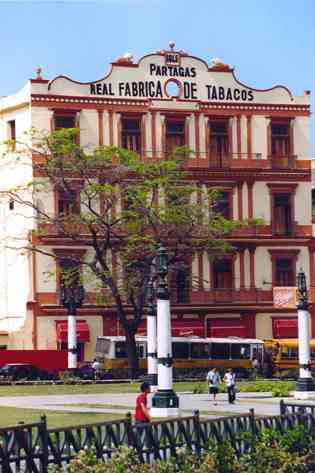 Havana Cigar Factory - Credit: HVhBxL
Havana is the capital city of Cuba, as well as a port and major centre of commerce. It is also a byword for the world renowned Cuban cigars, considered by many to be the finest on the market. Production is controlled by the government, largely via the company ‘Cubatabaco’, and the tobacco leaves used are cultivated throughout the country. There are various techniques involved in the hand rolling of cigars, and the workers who perform this task – known as ‘torcedores’ – are usually considered to be the gold standard in the industry. Since 1994, a second company called Habanos S.A. has overseen all aspects involving export and distribution abroad of the cigars. This company also introduced the annual ‘Habanos Cigar Festival’ in 1997, which includes tours of factories and plantations, tastings, lectures and seminars, and master classes in the art of rolling a cigar.
The smoking of cigars has traditionally been perceived as a masculine act, with connotations of wealth and gravitas. In keeping with our story, perhaps Rudyard Kipling is worth quoting; he once said, “A woman is only a woman, but a good cigar is a smoke”.
 Stoat with winter coat. - Credit: 4028mdk09
These are both furs, once highly prized and expensive forms of clothing, though now often frowned upon. Ermine comes from the stoat, and was usually used for trimmings, such as cuffs and collars, on a larger garment. The animal’s winter coat was especially coveted, a beautiful pure white. Ermine can be seen in portraits of the royalty and nobility of Europe; heraldic ermine is decorated with black spots.
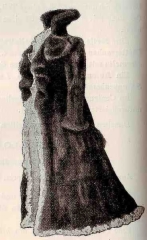
Much ermine was sourced from Russia, as was sable. A species of marten, sable was prized for its dark, sometimes black colour, and the fact that it keeps its smoothness whichever direction it is stroked. Such fur is still used in expensive clothing, though hunting restrictions mean that the pelts usually come from farmed animals.
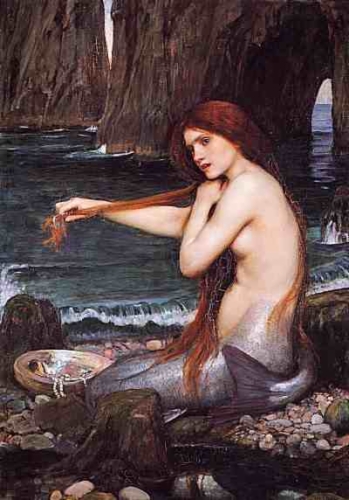
Although mermaids have featured in various world mythologies since 1000BC, the most familiar example in Western culture is Hans Christian Andersen’s ‘The Little Mermaid’ (1836). At the age of fifteen, the mermaid in the tale is permitted by her father, the Sea King, to venture up above the surface of the ocean. When she does so, she rescues a young human Prince from drowning, and falls in love with him. Before deciding to visit the evil Sea Witch and gain legs to walk on land, the mermaid spends a melancholic period of time longing to see the Prince again. This is depicted in the famous statue situated at Copenhagen harbour.
In other tales, mermaids had both malevolent and benevolent characteristics, sometimes saving humans and sometimes drowning them. In British (often Cornish) folk tales, mermaids were usually perceived as bad omens for seafarers, and in some cases swam in fresh water. Over the centuries, people have claimed to see these alluring creatures; in 2009 a town in Israel offered a $1,000,000 reward to anyone who could prove the existence of a mermaid that various people had claimed to have spotted in the area.
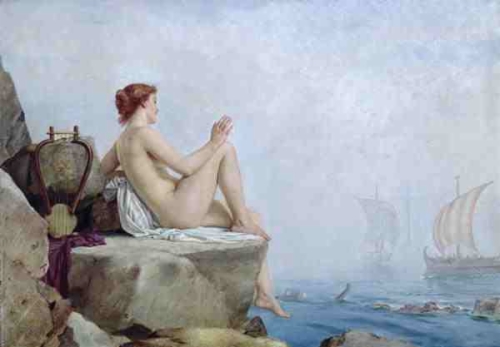
The Sirens were a group of half-bird, half-human women in Ancient Greek mythology. They were highly dangerous, using their beautiful music to lure sailors to death on the rocks they stood on. They famously appear in Homer’s ‘Odyssey’, when Odysseus asks his crew to tie him to the ship’s mast so he might hear the Siren’s song and survive. In the ‘Argonautica’, Jason’s voyage is rescued from harm when Orpheus plays his own lyre simultaneously, muting the deadly music coming from the rocks nearby. In most myths, it was said that the Sirens would perish once someone had heard their music and survived. Over time, there has been some overlapping in depictions of the Sirens and that of mermaids; for example, the French word for mermaid is ‘sirène’.
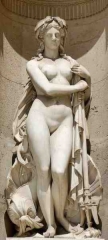 Amphitrite by Devaulx, 1866 - Credit: Jastrow
The Queen of the Sea was Amphitrite, wife of Poseidon in Greek mythology.
She was said to be the mother of a variety of sea creatures, including dolphins and the merman Sea-God Triton. Her own parentage is disputed: one source declares her a daughter of Nereus, making her a Nereid; another places her among the Oceanids, with Oceanus as her father. She has often been referred to in poetry as a female personification of the sea. Both naval ships and asteroids have been named in her honour.
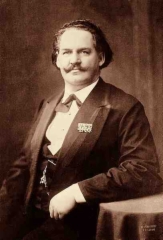
Carl Bechstein (1826 – 1900) was a leading designer and manufacturer of pianofortes, at one point holding the Royal Warrant of Queen Victoria. His company, C. Bechstein Pianofortefabrik, was established in 1853 in Berlin, with two more factories in the city following by 1897. The innovations and experimentation being used by many contemporary composers meant that pianos now needed to be robust enough to accommodate these pieces. Successes such as the Royal Warrant made the instruments especially popular in Britain, with the London branch of the company opening in 1885. Many of the other royal houses of Europe also appointed Bechstein as their official piano supplier. The company is still very successful today, and modern musicians such as Elton John, Freddie Mercury and Paul McCartney have all favoured Bechstein pianos at one time or another.
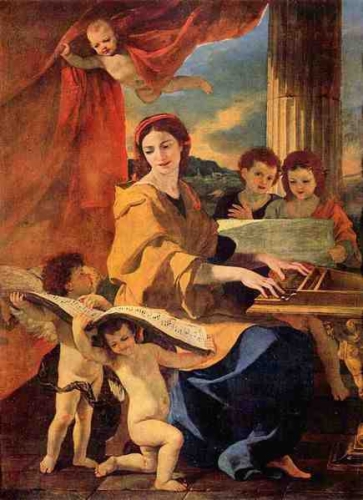
Saint Cecilia is a martyred Saint who is reported to have lived in the 2nd Century AD. The most popular account of her life holds that she was killed in Sicily during the reign of Marcus Aurelius; she is meant to have been executed for her Christian faith alongside her husband Valerian, and his brother Tiburtius. Famous elements of her story include her instructions that her home be kept as a church, as she left to go and face her death. Attempts by officials to execute Cecilia all subsequently failed; they attempted to decapitate her three times. She was severely wounded, and survived for another three days before passing away. She was said to have died singing praises to God, which is why she was later made the patron saint of musicians. Henry Purcell composed a beautiful tribute to her in 1697, in honour of her feast day on November 22nd. Here is a version of it, along with some images of Cecilia; she has been a popular muse for centuries.
Flemish Primitives were the paintings completed by artists of the then-called Low Countries (the Netherlands, Belgium, Luxembourg, and parts of Germany and France) between the 15th and 16th Centuries. Influences from both the passing Medieval period and the burgeoning Renaissance can be seen in most of the works.
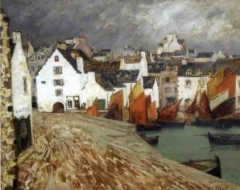
Breton - or Breizh - is the local language of Brittany. Celtic in origin, it is closely related to Cornish, and came to Northern France via the emigration of Britons during the 5th -10th Centuries. The French government acknowledge it as part of the country’s heritage, but not as an official national language. This has led to a considerable amount of campaigning, as it is still proudly spoken in the region; in some areas of Brittany, road signs and street names will be written in both French and Breton. This allows tourists to note the additional similarity of the language to Welsh – the Breton anthem, ‘Bro Gozh ma Zadoù’ is based on the Welsh song ‘Land of My Fathers’. There are also a number of non-government funded Breton language schools which provide an immersive environment for young learners, and some Breton-only newspapers and magazines. Some words would be familiar to English speakers, because of our shared roots; for example ‘skol’, meaning ‘school’. As a term, ‘Breton’ is also used to describe the culture and people of the area, who are classed as a distinctive ethnic group and one of the Six Celtic Nations.
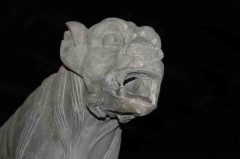 Gargoyle - Credit: Taxiarchos228
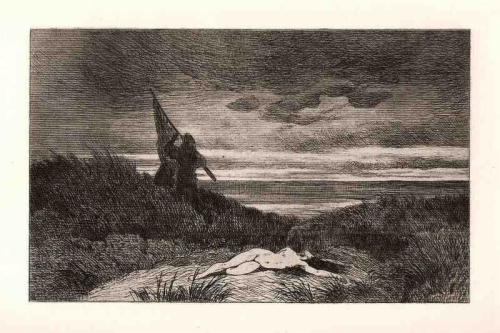
Félicien Rops (1833 – 1898) was a Belgian artist and printmaker, as well as a founding member of the Société Libre des Beaux-Arts in Brussels. He began his career whilst still a student, drawing satirical caricatures of politicians and public figures which were published in a student newspaper. He later formed a deeply significant friendship with Charles Baudelaire, and created a frontispiece for the poet’s ‘Les Épaves’. Rops is considered to be a Symbolist.

The London street of Savile Row in Mayfair is the location of what many consider to be the finest tailors in the world. Helped into existence by the Regency dandyism and patronage of Beau Brummel, the French Revolution across the Channel also had its influence; the fashion for opulent, aristocratic clothing ceased to be en vogue. Sharper, bespoke tailoring instead became popular, mirroring the emergence of prêt-a-porter in the designs of Poiret and Worth. Many Savile Row tailors throughout the 19th Century gained Royal Warrants, both from Britain and abroad, which continues to this day. Although influenced by fashion, the aesthetic of Savile Row tailoring has never changed: quality, craftsmanship and elegance seem sewn into garments alongside each thread.
 Steinway & Sons Piano - Credit: Alton
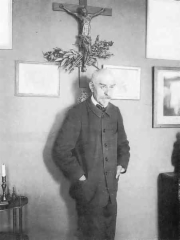
Joris-Karl Huysmans (1848-1907) was a French writer, famous for the novel ‘À rebours’ as well as ‘Là-Bas’. His work was considered to be quite decadent and perverse, with great attention given to sensual description and themes such as homosexuality and Satanism being given attention. Originally interested in the Naturalist style of writing, Huysmans later became more aligned to the Symbolists; he was also inspired by his return to the Catholic church in later life. He was an admirer of two of the painters referred to in this story, namely Odilon Redon and Gustave Moreau, as well as the burgeoning art movement of Impressionism.
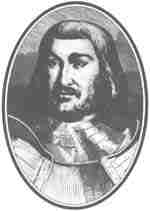
‘Là-Bas’ was published in 1891, and soon became banned in some places. The disillusioned protagonist, Durtal, researches the practice of Satanism in contemporary France, finding that it is still very much in existence. He comes to this discovery through first reading about the life of the 15th Century murderer, Gilles de Rais, who is himself a highly significant figure for our purposes; he has long been thought to be a model for the fairy tale ‘Bluebeard’, which in turn is a clear influence of ‘The Bloody Chamber’. De Rais was a Breton knight and Baron, and the convicted killer of up to 200 children. The natures of the crimes were particularly sadistic, and included extreme acts of paedophilia. His alleged interest in the occult is the link to his appearance in Huysmans’ story.


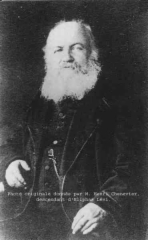
The heavily bearded Eliphas Levi (1810-1875) was a French occult writer and self-defined magician, and a profound influence on Aleister Crowley. In some contrast to the other books our narrator picks up here, Levi was not a conjurer of evil or practitioner of black arts; much of his work was concerned with the pursuit of wisdom and divine love. His beliefs about the power of human intention are reflected in some contemporary notions about ‘cosmic ordering’, as he once wrote, “Nothing can resist the will of man when he knows what is true and wills what is good”. The texts referred to here by Carter are all real books; despite some frankly wise advice in ‘The Key of Mysteries’ (“Judge not; speak hardly at all; love and act”) it can be appreciated that the murky and sensuous world of occultism would interest Milord and earn a place in his library.
This title, along with ‘Immolation of the Wives of the Sultan’, is invented by Carter. They do however recall the well known (in some circles) 1828 erotic novel ‘The Lustful Turk, or Lascivious Scenes from a Harem’. This oh-so charming story had quite an influence on later pornographic material, in that its naive, virginal heroine is raped and then decides she enjoys it. Its setting abroad, in what was then considered ‘Oriental’, is also very much of its time, as it projects deviant and violent behaviour coming from foreigners. A later story with similar themes was ‘A Night in a Moorish Harem’, (1900), which tells the tale of a shipwrecked sailor facing the bewildering luck of finding himself stranded in a harem with nine women. Putting modern sensibilities to one side, these books can be unintentionally amusing; here is an excerpt where our sailor describes a particularly tiring evening when “If the intrigue had been pursued it would have ruined her reputation and my health”.
Eulalie is an unusual name. Carter would have been familar with it from this poem by Poe, and this fairy tale.
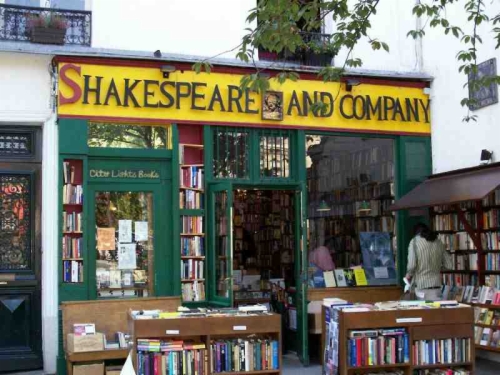 Shakespeare and Company - Credit: celebrategreatness
The Left Bank of Paris is an area of the city situated south of the river Seine, with the 5th, 6th and 7th arrondissements lying on its shore. It was specifically Montparnasse, in the 6th and 14th arrondissements, which acquired an association with literary activity, thanks to the patronage of writers, intellectuals and artists in the early part of the 20th Century. Similarly to Montmartre, rents were cheap and a sense of bohemian community welcomed like-minded souls from far and wide. Picasso, Matisse and Degas were sometime residents, as were the many American writers of the ‘lost generation’, such as Ernest Hemingway, F. Scott Fitzgerald, Gertrude Stein and Ezra Pound. Henry Miller spent possibly some of the most crucial years of his life in the area. One of the most famous bookshops in the world, Shakespeare and Company, is situated in the Left Bank. Established by the great Sylvia Beach in 1919, it continues to thrive today (though not in its original site) thanks to the equally legendary George Whitman. The bookshop allows impecunious devotees of literature to sleepover for free on one condition: they must read a book a day for the duration of their visit.
This is a quote from a poem by Baudelaire, called 'Les Bijoux' ('The Jewels'). It draws attention to the way the Marquis has fetishistic attraction to the paraphernalia linked to his murderous desires. We are told earlier in the story that the red necklace belonged to an aristocratic survivor of the Terror, and in an example of ‘guillotine humour’ wore it around her neck to demonstrate her avoidance of execution. Fetishism is often argued to be linked to the trauma of the mother withdrawing from the early closeness with her child in his early years. Freudians would no doubt agree that the Marquis’ singular treatment of women demonstrates ‘issues’ with Mama...
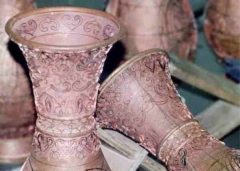 Chinese Cloisonne - Credit: Leonard G.
 Muscat Grapes - Credit: KetaiBlogger
Sorbet is prepared by freezing a mixture of water and fruit, sometimes with a generous dash of alcohol. Asti Spumante is ideal for this, as it is a sweet, sparkling dessert wine. It is Italian in origin, and a popular variety is sold under the Martini brand. The quality of the wine has been said to decline in recent years due to EU regulations, but it would certainly have been at its best at the time our story is set.
Here is a recipe for muscat grape sorbet.
This is the seventh piece to appear in the second book of Debussy’s Préludes, so was written during 1912-1913. Its title means, ‘The terrace of spectators by the light of the moon’, and was said to have been inspired by a newspaper article the composer read about the celebrations when King George V was crowned Emperor of India. It can be heard here.
Symbolism was an artistic and poetic style which evolved in the late 19th Century, both as a progression from the darker aspects of Romanticism and a rejection of Realism. Broadly speaking, it was concerned with the idea that absolute truth could not be conveyed directly; it had to be implied through the use of familiar symbols which would provoke certain associations in the viewer or reader. This parallels the budding interest in psychoanalysis which was also gaining a foothold. Many of the well known Symbolist painters are French, namely Odilon Redon, Puvis de Chavannes, Paul Gauguin and Gustave Moreau. The style was also popular in Russia, as seen in the work of Mikhail Aleksandrovich Vrubel and Léon Bakst. The well known painters Gustav Kilmt (Austrian) and Edvard Munch (Norwegian) were also Symbolists. The style became a great influence on the later art movements of Surrealism and Abstract Expressionism.
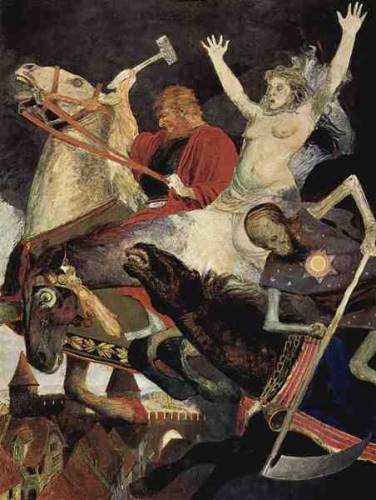
Poets that were Symbolists include Baudelaire, Mallarmé and Verlaine.
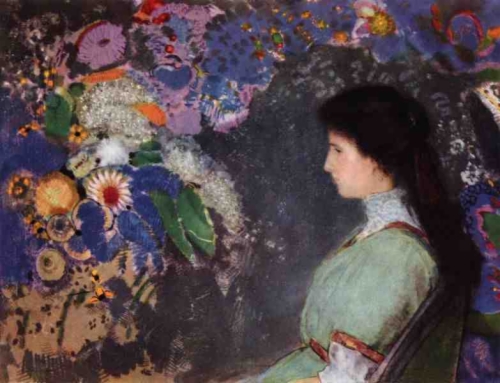
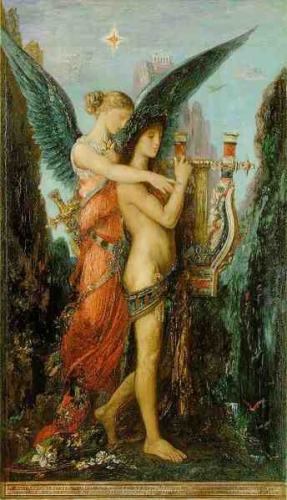
Gustave Moreau (1826-1898) was a Parisian Symbolist artist. He was very prolific but generally lived quite a secluded life; though in 1892 he did become a popular professor at the École des Beaux-Arts. He had himself been taught by the artist Chassériau, who was a profound influence on him. One of his own pupils was Matisse; Moreau was known for encouraging his students to develop their own distinctive styles rather than adhering to preconceived ideas about art.
The painting referred to here is an invention, but it does tally with the themes that interested him. Much of his output depicted figures from the Classical myths, such as Orpheus, Oedipus, Prometheus and Europa. He also painted biblical scenes, such as the Pietà and Salome. These are all characteristic of Symbolism, as their familiarity to the viewer combined with the difference in style would provoke interesting mental and emotional responses.
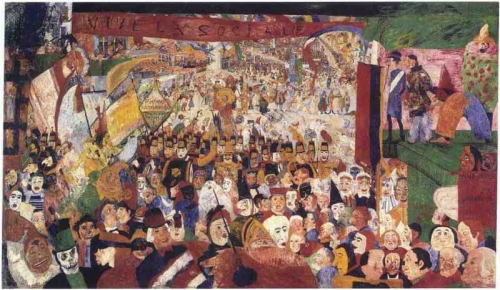
Another invented title, but again, feasible. Baron James Sidney Edouard Ensor (1860-1949) was born in Belgium to an English father and Flemish mother. He was both innovative and socially engaged – much of his work has satirical tones – and occasionally controversial. Elements of Carnival and the grotesque are also seen in his work; particularly fascinating when combined the religious elements he often explored. His parents had been shopkeepers by the seaside and sold toys, masks and souvenirs; all of these appear in his work. He also depicted skeletons, and dressed real ones in his studio to ‘model’ for him. Somewhat chilling considering what is in the Marquis’ dungeon…
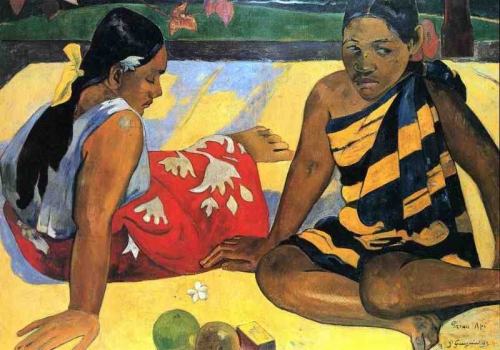
Eugène Henri Paul Gauguin (1848-1903) was a French artist and occasional writer. He worked in painting, woodcuts, sculpture and ceramics, and is considered to have worked in the styles of Symbolism, Post-Impressionism, Primitivism and Exoticism. He had Peruvian heritage and spent some of his early childhood there, which undoubtedly had an influence on the themes which would later later preoccupy him. Already a married father of five when he took the decision to pursue his art full time, he had begun his adult life working as a stockbroker. During his career, he befriended and painted alongside other artists such as Pissaro, Cézanne, Charles Laval and Meijer de Haan. He famously shared a house with Van Gogh for nine weeks in Arles in 1888; although a fertile time for both artists, a disagreement led to Van Gogh's famous 'ear cutting' incident. Soon after this, Gauguin began his search for a tropical paradise to live and work in, free from the constraints of 'civilisation'; he spent time in Martinique, Panama, Tahiti and the Marquesas Islands trying to achieve this. His artistic evolution and earlier adherence to Symbolism led him to become fascinated by the so-called primitive art of Africa and Asia, which profoundly influenced his own creative output. His life in exotic locations has stimulated much debate; it is known that he had sexual relations with very young women, and married a thirteen year old. At the same time, he painted Polynesian women as strong, beautiful and powerful, and often advocated for the indiginous people against the colonial authorities and the Catholic church. He died of syphilis at the age of 54 and is buried on the island of Atuona in the Marquesas.
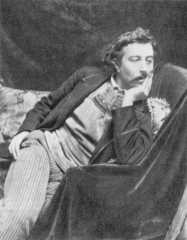
Gauguin's legacy was vast. His influence is obvious in a great deal of Picasso's work, even leading the Spaniard to be nicknamed 'Gauguin's son' on occasion. For this reason, he can be seen as one of the instigators of Cubism.
More on 'The Yellow House' shared by Gauguin and Van Gogh in Arles.
A perspective on Gauiguin's depiction of Polynesian women.
More on Gauguin's influence on Picasso.
A feminist perspective on Gauguin.
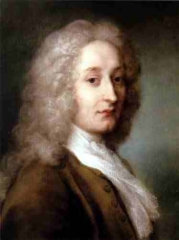
Jean-Antoine Watteau (1684-1721) was a French artist, and was instrumental in the evolution of Baroque into Rococo. As a young man, he was an assistant to Claude Gillot. The older artist designed theatre sets, and passed on this pasion - including ballet - to Watteau. He also used the Commedia dell'arte for inspiration, which can be seen in his portrait of Pierrot. The many scenes of rural idyll that he painted were known as 'fête galante', and showed well dressed, wealthy groups of people enjoying themselves in the countryside.
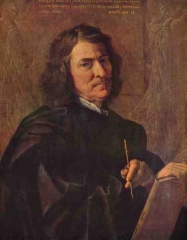
Nicolas Poussin (1594-1665) was also a French painter, and was born in Normandy. He painted in the Classical style, as opposed to Baroque, which dominated at the time. At the court of Louis XIII of France he served as First Painter to the king, but spent the greater portion of his life working in Rome. The Renaissance influences in his work are clear, and influenced his choice of subject; he painted many biblical themes such as 'The Destruction of Jerusalem' and 'Adoration of the Golden Calf'. Classical figures including Cacus and Phocion were also favoured by him.
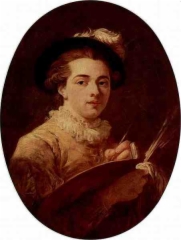
Jean-Honoré Fragonard (1732-1806) was a prolific French painter, born in the Alpes-Maritimes. He worked in a lush, sumptuous Rococo style, and was greatly influenced by his travels in Italy. He attained a good number of private clients in France, many of them from the court of Louis XV, including the king himself. He was also commissioned by Madame du Barry. The French Revolution put paid to this; luckily Fragonard was able to leave Paris just before the Reign of Terror hit its peak. His son, Alexandre-Évariste, also became a well known artist.
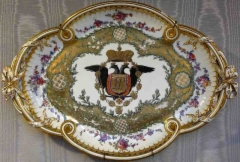 Sevres Porcelain - Paul Petrovich - 1773 - Credit: Siren-Com
Sèvres is a town southwest of Paris which is famous for its fine porcelain. The factory is known as the Manufacture nationale de Sèvres, and though it was initially based at Vincennes, the porcelain has been produced since 1740. Sèvres was chosen for its proximity to to Madame de Pompadour's Bellevue Palace; she and the king, Louis XV, were supporters of the enterprise from the start. His palace at Versailles was also nearby. He was obliged to provide heavy financial assistance, as he was keen for the pieces produced to be as fine as they could be. Later, Napoleon enjoyed obtaining his porcelain from Sèvres; as time went on, the emerging middle class also began to purchase, enabling the factory to become financially stable.
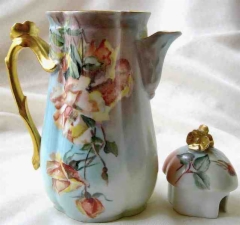 Limoges Chocolate Pot - Credit: PetitPoulailler
 Vicuna - Credit: Magalhães
Fittingly, there is an Inca folktale about the vicuña. The animal was said to be the reincarnation of a beautiful young girl who was pursued by an aged, ugly king. She told him she would only allow his advances if he gave her a coat made of gold...and so he did. The animal was sacred to the Incas, and it was forbidden to kill them.
Whether you are exceptionally wealthy, or just fancy a jaw dropping experience, here are some retailers selling vicuña garments. US$2,000 for a shawl anyone?
There was once a nice scandel involving a vicuña coat, which you can read about here.
 Wall Street Sign - Credit: RMajouji
Wall Street runs from Broadway to South Street on the East River in New York. It is the financial district of the City and the home of the Stock Exchange. As a term, it has transcended its specific location to encompass all financial commerce taking place in the area. It has held this status since the early 19th Century, when the opening of the Erie Canal created new trade routes to elsewhere in the country. The Civil War continued to help the area grow, as the North emerged victorious. At this stage, banks began centralising their operations there, and the age of magnates such as John D. Rockefeller and J.P. Morgan came into being. At the time of our story's setting, Wall Street was at its strongest and most prosperous. This age also saw the birth of the skyscraper. All this razzmatazz ended abruptly in 1929 with the collapse of the Stock Exchange, which led to the Great Depression. The 1980s saw perhaps the greatest resurgence in the brash power of the district; as the film 'Wall Street' (1987) proclaimed: Greed is Good.
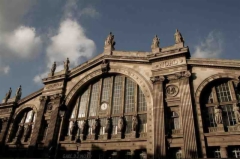 Gare du Nord - Credit: Jan Ramroth
Gare du Nord, meaning simply 'North Station', is one of the largest terminus railway stations in Paris, and the busiest in Europe. As part of the SNCF network, it carries passengers throughout France and other European countries including the UK, Germany and Belgium. It opened in 1846, and had to be expanded fourteen years later.
The destination cities, both domestic and international, are famously represented by 23 female statues on the crown and facade of the building. These include Amsterdam, Berlin, Cologne, London and Frankfurt.
 Jinn Stones at Petra - Credit: Berthold Werner
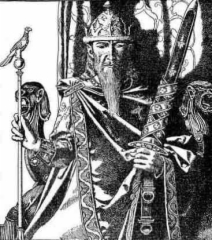
Here we have another link to Tristan and Iseult: King Mark of Cornwall was Iseult's husband and the uncle of Tristan. Arthurian legend tells that he ruled in the 6th Century. In most versions of the story he forgives the lovers for their affair, though he is occasionally shown as less benevolent, even resorting to rape and murder in his fury. He also has connections to Wales, which is logical given the shared roots we have seen between Wales, Cornwall and Brittany. He was said to have lived as Castle Dove near Fowey in Cornwall, the ruins of which can be seen today.
The Romance of Tristan and Iseult by Bédier, Joseph, 1864-1938
 Laos - Credit: Thomas Drissner
Laos is a country in Southeast Asia, landlocked by China, Burma, Vietnam, Thailand and Cambodia. Like other countries in the region, it became subject to French administration in the 19th Century. It did not gain full independence until 1954. Its monarchy ended a short time later due to civil war; the country remains a single party Communist state.

Laos has long been one of the largest producers of opium, although this has gradually reduced over the last twenty years due to crop reduction and other initiatives. Opium is a narcotic obtained from the latex of the opium poppy. There is evidence of its use as far back at 4200BC; some properties of the plant are also used for codeine. The levels of morphine also mean it is used in the manufacture of heroin. Opium was traditionally used for recreational purposes, which also applied to Europe after travel and trade routes gradually opened up. There are many cultural examples of opium use in Western culture, perhaps most famously in Thomas de Quincey's 'Confessions of an English Opium Eater' (1822). The drug came to have a dark glamour, with associations of dissolute behaviour, creativity and licentiousness.
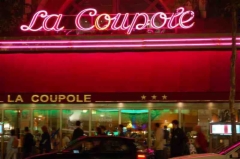 La Coupole - Credit: Tomoyoshi NOGUCHI
If this is the famous Parisian brasserie - and it does appear to be - then we have something of an anachronism, as it did not open until 1927. Situated in our beloved Montparnasse, it was frequented over the years by such rogues and luminaries as Man Ray, Picasso, Jean Cocteau, Brassaï, Marc Chagall, Edith Piaf, Josephine Baker, Simone de Beauvoir and Jean-Paul Sartre. The place still thrives today, boasting a fine lamb curry, an elegant dance hall and an illustrious visitors book. Well, well worth a visit, mes amis.
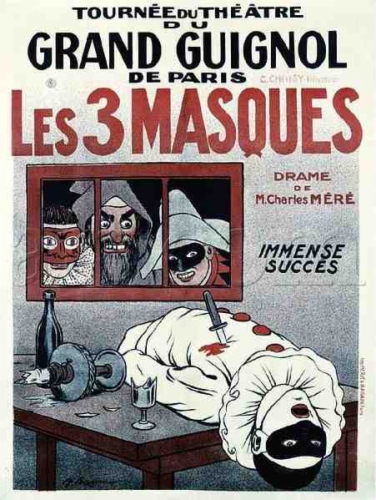
The theatre closed in 1962. Its gradual decline in attendance has been blamed on the emotional and psychological effects of World War Two. As its last director, Charles Nonon said, "We could never equal Buchenwald. Before the war, everyone felt that what was happening onstage was impossible. Now we know that these things, and worse, are possible in reality".
Grand Guignol Online is a brilliant resource if you'd like to find out more about this extraordinary place. Very few of the plays have been translated into English, but there is 'At the Telephone', by André de Lorde; it's worth a quick read, and is not gory!
The little clip below is worth a look, but towards the end, it is rather grim...
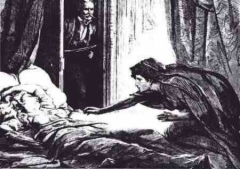
Vampire aficionados will associate the name Carmilla with the novella of the same name, written by Joseph Sheridan Le Fanu in 1872. Carmilla is a beautiful female vampire who preys on young women; the story greatly influenced Bram Stoker when he wrote 'Dracula'. The fact that she chooses female victims began the tradition of lesbian vampires, famously and amusingly epitomised by the marvellous Ingrid Pitt in Hammer Horror's 'The Vampire Lovers' (1970), and as recently as 2009 in the woeful 'Lesbian Vampire Killers'. From a less exploitative point of view, the use of homosexuality in genre fiction such as this allowed certain themes to be explored long before it became permitted in mainstream literary works.
Tapestries began to be made in Europe during medieval times, both for decoration and protection against cold drafts. They are woven on a vertical loom; gold, silver or silk thread were often used to denote wealth. When kings travelled on a progress or visit abroad, they would often roll up tapestries and take them along with their entourage. Germany and Switzerland were the first European countries to specialise in their manufacture, with the Netherlands and France also developing expertise. Ultimately, Flemish tapestries were deemed the finest due to their particularly exquisite craftsmanship and use of colour. Popular themes for tapestries included royal and noble crests and emblems, Biblical and Classical icons, and hunting scenes. Venetian tapestries bore the rich influence of the Renaissance, though artisans often hailed from the other countries in Europe known for their skills.
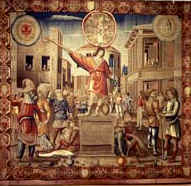
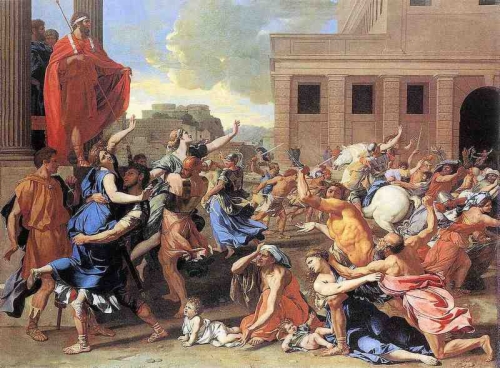
The Rape of the Sabine Women is an event described in Classical legend, when the first generation of Roman men 'acquired' wives from the nearby Sabine tribe. Although the word 'rape' is said to mean 'abduction' in this sense, the notion of forced marriage surely by its very nature denotes sexual violation. Livy disputed this; when he described the event he said that the women were guaranteed civic and property rights. Outrage at the abduction nonetheless resulted in war against the Romans and their leader, Romulus. When the Sabines gained a foothold into Rome during battle it was their women who intervened to stop the bloodshed and force reconciliation. Following this, one nation was formed. Many artists throughout the centuries have found inspiration in these brave muses, including the painters Rubens, Poussin and Picasso, and the sculptor Giambologna.