
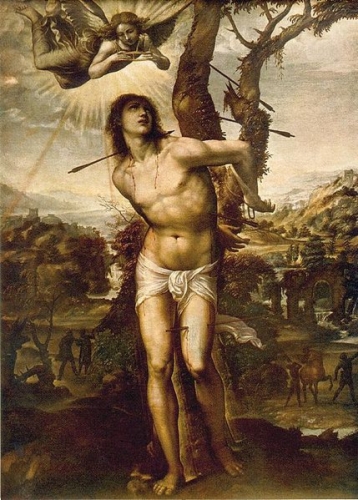
The Brotherhood’s school is named for Saint Sebastian (c 265- c288), a martyr and Christian saint venerated in the Roman Catholic Church. According to Acts of the Saints (Acta Sanctorum), Sebastian was from the Roman province of Gallia Narbonesis and schooled in Milan. Unaware of Sebastian’s Christianity, Emperor Diocletian appointed him captain of the Praetorian Guard.
Sebastian restored the faith of two imprisoned Christian brothers sentenced to death. He also converted their parents and cured a mute woman, the return of her voice converting a further 78 people.
For what he considered betrayal, Diocletian ordered Sebastian be bound to a stake, shot by archers and left for dead. Sebastian didn’t die however, and the widow of Castulus, Irene of Rome, nursed him back to health. Later, Sebastian indulged in a public vocal tirade against Diocletian, who had him beaten to death.
A revered figure in art, Sebastian’s first known depiction was in a mosaic dating from around 527 in the Basilica of Sant'Apollinare Nuovo in Ravenna, Italy. From the Renaissance onward, images of him proliferated, usually as a scantily-clad youth pierced with a multitude of slender arrows. Depictions of him from this time onward bear a distinctly homoerotic subtext.
The supposed remains of St Sebastian are housed in the Basilica Apostolorum, Rome.
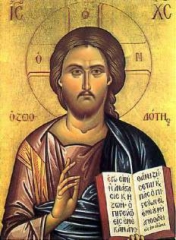
 Jesus Christ
By the fourth century, it was the main religion of the Roman Empire. It spread to the rest of Europe in the Middle Ages, with minority pockets of worshippers in the Middle East, Northern Africa and parts of India. Following the Age of Exploration, beginning in the 15th century, Christianity spread to the Americas and Australasia.
As a result of its global growth, it had an almost unparalleled influence on the development of Western civilisation. But since the Enlightenment and the dawn of the Modern Era, secularism and rationality have challenged Christianity’s orthodoxy and adherence to the religion in Europe dropped off. However, its position in North America and in many parts of Africa remains strong. At the dawn of the 21st century, worldwide followers stand at about 2.2 billion.

 Conch - Credit: Brian0918
Conch is the name given to a variety of sea snails or their shells. True conchs are marine gastropod molluscs. The shells are often used as musical wind instruments (AKA shell trumpets). When a hole is cut into the top of the spire, it can be used as a trumpet. Also known as ‘conques’, they are popular instruments in India and Tibet, the South Pacific and the Caribbean.
The most famous conch in literature is to be found in Lord of the Flies by William Golding, another novel about a group of boys who go murderously off the rails.
An echoplexed Indian conch was used by Jerry Goldsmith in his score for Ridley Scott’s Alien in 1979. Scott thought the sound so eerie and otherworldly, he requested Goldsmith use it throughout the film. Listen on Spotify

 Eminem performing 2009 - Credit: GlenJamn
Eminem (born Marshall Mathers, Detroit, 1972) is an American rapper, record producer and actor. Emerging in 1999 with his second album, The Slim Shady LP, he rapidly gained a worldwide mainstream following despite his subject matter being at times openly homophobic and misogynistic. He has since recorded five more albums. His latest, Recovery, was released this year. He has sold more than 80 million albums worldwide. His notoriety may well have been his greatest asset in propelling him to stardom.
Coldplay and Keane are British mainstream indie-pop bands. Coldplay formed in London in 1997 while its members were studying at University College London. They have recorded four albums and always give ten per cent of their profits to charity.

 Keane at Alexandra Palace, London - Credit: Preamble
Both Coldplay and Keane have been derided as ‘landfill indie’. Coined by Word magazine, the term refers to bands that stay faithful to conventional chord and rhythm structures and verse-big chorus-verse song structures. In short, they are perceived to lack imagination or original ideas. This criticism notwithstanding, both bands remain hugely popular and successful.
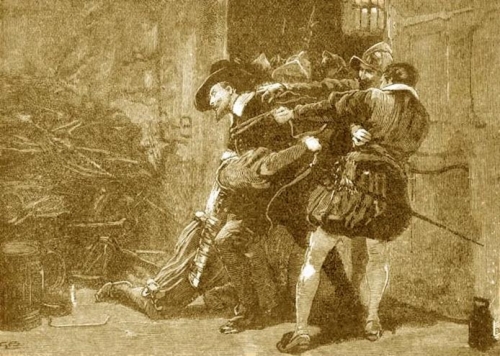
Guy Fawkes (AKA Guido Fawkes, 1570-1606) was a key figure in the failed Gunpowder Plot of 1605.
Born and educated in York, Fawkes was a Catholic convert who fought in the Eighty Years’ War on the Catholic Spanish side against Protestant Dutch rebels. It was during this time he adopted the pseudonym ‘Guido’.
On the continent he met Thomas Wintour, with whom he returned to England. Wintour introduced Fawkes to a band of provincial Catholics bent on assassinating King James I and restoring a Catholic monarch to the throne. The plotters secured a space beneath the House of Lords where on 5 November 1605, after an anonymous tip-off, Fawkes was discovered with a stockpile of explosives and arrested.
To his captors, Fawkes openly expressed regret at the plot’s failure. Curiously, this gained him the admiration of the King who declared Fawkes to be possessed of “a Roman resolution”. Still, he was tortured into divulging the names of his co-conspirators and the following January, leapt free from the gallows where he was to be hanged. He jumped, broke his neck and died.
In England, the Gunpowder Plot is commemorated annually on 5 November by the burning of Fawkes’s effigy on bonfires.

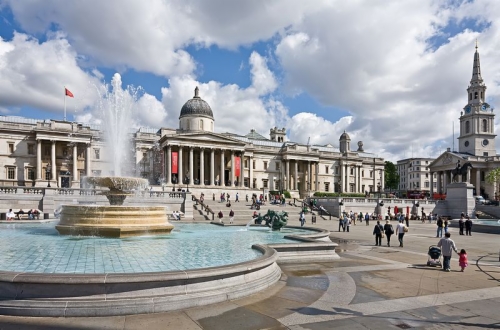 Trafalgar Square today - Credit: Diliff
In the 1820s the Prince Regent requested John Nash clear the area as part of the Charing Cross Improvement Scheme, but Sir Charles Barry was responsible for the architectural style, completed in 1845. The Square’s centrepiece is Nelson’s Column: from a base of four lions rises a 151-foot granite column surmounted by a statue of Admiral Horatio Nelson.
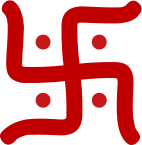
The swastika is a symbol that takes its name from the Sanskrit ‘svastika’ meaning a lucky or promising object. It has an ancient history, with the first known examples appearing in Neolithic scripts. In Indian culture both past and contemporary, it exists as a geometrical motif and religious symbol, central to Eastern and Dharmic religions including Hinduism, Buddhism and Jainism. Jeremiah adopts the symbol after this fashion for the Brotherhood.
 Siouxsie and swastika 1976
However, it is now generally seen as a symbol of the most noxious ideology, gaining its greatest fame as the adopted symbol of the Nazi Party in Germany, where it is now outlawed. Since World War II it has been adopted by many Neo-Nazi groups and was even worn as a ‘fashion accessory’ around 1975-76, by the early instigators of punk rock who claimed to have no Nazi sympathies, but rather wore the symbol for its shock value alone. Singer Siouxsie Sioux has latterly claimed, somewhat unsatisfactorily for many, that she had worn the swastika in the spirit of “high camp - not death camp”.

Nazism was the ideology behind the National Socialist Party (Nationalsozialismus) which ruled Germany from 1933 to 1945.
Led by Adolf Hitler (1889-1945) the party rose to prominence in a heavily demoralised Germany left reeling from defeat in World War I, shamed and angry over the 1919 Versailles Treaty (which insisted that Germany assume sole responsibility for the war) and the blights of the worldwide Great Depression. The party was elected in 1933.
The Nazis claimed to offer a “third way” to the people of Germany – neither capitalism nor communism, the dominant ideological poles of the time. They promised a nationalist form of socialism that would provide for their people, who they believed were the summit of the Aryan race (to them, the Master Race). This particular strand of fascism held that the biggest threat to said race and Germany’s future was the Jews, who they considered to be a parasites bent on self preservation through alignment with Enlightenment values like liberalism, democracy, parliamentary politics, capitalism, industrialisation, Marxism and trade unionism. Unsurprisingly, all such things were anathema to the Nazi party.
 Gates to Auschwitz Concentration Camp - Credit: Tulio Bertorini
It is one of humanity’s greatest failures.
