
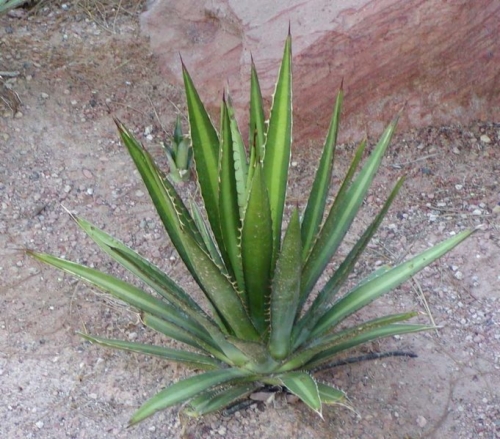
 Agave lechuguilla - Credit: Stan Shebs
Lechuguilla is an agave native to the Chihuahuan, Coahuilan and Sonoran Deserts.
The plants are known colloquially as Shin-daggers after the very sharp, hard points on its rigid leaves, which are capable of piercing through clothing and even leather.

A burro is a type of small donkey, especially one used as a pack animal.
Although the word burro is often used interchangeably in the western United States with the word donkey, it usually refers to the smaller donkey descended from Mexican stock.

 Burros carrying fodder for horses (Peru, 1923) - Credit: J. Francis Macbride
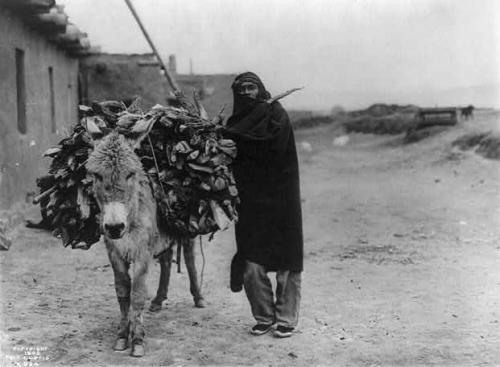 Zuni man and loaded burro - Credit: Edward S. Curtis (Library of Congress)
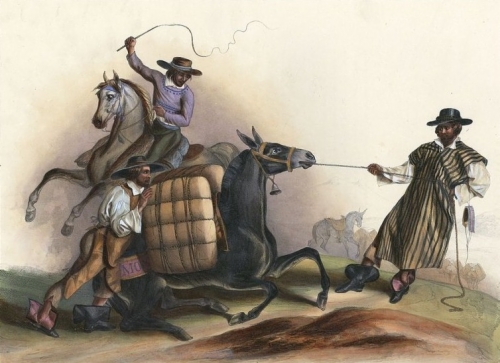 Mexican arrieros depicted in a lithograph by Frédéric Lehnert (1836) - Credit: Carl Nebel
Similar to a wrangler or a muleteer, arrieros work transporting merchandise or luggage with the help of pack animals.
The profession emerged in South and Central America during the 18th century and continues to the present time in areas where the absence of good roads prohibits the use of wheeled vehicles.
A traditional alternative to rolling papers among the poor of Mexico. The fibres of the cornhusk are first removed so they can be used to secure the rolled cigarette. They are then dipped in water, dried and cut to size, usually in a rectangular shape.
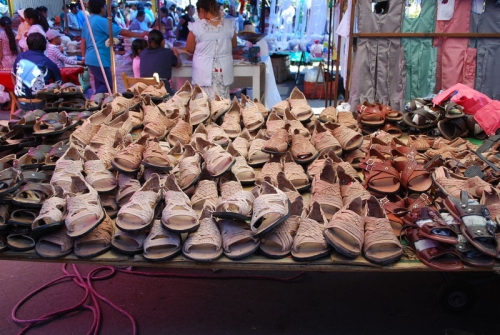
 Huaraches for sale in Oaxaca, Mexico - Credit: Alejandro Linares Garcia
Huaraches are a type of Mexican sandal, traditionally made from hand-woven leather.
The origins are unknown, but there are clear links in their design with similar Pre-Columbian sandals depicted in ancient codices.
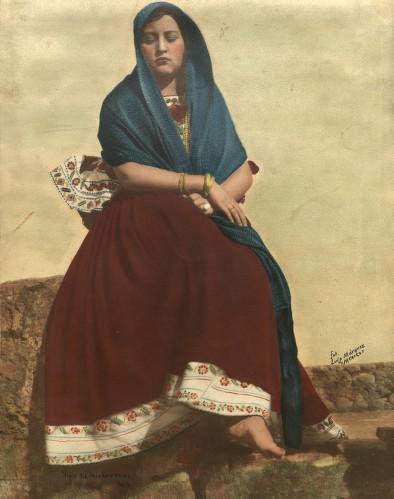 Seated woman in blue rebozo shawl and red skirt (1937), by Luis Marquez - Credit: Courtesy of Special Collections, University of Houston Libraries
A rebozo is a type of scarf or shawl worn by Mexican woman, made variously of cotton, wool, silk, or articela.
It is unknown whether the indigenous people of Mexico used them before the arrival of the Spanish, but the word does not appear in the Spanish language until the year 1562.
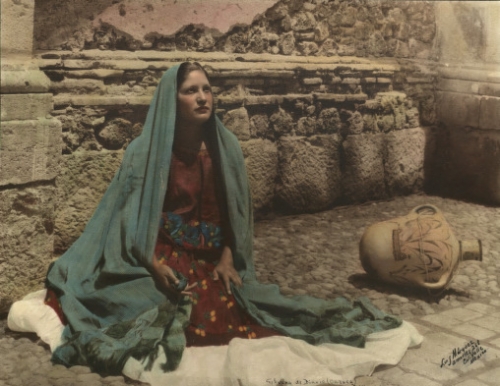 Seated woman with teal rebozo shawl on her head (1937), by Luis Marquez - Credit: Courtesy of Special Collections, University of Houston Libraries
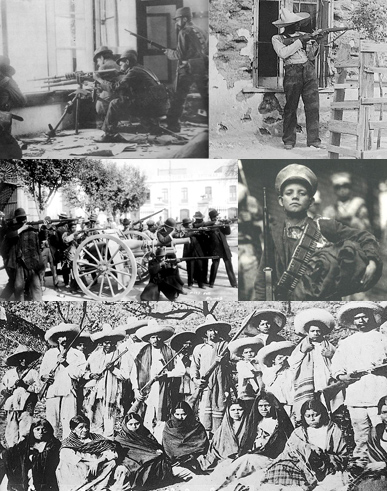 Collage of images from the Mexican Revolution - Credit: Tatehuari
Far from a simple struggle between oppression and liberty, the Mexican Revolution was a 10-year period of shifting allegiances between a spectrum of leaders in which successive attempts to create stable government were wrecked by new outbreaks of devastating fighting.
A brief outline of the Mexican Revolution can be found in the embedded video and more detail in the setting (‘McCarthy’s Borderlands’).
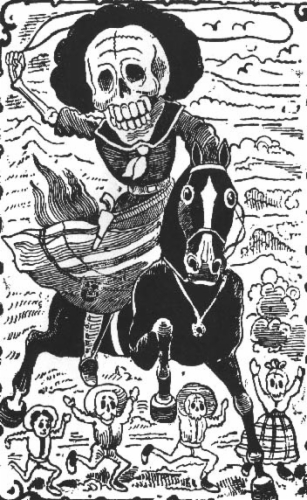 Calavera de la Adelita - Credit: Jose Guadalupe Posada
A revolutionary, she said. Soldadera.
Although the term soldadera (meaning camp follower) originally referred to the wives, children and relatives of the soldiers in the Mexican army (soldaderas were allowed to follow the army to discourage desertion), it has now become synonymous with the women who took up arms and fought alongside the men during the Mexican Revolution.
Soldaderas like Dolores Jiménez y Muro, Margarita Neri, and Hermila Galindo are today considered heroines of Mexican history
You can read more about the soldaderas and the role women played during the Mexican Revolution here.
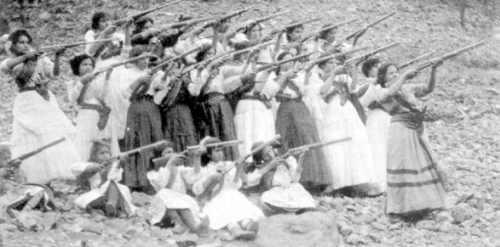 Soldaderas pose with their weapons during the Mexican Revolution - Credit: Wikipedia
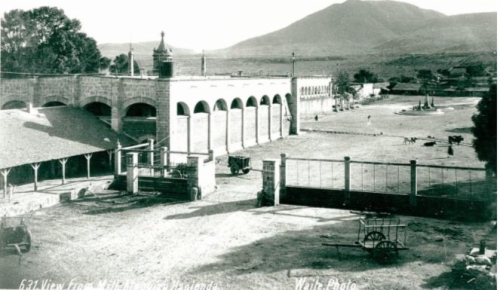 Hacienda de Atequiza, Mexico (1905) - Credit: Charles B. Waite
 Hacienda of Xcanchakan (1843) - Credit: Frederick Catherwood
A hacendado was the owner or manager of a hacienda, Spanish for an estate.
Depending on the region, the haciendas could be plantations, mines, mills, distilleries or business factories. Many haciendas combined a number of these activities. The haciendas in the northern regions of Mexico were usually agriculture and livestock based. Hacienda society was structured with the hacendado and his small management circle at the top, and below them the vaqueros (cowboys), peones, and campesinos (peasants). The peones worked land that belonged to the hacendado. The campesinos worked small holdings, and owed a portion to the hacendado.
In Mexico the haciendas were abolished by law in 1917, but remnants of the system continued to affect the country well in to the mid-20th century, as can be seen in the novel.
 Old Mennonite couple, by Marjory Collins (1942) - Credit: Library of Congress
The Mennonites are a group of Christian Anabaptist denomination, originating from the Dutch and German-speaking regions of central Europe.
In 1922 Mexican President Álvaro Obregón invited Mennonites, fleeing from perceived persecution in Manitoba, Canada, to settle in the northern regions of the country. He offered them cheap land and freedom from taxation for 100 years as long as the Mennonites agreed to supply cheese (now called Queso menonita) for northern Mexico.
There are 80,000 Mennonites presently living in Mexico, particularly in the states of Chihuauhua and Durango.
The Mennonites' historical dedication to pacifism makes their appearance something of an anomaly in the blood-drenched lands of McCarthy's borderlands.

The Sierra de la Cabellera is a mountain range in Sonora, Mexico.
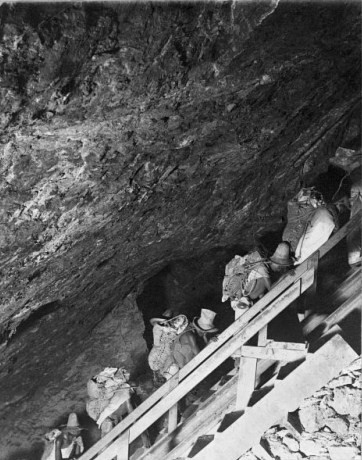 Labourers carrying silver ore within Mexican mine (c. 1890-1923) - Credit: Frank and Frances Carpenter Collection
The principal industry of the state of Chihuauhua is mining – its mineral resources including gold, silver, copper, mercury, lead and coal. The silver mines of Chihuahua are among the richest in Mexico, and include the famous mining districts of Batopilas, Chihuahuilla, Cosihuiriachic, Jesus Maria, Parral, and Santa Eulalia or Chihuahua el Viejo.
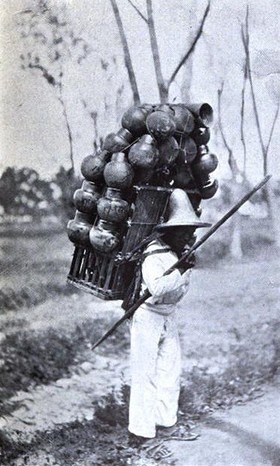
 Peon with tumpline - Credit: Jorge Elías
 Mexican man carrying blind woman with tumpline - Credit: Jorge Elías
A tumpline is a strap attached at both ends to a backpack or other luggage and used to carry the object by placing the strap over the top of the head, thereby alleviating pressure on the carrier’s shoulders and hips. Indigenous peoples of South and Central America have used the tumpline for thousands of years to transport heavy loads across uneven terrain.
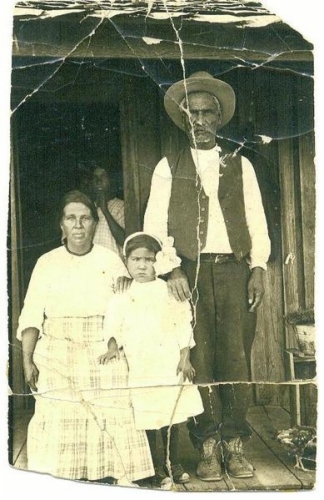 Texan Yaquis (Lubbock, Texas, 1913) - Credit: Iz ramirez
The reference here is specifically to the succession of brutalities inflicted upon the Yaqui by the Mexican authorities.
The Yaqui had enjoyed relative autonomy under the Spanish, but the situation changed following the Mexican War of Independence when the newly formed Mexican government declared the Yaqui to be full citizens of the country and thus liable for taxation. Yaqui rebellions followed which were violently suppressed by the government forces, including a massacre in 1868 where 150 Yaqui were burned to death by the army inside a church.
Following a failed effort to win independence led by the Yaqui leader Cajemé in the 1880s, the Yaqui people were subjected to further brutality under the regime of Porfirio Díaz. Tens of thousands of Yaqui were transferred from Sonora to the Yucatán peninsula, where some were sold into slavery. Many Yaqui fled to the United States, especially Arizona, to escape this persecution.
McCarthy is describing a group of night-blooming plants commonly known as moonflowers. The petals of the flower open in the evening so they can be pollinated by night-flying moths. Like most moth-pollinated flowers, the moonflower has white petals, which attract the insects.
 Moonflower (Ipomoea alba) - Credit: Hans Stieglitz
 M1911 A1 pistol - Credit: M62
Chambered with a .45 ACP cartridge, the M1911 handgun was formally adopted by the U.S. Army on March 29, 1911 (hence, its name).
It was the standard-issue firearm for the U.S. armed forces until 1985.
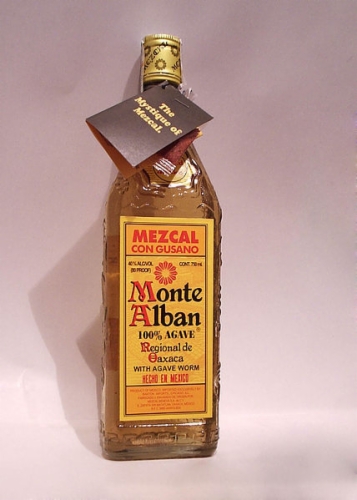 Mescal - Credit: Ilia "Yadra" Harlamov
Mescal, or mezcal, is an alcoholic drink distilled from the maguey plant (a form of agave) native to Mexico.
Most mescal is produced in Oaxaca, where it is made from the heart of the maguey, called the piña, much the same way it was 200 years ago.
It has a strong smoky flavour compared to tequila - itself a type of mescal made from the blue agave.
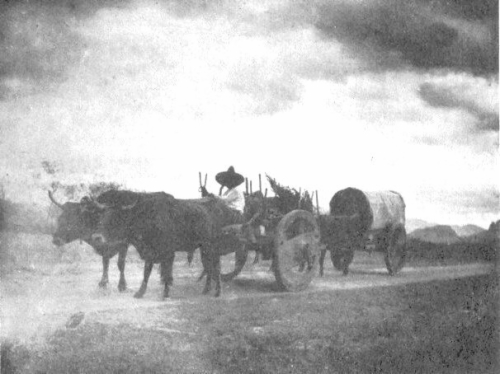 Carreta - Credit: Frederick Starr
A carreta is a wooden ox-cart commonly found in rural parts of Mexico.
Contrary to popular belief, the concept of the wheel was known to the peoples of Mesoamerica before the arrival of the Spanish, even if its use was never developed in the same way as in Eurasia and northern Africa.
Many theories have been put forward as to why – the most convincing being the lack of draft animals and the unsuitability of Pre-Columbian roads for wheeled transport.
You can read more on this subject and view photographs of Pre-Columbian wheeled-figurines here.