


 A map showing the location of Pylos and other important cities - Credit: Dbachmann/Wikimedia Commons
Pylos was a city located on the west coast of the Peloponnese (southern Greece), ruled by Nestor, an old and much respected Greek hero. Though too old to fight, Nestor played his part in the Trojan War as an advisor and a leader.
 Sandy Pylos - Credit: Koppi2/Wikimedia Commons

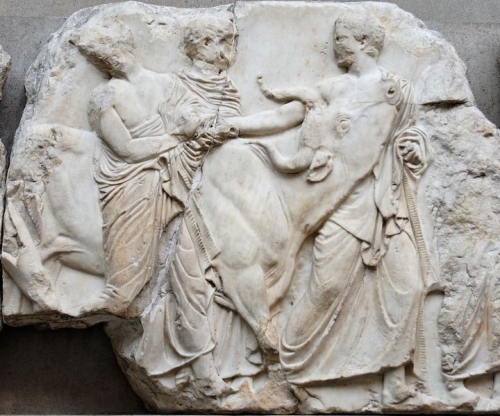
 Leading bulls to sacrifice, south frieze of the Parthenon, ca.447–33 BC - Credit: Marie-Lan Nguyen/Wikimedia Commons
An important aspect of ancient Greek cult involved appeasing and honouring the gods with sacrifice and libations. A large variety of animals, foods and liquids were used for these rites. Specific animals were sometimes associated with certain gods, such as black or white bulls for Poseidon.

 Sacrifice scene, red-figure cup interior, ca.510–500 BC - Credit: Marie-Lan Nguyen/Wikimedia Commons
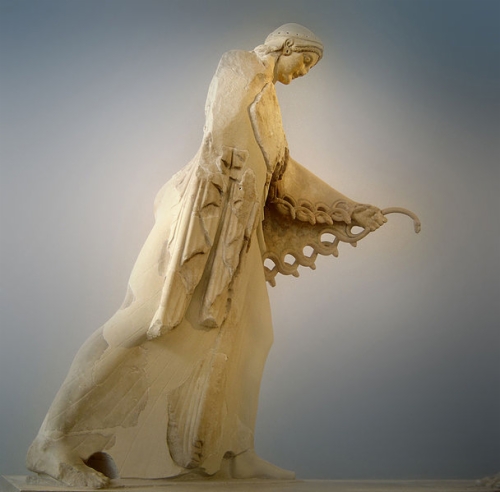
 Athene shakes her aegis, statue of Athena, from the Gigantomachy group, c.525 BC - Credit: Ricardo André Frant/Wikimedia Commons
 Artemis pouring a libation, white-ground lekythos, ca.460–50 BC - Credit: Marie-Lan Nguyen/Wikimedia Commons
 Two-handled cup, with an elaborate two-handled kantharos (drinking-cup) between two eyes. Black-figure, ca.530 BC - Credit: Marie-Lan Nguyen/Wikimedia Commons
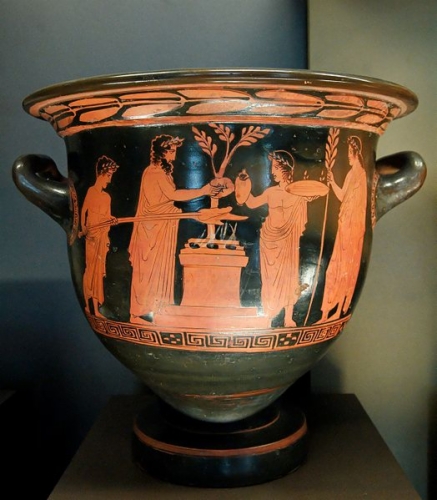 Sacrifice scene. Red-figure krater, ca.430–20 BC - Credit: Marie-Lan Nguyen/Wikimedia Commons
Once the sacrificial animal had been killed, the meat was cooked. The thigh bones, wrapped in fat with some of the flesh, were burnt as an offering, the smoke rising up to the gods. Sometimes omens might be read in the smoke or in the entrails of the animal. Finally, the remaining meat was roasted on spits and skewers before being served up as a feast.
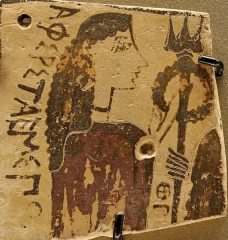 Amphitrite, Corinthian plaque, 575–550 BC - Credit: Marie-Lan Nguyen/Wikimedia Commons
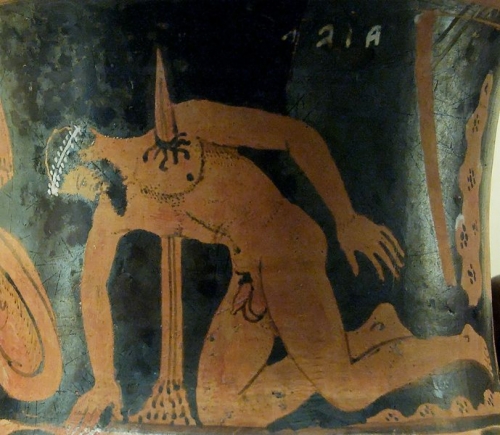 The suicide of Ajax the Great. Red-figure calyx-krater, ca.400–350 BC - Credit: Marie-Lan Nguyen/Wikimedia Commons
The two sons of Atreus referred to here are the Greek leaders and brothers Agamemnon and Menelaus. It was Menelaus’ wife, Helen, whom Paris took to Troy, beginning the war. Menelaus was king of Sparta, and Agamemnon of Argos (or Mycenae, depending on different traditions). Both were very powerful men amongst the Greeks.
The Myrmidons were the tribe of skilled warriors commanded by Achilles.
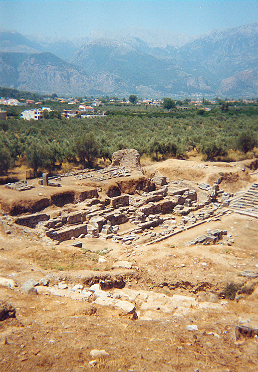 Ruins at the ancient site of Sparta - Credit: Thomas Ihle/Wikimedia Commons
 A strigil and oil flasks (aryballoi) - Credit: Xocolatl/Wikimedia Commons
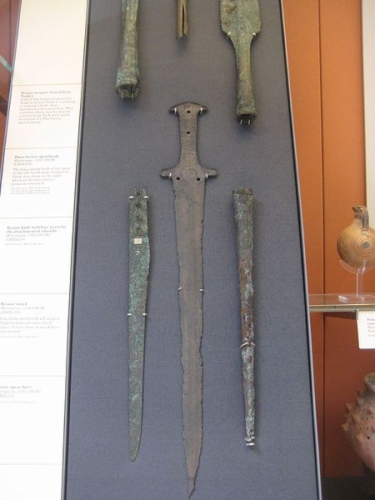 Bronze swords, one of the traditional gifts that hospitality dictates - Credit: Claire H/Wikimedia Commons
Hospitality was an important concern for the ancient Greeks, and one of the main themes of The Odyssey. Not only was it customary for rich men, princes and kings to entertain each other and exchange gifts, it was considered the duty of every Greek to offer hospitality to a stranger in need. For travellers and sea-faring people, being able to rely on the kindness of strangers was particularly important. Hospitality was also considered vital on a religious level; not only did mortals have to worry that a stranger may be a god in disguise testing them, all suppliants also came under the protection of Zeus. Homer uses both guest-friendship and gods in disguise as recurring themes in his poem, a moral lesson for his audience about how Greeks ought to behave to each other. In The Odyssey, it is this hospitality, or lack of it, that marks the difference between civilisation and barbarism.
In Homeric society, heroes are usually kings or princes (basileis), and always rich, important members of the elite. Their status is instantly evident to anyone, as they are taller, stronger and more handsome than normal men. Although there is probably some truth here (those who can afford better food, weapons and training will naturally be bigger and better fighters), this is probably more to do with a need to elevate the social elite, to justify their position over other men, as well as the tribute they would receive from their subjects. Epic poetry such as The Odyssey was most likely composed for the elite, with their interests in mind, to be performed at banquets like those described in this poem.
There were two important Thebes in the ancient world, one in northern Greece, the other in Egypt. The Egyptian Thebes was the capital of Egypt at varying points in its history.
 Helen of Troy, by Evelyn de Morgan (1898) - Credit: Wikimedia Commons
Helen’s degree of guilt in starting the Trojan War differs according to different accounts. In some, she leaves with Paris willingly; in others she is abducted. One account (Euripides) even tells of Helen being transported to Egypt, with a phantom Helen sent to Troy in her place. Homer’s Helen is ambiguous; she refers to herself as a shameless creature, but then tells how she secretly tried to help the Greeks at Troy. Menelaus relates quite a different story, however, in which Helen sides with the Trojans and almost foils the Greeks’ cunning plan. Helen is presented to us as an opportunist, a clever woman with an extraordinary ability to come out of any situation on top.