

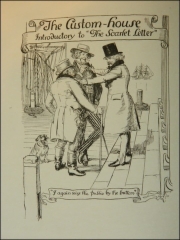
 "I again seize the public by the button" - illustration for The Custom-House (1920) - Credit: Hugh Thomson
When The Scarlet Letter was first published on March 16, 1850, the immediate response amongst the inhabitants of Hawthorne’s native Salem was outrage at his depiction of local characters in the introductory essay, ‘The Custom-House.’ A review in the Salem Register declared, “We were almost induced to throw down the book in disgust, without venturing on The Scarlet Letter, so atrocious, so heartless, so undisguised, so utterly inexcusable seemed his calumnious caricatures of inoffensive men, who could not possibly have given occasion for such wanton insults.”
Elsewhere, however, ‘The Custom-House’ was lauded for its demonstration of “how rich and exhaustless a fountain of mirth Hawthorne has at his command,” (Graham’s Magazine). The North American Review went further, averring that “this naughty chapter is more piquant than any thing in the book.” A range of contemporary opinion can be found here.

A custom house is a government office responsible for collecting customs and for clearing ships for entry and exit of the port. Salem's version was built in imposing Federalist style in 1819, facing the Derby Wharf at the juncture of Derby and Orange Streets.
 Salem Custom-House (c.1906) - Credit: Detroit Publishing Co
Hawthorne was the custom house surveyor from 1846 after being nominated by James K. Polk, the newly-elected Democratic President. (It was established practice for a government to fill its departments with its own supporters and the Democratic Hawthorne sought benefit from this kind of political patronage throughout his career.) His post was supposed to last for four years but was terminated after three when the Whig leader, Zachary Taylor, became President.
Explore the custom house and its neighborhood using the street-view map below.
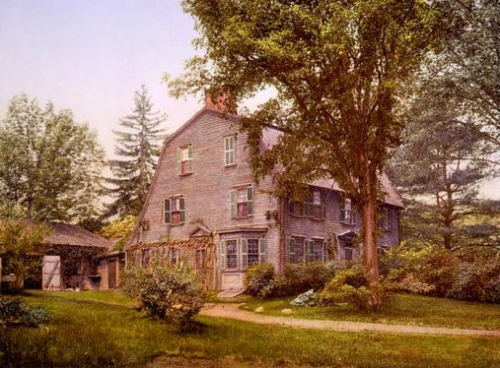 The Old Manse - Credit: Detroit Publishing Co.
The Old Manse is a handsome Georgian house located on Monument Street, Concord, Massachusetts by the Concord River. Built in 1770 by the Reverend William Emerson, its register of inhabitants resembles a student's reading list for a nineteenth-century American literature course. The transcendentalist Ralph Waldo Emerson, grandson of the reverend, lived here whilst writing Nature (1836); Nathaniel Hawthorne moved in with his bride, Sophia née Peabody, on 9th July, 1842; and Henry David Thoreau created a vegetable garden as a wedding present for the couple.
During his residency, Hawthorne published roughly twenty sketches and tales, later collected in Mosses from an Old Manse (1846). The essay he refers to here heads the collection.
 Entrance to the Old Manse - Credit: Library of Congress Historic American Buildings Survey
The Memoirs of P. P., Clerk of this Parish was written as a satire on Bishop Gilbert Burnet’s History of my own Time (1724), an account of the historical events that had passed since the English Civil War. The Memoirs of P. P. lampoons Burnet’s clumsy writing, pomposity and inability to distinguish the banal from the profound — as the advertisement states, it “might justly be entitled, 'The Importance of a Man to Himself.'” It first appeared in Miscellanies in Verse and Prose (1727) under the authorship of the Scriblerus Club, and is generally supposed to be the work of Alexander Pope. Though Hawthorne references it self-deprecatingly to suggest his prefactory essay contains all the flaws of the putative P. P.'s work, there are also parallels with The Scarlet Letter. Specifically, the clerk, having engaged in premarital liaisons himself, refuses to pass judgment on others who have committed similar crimes: “That the shame of women may not endure, I speak not of bastards; neither will I name the mothers, although thereby I might delight many grave women of the parish.”
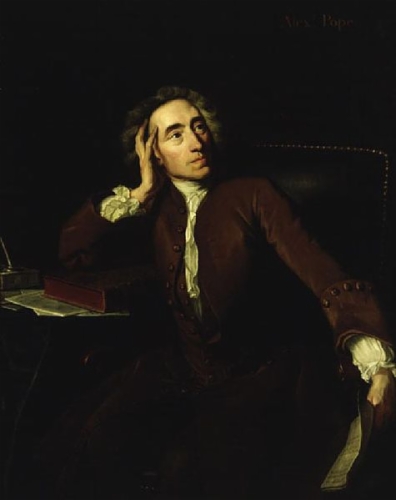 Portrait of Alexander Pope (c.1742) - Credit: Jean-Baptiste van Loo
Hawthorne originally conceived of The Scarlet Letter as a shorter work that would feature in a collection provisionally entitled Old-Time Legends: together with Sketches Experimental and Ideal. However, when he sent his prospective publisher James T. Fields the manuscript of ‘The Custom-House’ and the original version of The Scarlet Letter, Fields persuaded him to extend the latter by three chapters and to publish the two pieces unaccompanied. Some of the tales that had originally been intended for Old-Time Legends, such as ‘The Great Stone Face,’ 'Main Street' and ‘The Snow-Image,’ later appeared in The Snow-Image, and Other Twice-Told Tales in 1852.
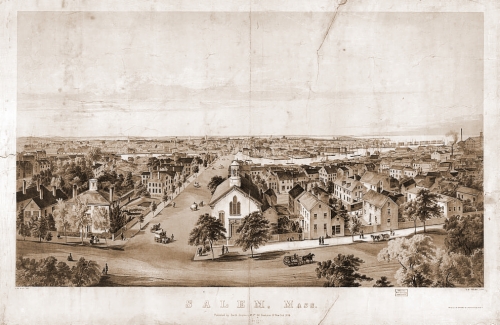 Salem as it was in 1854 - Credit: John William Hill
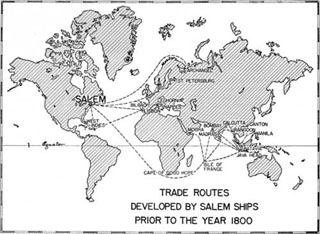
Salem, the county seat of Essex, Massachusetts, was settled in 1626 by Puritan pilgrims who named it for the Hebrew word for peace, shalom. Ideally located on the edge of Massachusetts Bay, by the end of the eighteenth century it had become the wealthiest trading port in America. Salem merchants dealt in luxuries, importing lacquered furniture, indigo, textiles and spices from the Far East, and molasses from the West Indies for the highly lucrative purpose of manufacturing rum. Export ships carried dried fish, lumber, cotton, tobacco and beef all around the world. Salem’s maritime fortunes were brought an abrupt halt by the Embargo Act of 1807, which vetoed any vessel traveling to a foreign port, and by the War of 1812 against the British. During the nineteenth century, it increasingly turned to industry as a means of generating wealth and, as the tanneries, shoe manufacturers and cotton companies gained in stature, the wharves slipped into the decline Hawthorne describes here.
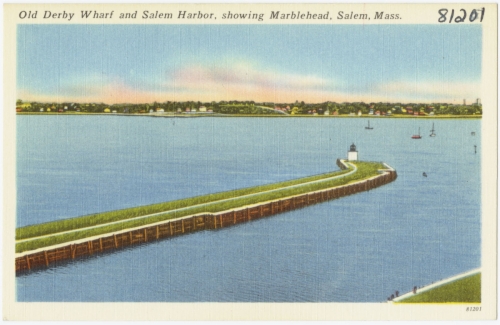
 Old Derby Wharf and Salem Harbor - Credit: Boston Public Library
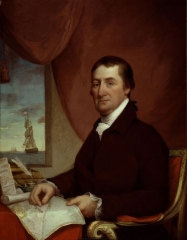 Elias Hasket Derby (c.1800-25) - Credit: James Frothingham
Elias Hasket Derby (1739-1799) was a powerful shipping magnate who dominated Salem’s commercial life during the post-Revolutionary period. Having inherited his father’s fortune and maritime business, Derby rose to become the biggest privateer owner in Salem during the Revolutionary War. In the years that followed, he expanded Richard Derby's trading empire to the cover the entire globe, becoming the first American to establish trade links with the Baltic and Asia. With his tremendous foresight and unerring instinct for picking the right men for the job, he soon developed an enterprise mighty enough to pose a serious threat to the hegemonies of maritime suzerains the British, Dutch, French and Swedish East India Companies. The nickname ‘King Derby’ comes from the fact that he is known as America’s first millionaire, although there are several other contenders for this title. Though several recent books have casually assumed this to be the name by which he was either revered or sarcastically denigrated during his lifetime, Hawthorne in fact seems to be its originator.
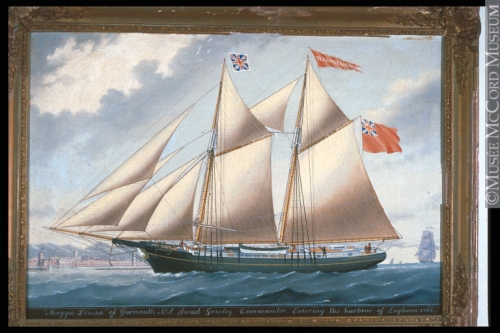 'Maggie Louisa' of Yarmouth, Nova Scotia (1866) - Credit: McCord Museum
Nova Scotia is a maritime province lying on Canada’s eastern coast. It was first settled in 1605 by French colonists and boat-building formed the backbone of its industry from the outset. In Hawthorne’s time, it boasted the third largest ocean-going fleet in the world. Schooners — relatively small and speedy vessels with fore-and-aft rigging — were Nova Scotia’s mainstay, conveying goods down the length of the Atlantic Seaboard and into the Caribbean.

 An aerial view of contemporary Nova Scotia - Credit: Jvienneau
Visit an online archive of photographs and historical documents relating to Nova Scotia schooners here.

The American flag was first officially adopted in 1777. At this time, it comprised thirteen red and white stripes, representing the thirteen colonies which had achieved independence from British rule, and thirteen stars on a blue background signifying the states of the newly-formed Union. Since then, the flag has been amended numerous times as new states have been established and incorporated into the Union. In 1850, there were thirty stars. As Hawthorne says, the flag is hung vertically to indicate a civil office. It is always hung so that the blue canton is in the upper left corner.
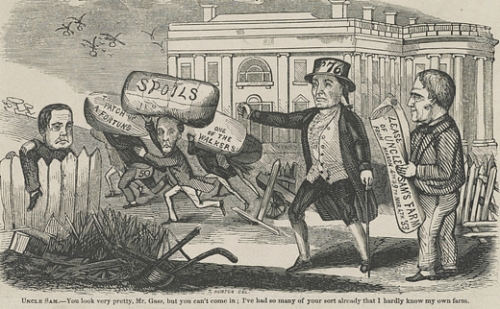 Illustration from a Whig campaign song sheet (1848) - Credit: Horton & Co.
Uncle Sam is the personification of the American government. He made his debut in American cultural mythology during the War of 1812, and was based on Samuel Wilson, a New York meat packer. His appearance wasn’t standardized until 1917 when James Montgomery Flagg’s famous army recruitment poster formed the template for subsequent depictions. This 1848 illustration shows him banishing the Democrats from office to make way for Zachary Taylor, a Whig candidate.

The bald eagle was adopted as America’s national emblem in 1782 when it was incorporated into the Great Seal and has since made its perch upon the Presidential flag, assorted federal flags and innumerable government buildings. The “unhappy fowl” above the custom house was a wooden carving created by local artisan Joseph True in 1826. Hawthorne’s description of its “bunch of intermingled thunderbolts and barbed arrows in each claw” does not entirely tally with the reality: like most of its kind, it carries the olive branch of peace along with the arrows of war. True’s bird was replaced in 2004 by a fiberglass replica and is now exhibited as part of the custom house museum.
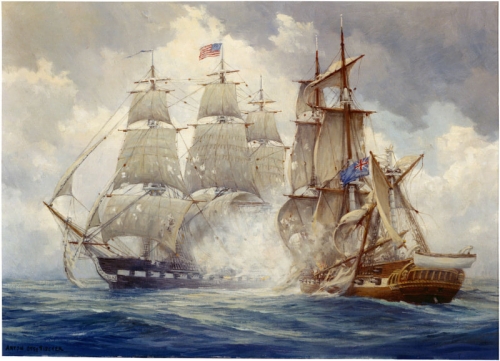 U.S. Frigate Constitution defeats H.M. Frigate Java during the War of 1812 - Credit: Anton Otto Fischer
The War of 1812 erupted on 18th June as mounting tensions between America and Britain reached crisis point. Britain was at the time engaged in the Napoleonic Wars and freely rode over American interests by compelling merchant sailors to join in the efforts of the Royal Navy and using the continent as an immense store-cupboard for everything from beef to feed its naval commanders to timber for its impressive fleet of war ships. At the same time, the British colonial powers stood in the way of America’s expansionist ambitions by protecting Native American territories. The ensuing conflict, which was seen as a second war of independence, lasted over two years, finally ending with the American ratification of the Treaty of Ghent on 17th February 1815.
In Salem, the war sounded the death knell for maritime trading. Both the British and the French hijacked its vessels for their own use during the Napoleonic Wars and many seamen were kidnapped and pressed into naval service. By 1815, it had lost about three quarters of its ships. Boston and New York, meanwhile, had taken over as America's major ports, leaving Salemites with the choice of either relocating or following the trend towards manufacturing industries on their native soil.
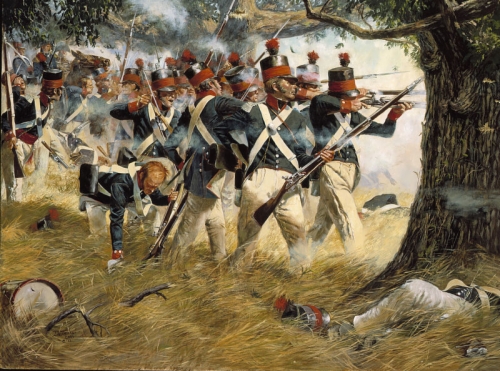 American soldiers attack the British forces at North Point, Maryland - Credit: US Army, Don Troiani
Explore the Library of Congress' exhaustive collection of documents relating to the War of 1812 here, and watch a documentary on its historical unfolding below.
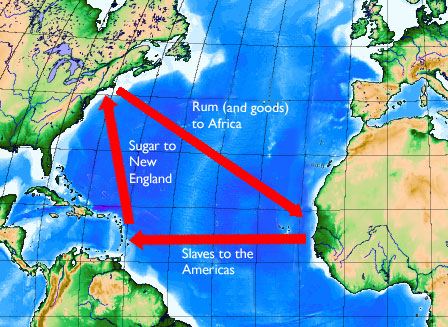
This is an oblique nod to one of the less edifying aspects of Salem’s ocean-going exploits. The New England port was for centuries engaged in a triangular trade pattern, whereby sugar and molasses would be conveyed from South America and used to manufacture rum, which was then exported to West Africa. On the return journey, Salem’s ships would carry a human cargo of slaves back to South American sugar plantations. Though Salem was largely faithful to the 1808 Act which forbade the importation of slaves into the US, it continued to bolster the “peculiar institution” through these indirect means up to the Civil War.
Hawthorne, who in a notebook entry of 1838 declared himself “more of an abolitionist in feeling than in principle,” was not entirely opposed to slavery and the currents of racism that recur in his private writings make upsetting reading for admirers of his work. Allen Flint offers an illuminating exposition of his views in ‘Hawthorne and the Slavery Crisis’ (1968).
Ambitious young clerks would customarily seek purchase on the first rungs of the career ladder by making investments in privately funded trading ventures.
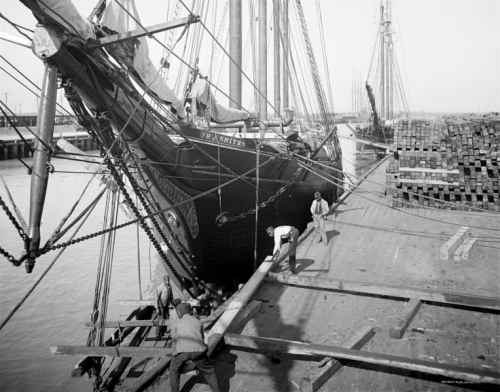
The colonization of the northern areas of America was a process that created massive deforestation. The wood needed to build and heat homes in a region where temperatures were low for three quarters of the year, not to mention that for cooking and illumination, took a heavy toll on forests adjacent to settlements. Boston and its surrounding areas, which lacked native trees, suffered tremendous fuel shortages and had to import firewood from provinces to the south-east.
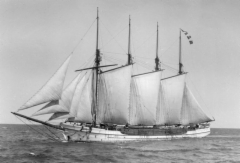 A lumber schooner at sea - Credit: David Evans
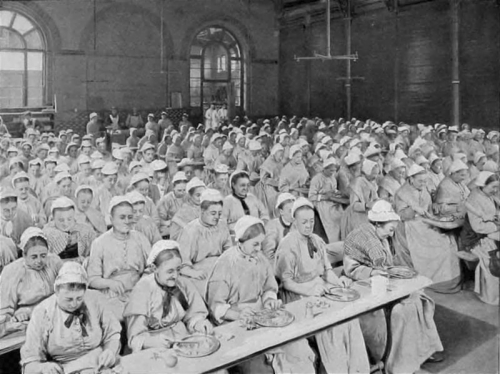
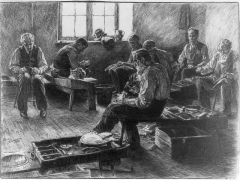 The denizens of an almshouse making shoes - Credit: Cabinet of American illustration (Library of Congress)
By the nineteenth century, alms-houses were the principle means of support available to those without any other means of subsistence. Though America had had a small number of such institutions from the seventeenth century, they began to mushroom exponentially following on from the report Josiah Quincy made in 1821 on poverty relief in Massachusetts. Criticizing compulsory provision to the poor as encouraging indolence and dissipation, he recommended alms-houses make their inhabitants work for some proportion of their maintenance. Though much of the rhetoric was philanthropic (working towards one’s upkeep was supposed to facilitate self-respect and dignity), the reality was more punitive, with extremely poorly-rewarded labor providing a punishment for the moral laxness that was supposedly the root cause of poverty. Lack of funding and capable staff further contributed to the dire circumstances the ‘able poor’ – a category peopled by destitute families, single mothers, widows, men who had lost their jobs and, increasingly, the mentally ill – experienced in these institutions.
For Hawthorne, governmental roles, being funded by the public purse and requiring little by the way of independent enterprise, encouraged exactly the kind of moral and physical torpor usually attributed to those reliant on charity. For him, this hypocrisy symbolizes the extent to which his countrymen have fallen from the stern ideals of their Puritan forebears, a company guilty of a hypocrisy of a different kind. It is through this examination of the moral corruptions of past and present — and his tortured identification with both — that Hawthorne creates a dialogue between ‘The Custom-House’ and The Scarlet Letter proper.
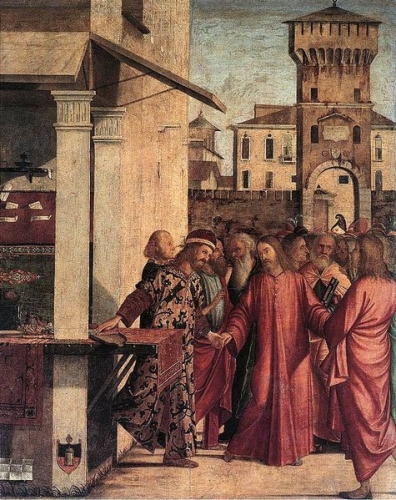 The Calling of Matthew (1502) - Credit: Vittore Carpaccio
According to the Bible, Matthew is one of the Twelve Disciples whom Jesus selects to spread his message. When Jesus calls Matthew to join him, he is employed as a tax-collector in Galilee: “And as Jesus passed forth from thence, he saw a man, named Matthew, sitting at the receipt of custom: and he saith unto him, Follow me. And he arose, and followed him.” (Matthew 9:9)
Matthew, one of the Four Evangelists, is held to have authored the first of the Synoptic Gospels in the New Testament. Several versions are available here.
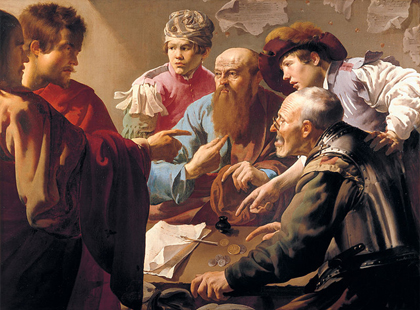 The Calling of St. Matthew - Credit: Hendrick ter Brugghen
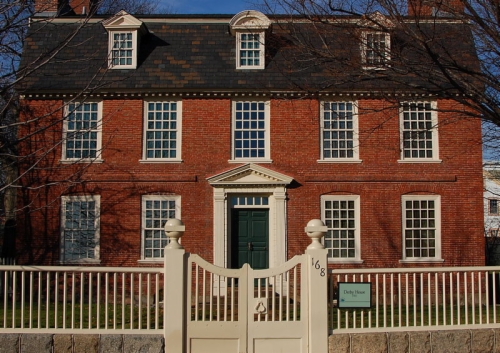
 Derby House, Derby Street - Credit: Fletcher6
Derby Street — which is named after Elias Hasket Derby, the famous shipping magnate to whom Hawthorne alludes earlier — runs parallel to Salem Harbor. At the height of the city’s maritime powers, as many as 30 wharves jutted out from its length. It was on Derby Street that the custom house was situated, across from the wharf that also took its name from Salem's merchant “king.”
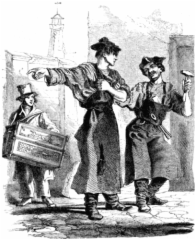 Sailors wearing slops - Credit: J. Ross Browne
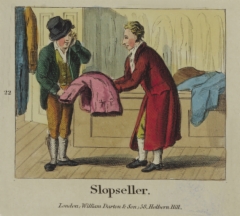
 Slopseller (1830) - Credit: Courtesy of the Jewish Museum London
 London's West India Docks at Wapping (1810) - Credit: Thomas Rowlandson & Charles Pugin
Wapping is the part of London that houses the dockside area. It has a long seafaring history: Sir Walter Raleigh equipped his ship there for his voyage to Guyana and James Cook lived there as a young boy. By Hawthorne’s time, it enjoyed a monopoly, being the place at which ships carrying imports from abroad were obliged to unload by the East India Company.
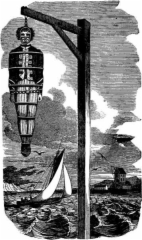
Though Hawthorne uses Wapping generically to refer to any dockside area, it is interesting to note that it, like the port of Salem, was a major site of public punishment. Execution Dock was the stage where assorted buccaneers, mutineers and smugglers were hung for over 400 years up until 1830. The scaffold was positioned right above the water, and the bodies weren’t cut down until three tides had washed over them.
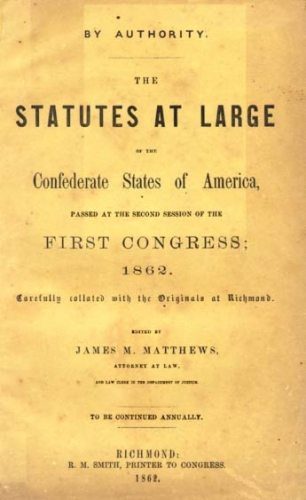
All the acts passed by the United States Congress are contained in Statutes at Large, a serial work which, by Hawthorne’s time, had run to eight volumes. Anyone interested in perusing these will find them here, while an 1804 edition of the Digest of Revenue Laws, supplemented by information relating to custom houses, can be browsed below.

The Locofoco Party, formed in 1835, was a radical branch of the Democratic Party, opposed to hierarchies, banks, monopolies, tariffs, paper money and anything else they believed went against the principles of democracy by conferring special advantage on a favored few. They took their name from the new self-igniting matches they used to illuminate their meetings after their Tammany opponents attempted to sabotage them by turning off the gas lamps.
Hawthorne had been accused of being appointed to his position in the custom house on the basis of his “Locofocoism” in the Boston Atlas only a year before The Scarlet Letter was published. The Salem Register, however, took pains to distinguish him from his more politically radical colleagues, saying, “we should be sorry to rank him with his temporary associates, the clique of plotters who have made themselves so offensive as public officers” (11 June, 1849). The entire article can be read here, and you can read more about the Locofocos here.
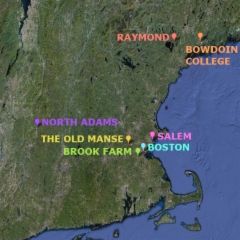 A map showing all the places Hawthorne had lived prior to 1850
 Nathaniel Hawthorne's birthplace - Credit: Lunita Lu
When The Scarlet Letter was published in 1850, Hawthorne had spent twenty-eight of his forty-one years in Salem, the town of his birth. These had been interspersed with a family experiment at living in the wilderness of Raymond, Maine; four years absorbing the classics and religion at Bowdoin College in Brunswick; a period of editing the doomed American Magazine of Useful and Entertaining Knowledge at Boston; stints at North Adams and the utopian community of Brook Farm; and, most recently, three years at the Old Manse.in Concord, Massachusetts.
For more detail about Hawthorne's life, have a look at the Author page.
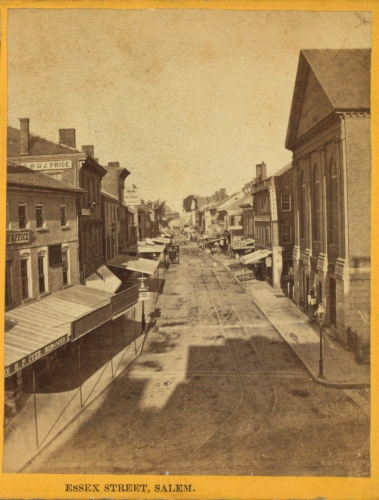

Gallows Hill was the site of the executions during the infamous Salem witch trials. Surprisingly, its location is by no means a certainty. Charles Wentworth Upham, the author of several works on the Salem witches, locates it near the intersection of South Street and Hanson Street, towards the back of what is now Gallows Hill Park (shown on the first map below). However, more recent specialists have contested this on the grounds that its steep rise would have made dragging the condemned up there in carts highly impractical.
New Guinea refers to the High Street area. It was here that black former slaves had their encampment, pointing up the highly segregated nature of Salem at the time.
The alms-house at Salem Willows, constructed in 1816, lay for over 140 years on what is now Memorial Drive (see the second map below).
The “long lazy street” that connects these insalubrious landmarks is Essex Street.
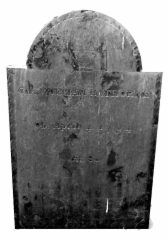 William Hathorne's grave at Burying Point Cemetery, Salem - Credit: Dana Huff
William Hathorne (Nathaniel was the first member of the family to spell his surname with a w) became the first of Hawthorne’s ancestors to emigrate to America in 1630. Though the son of a poor English yeoman, he was an immensely talented and capable man and quickly ascended the rungs of early Salem society. He gained prosperity as a merchant before becoming a deputy to the General Court of Massachusetts. He was appointed as the House of Deputies’ first speaker and later served a magistrate at the high court. His illustrious career then saw him become the captain of the Salem military company where he led the colonists to victory in King Philip’s War, a hugely destructive conflict in which some 3,000 Native Americans were slain. He was also a zealous participant in the persecution of the Quakers. Nathaniel Hawthorne — his great-great-great grandson — would wrestle with this dubious legacy of mixed glory and shame throughout his career.
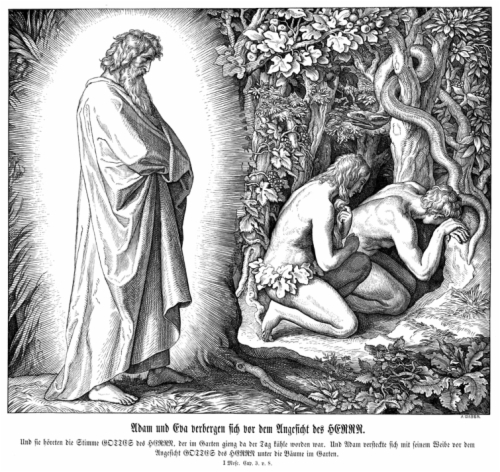 God delivers his curse to Adam and Eve (a.1872) - Credit: Julius Schnorr von Carolsfeld
A reference to the words with which God curses Adam and Eve as he ejects them from Eden: “In the sweat of thy face shalt thou eat bread, till thou return unto the ground; for out of it wast thou taken: for dust thou art, and unto dust shalt thou return.” (Genesis 3:19)
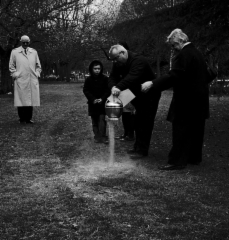 The scattering of ashes at a funeral - Credit: Giles Clark
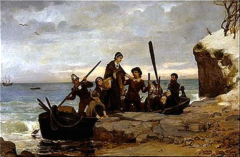 Puritan pilgrims arriving at Plymouth Rock (1877) - Credit: Henry A. Bacon
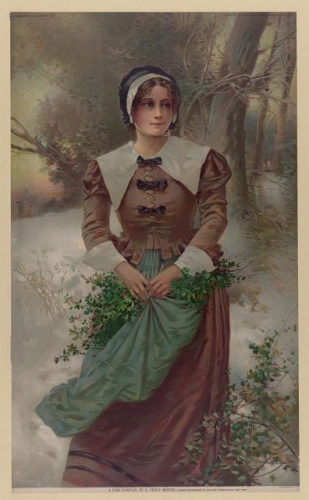 A Fair Puritan - Credit: Percy Moran
Puritanism originated in sixteenth-century England as an offshoot of Protestantism. Its adherents held that the Reformation had not gone far enough, and sought to rid the Church of England of the remaining vestiges of ceremony and ritual they regarded as idolatrous. Believing Charles I would ultimately foist Roman Catholicism — the religion of his wife — back on the country, some Puritans formed plans to establish a new colony on American shores where they would be free to practice their faith without fear of persecution. Migration began in the 1620s, with the Massachusetts Bay Colony, centered around present-day Salem and Boston, being officially established in 1628. The ensuing decades saw a mass exodus of English Puritans swell the numbers of the early settlers.
Puritanism is synonymous with harsh austerity, and the New England settlers were at the extreme end of the spectrum. Though they were a dedicated, prudent, hard-working, quiet-living people who valued self-examination and sincerity, they were also fiercely intolerant, and the paranoia which became rife in their enclosed society spurred them on to the cruel persecution of those they believed threatened their theocracy. Quakers and alleged witches, as Hawthorne goes on to say, were the main victims of their fear.
Watch a recreation of everyday life in Puritan New England below.
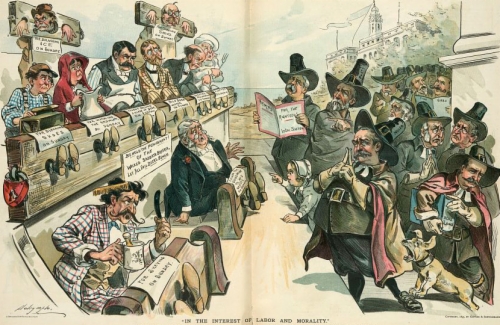 Cartoon satirizing the Puritan predilection for putting people in pillories and stocks for such outrages as shaving or blacking their shoes on a Sunday - Credit: Louis Dalrymple
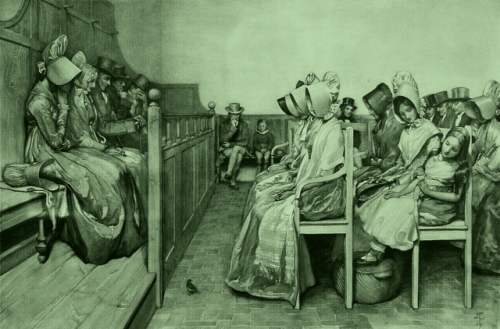 Quakers at their Meeting House - Credit: John Hall
The Quakers, a religious sect that split off from the Church of England, held that faith should be founded on a direct knowledge of and communication with Christ without the mediations of clergy. Facing similar persecution to the Puritans, the Quakers too migrated to the New World in search of religious freedom. Once there, however, they found themselves pitted against the Puritan settlers who deemed their beliefs heretical and their refusal to adhere to the official religion criminal. Flames were further fanned by the tactics some Quakers used to challenge the status quo: they would burst into church services, create noisy disruptions in the street, and divest themselves of clothing to demonstrate their indifference to worldly concerns. Puritan reaction was brutal: if they could not compel the interlopers to leave, they were imprisoned, flogged, fined and had their property confiscated. Many were executed, while others were subjected to tortures such as having holes bored through their tongues.
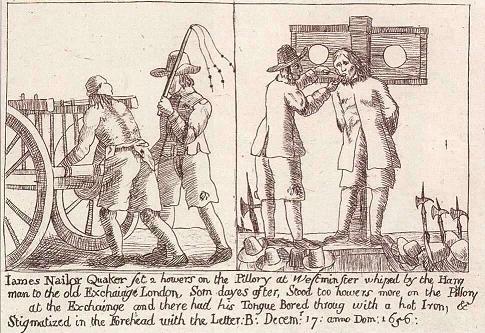
As magistrate, William Hathorne was responsible for ordering much of this cruelty and is counted as one of history’s most remorseless persecutors. Hawthorne read extensively about his ancestor’s deeds, and there was much written. William Sewel’s History of the Rise, Increase, and Progress of the Christian People called Quakers (1722) cast a disgusted eye over the atrocities he had sanctioned; while George Bishop, in New England Judged (1703), condemned the man “whose Name I record to rot and Stink... to all Generations.” Unsurprisingly, Puritan histories paint him in a more flattering light.
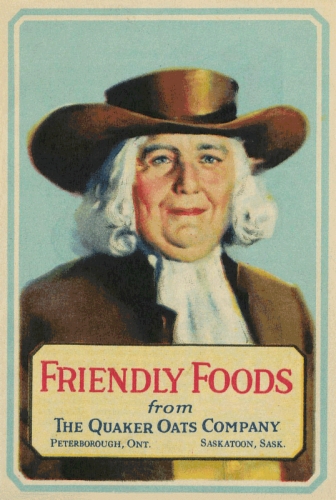 The portrait used by the Quaker Oats Company has come to typify the image of Quakers - Credit: CanadianaCA
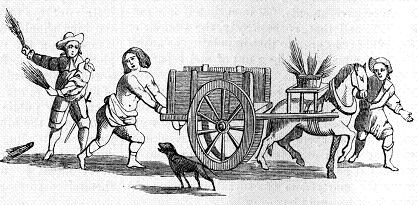 Whipped at the Cart - Credit: Illustration from The Comprehensive History of England (1902)
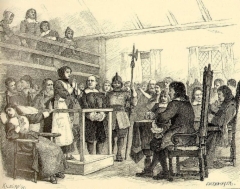 John Hathorne and the Rev. Cotton Mather interrogating supposed witch Martha Corey (1902) - Credit: John W. Ehninger
John Hathorne (1641-1717) followed in his father’s footsteps in every way. Having built upon William’s mercantile business, he was then appointed magistrate of Essex County. During 1692, hysterical accusations of witchcraft abounded in Salem and it was he, along with fellow magistrate Jonathan Corwin, who was responsible for interrogating both the accused and the accusers. Impartial he was not, and his questionings frequently assumed guilt in advance. He also put pressure on defendants to incriminate others, something many were happy to do since it gave them the opportunity to transfer their otherwise inevitable death sentence onto another victim. All in all, nineteen people were hung, one was pressed to death and several others died in prison. Of everyone involved in the persecution of alleged witches, John Hathorne was the only one not to repent of his actions. His cruelty has earned him the sobriquet “the hanging judge.” Arthur Miller resuscitated him in this guise for his 1952 play The Crucible, in which the magistrate's inquisitionary zeal serves as an analogy for the anti-Communist witch-hunts of the McCarthy era.
Below is a collection of transcripts of Hathorne’s interrogations.
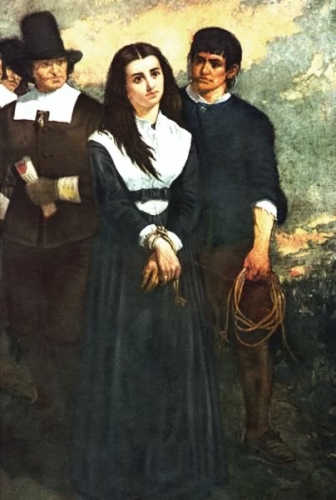 The Salem Martyr (1869), a painting of an accused witch - Credit: Thomas Slatterwhite Noble
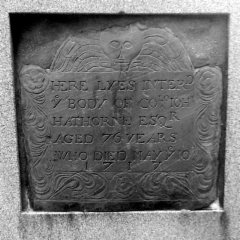 John Hathorne's Grave - Credit: Dana Huff
Charter Street Cemetery, also known as the Old Burying Point, is the oldest recorded cemetery in Salem and the second oldest in the United States. It was first established in 1637; John Hathorne was interred there in 1717. Time has so eroded his grave that it is now embedded in concrete to preserve it against further deterioration, but it remains one of the most famous the cemetery contains and is a mainstay of Salem’s enduringly popular witch tours. The winged skull that hovers over the epitaph may look like a grisly indictment but was in fact a ubiquitous symbol in early New England, representing at once the transitory nature of human life and the possibility of transcendence. The “stain” Hawthorne alludes to has been visually realized in recent years through the erection of Salem Witch Trials Tercentenary Memorial. Empty seats, each inscribed with the name of an accused witch together with the date and method of execution, are ranged in a circle. As repositories of infernal influence, the victims were of course not afforded a proper burial at the time of their death.
Explore the Salem Witch Trials Tercentenary Memorial with professional tour guide Mollie Stewart.
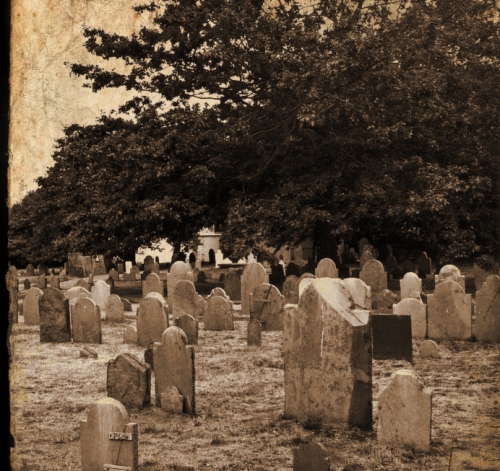 The old burying point - Credit: Kent Kanouse
For generations, the Hawthorne family retained a belief that a curse had been visited upon them because of the actions of John Hathorne. Moncure D. Conway traces this back to the testimony of the husband of one of the accused, which he quotes in his Life of Nathaniel Hawthorne (1890). Having watched his wife treated with such severity during her trial that she is on the verge of fainting, the unnamed man is reported to have “repeat[ed] something against their cruel proceedings,” an ejaculation which was presumably something to the effect that “God would avenge his wife’s sufferings” (p. 15).
With such tales circulating about his own ancestors, the idea of hereditary sin provided fertile ground for Hawthorne’s literary imagination. The theme finds its ultimate expression in The House of the Seven Gables (1851), in which the Pyncheon family are cursed after Colonel Pyncheon engineers for the man who owns the land he covets to be executed for witchcraft, thereby allowing him to claim it for himself.
 The Merry Fiddler (1623) - Credit: Gerrit van Honthorst
Although they had no problem with music as a solemn accompaniment to ceremonies, the Puritans were vehemently against it as a form of merry-making. Like other recreations, it was supposed to engender idleness and draw the mind away from the contemplation of God. Similarly, the reverence for the written word which the Puritans brought with them entailed an understanding of literature as a means through which God’s message could be disseminated and reflected upon. It was certainly not for entertainment. Hawthorne’s ancestors would never have encountered a novel — America’s first did not appear until 1789, when William Hill Brown’s Power of Sympathy was published — but he is right that they would have regarded his occupation with repugnance.
Hawthorne made the Puritan aversion to entertainments a central theme of his 1837 short story ‘The Maypole of Merry Mount.’ Read it here.
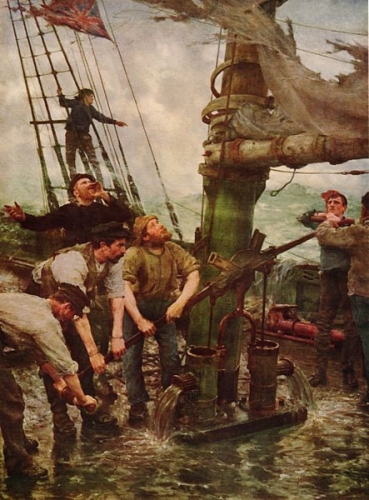 All Hands to the Pumps (1888) - Credit: Henry Scott Tuke
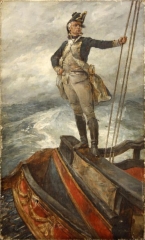 Naval Captain on the Poop deck taffrail.(a.1898) - Credit: William Heysman Overend
All four male representatives of the Hawthorne line between John and Nathaniel were ship captains of greater or lesser renown. Daniel (1731-96), Hawthorne’s grandfather, was something of a hero in the Revolutionary War, his legend being commemorated in song; the rest led honorable but unremarkable careers. Hawthorne's father, also called Nathaniel (1775/6-1808), was away at sea when his son was born and spent just four years with him before departing on a voyage to Suriname, during which he contracted the yellow fever that ended his life.
Short biographies are available at the invaluable Hawthorne in Salem website.
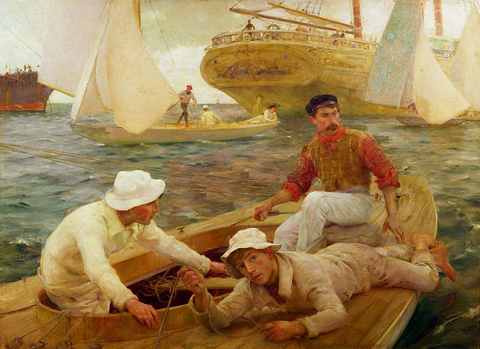 The Run Home (1902) - Credit: Henry Scott Tuke
Rather unusually, there is no thoroughfare of this name in Salem. Hawthorne is instead referring once more to Essex Street, which was the subject of his short story ‘Main Street’ (1849). This comic tale features the author as a cack-handed showman who regales his deeply-unimpressed audience with a series of tableaux depicting the street’s history, a pageant in which his ancestors feature prominently and not very flatteringly.
 The front and back of an 1851 half-cent
The “bad half-penny” is one that has been minted with inferior metals along with the copper of which it was supposed to be constituted. Anyone who found themselves in possession of one of these counterfeits would pass it on to someone else at the first opportunity. As a result, they tended to circulate much faster than real coins, thereby increasing the chances of returning to the original owner’s purse.
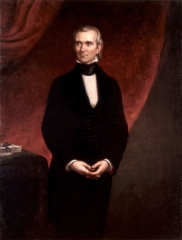 James Knox Polk - official White House portrait (1858) - Credit: George Peter Alexander Healy
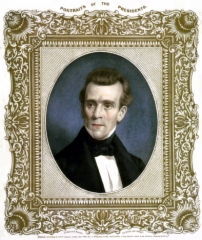 James K. Polk in c.1846 - Credit: Albert Newsam
Democratic President James K. Polk officially stamped the commission that approved Hawthorne’s appointment as custom house surveyor on 3rd April 1846. This pledged to him a four year tenure at $1,200 a year (approximately $36,400 in today’s money). However, he was prematurely ejected after three years when Zachary Taylor, a Whig, was elected into office on 4th March 1849.

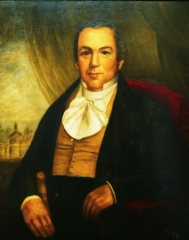
This is James F. Miller, an army major who gained hero status for his role in the 1812 war against the British Empire. He commanded a detachment against the Shawnee in General William Hull’s (unsuccessful) bid to capture the Detroit River and also played a prominent role in the Battle of Maguaga. Although the American troops once more failed to triumph, Miller was applauded for beating back the British, Canadian and Shawnee ambush they fell into and was elevated to colonel. This tenure that was doomed to be short-lived, for a week later he was taken hostage by British forces. Released after a year’s imprisonment, he then led his regiment to victory in the Battle of Lundy’s Lane.
Miller took up a role as collector at the Salem custom house in 1825. By the time Hawthorne arrived, he had been in post for 21 years and would be the author’s immediate supervisor for most of his time there. Miller was forced to quit the custom house in January 1849 when a stroke left him paralyzed.
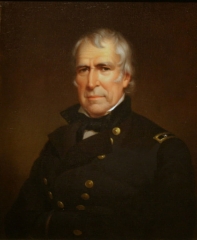 Zachary Taylor (1848) - Credit: James Reid Lambdin
Click here to see a timeline of all Presidential candidates up to the present day. The figures show that, relative to most other years, the contest between Zachary Taylor and Lewis Cass that saw Hawthorne lose his position at the custom house was fairly close, with the Whiggish Taylor winning by 12 per cent of the vote.
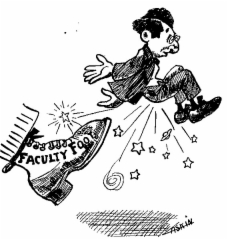 An unceremonious ejection from office - Credit: Olaf E. Caskin
During his tenure at the custom house, Hawthorne was responsible for laying off two inspectors he felt to be incompetent. One of these was William Webb, a renowned former sea captain who was forced into retirement at the august age of 81. Hawthorne’s rather callous attitude does not seem to have been diluted by the fact that Webb was a relative of his, being his father’s cousin. He died in 1848, aged 83.
The second Inspector Hawthorne sacked was Henry Prince, another former sea captain who had commanded vessels for Salem’s prominent merchants, including Elias Hasket Derby. When Hawthorne took up office, he was 82 years old and his health was beginning to fail. He died just five months after having been relieved of his duties.
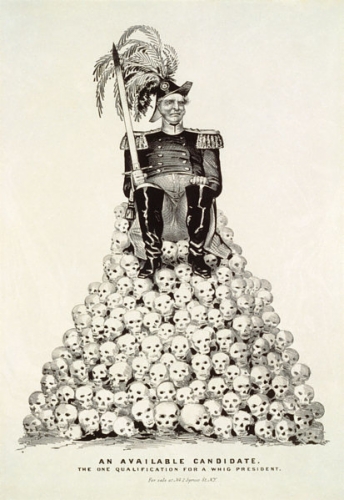 Political cartoon satirizing the one quality - bloody military might - that was supposed to qualify a Whig for office (1848) - Credit: N. Currier
Founded in 1833, the Whig Party were the main political opponents of the Democratic Party prior to the birth of the Republicans. They embraced a program of modernization and expansion, promoting a market-based economy as a means of securing America’s position globally. Morally, they took a more authoritarian position than their opposite number, advocating the prohibition of alcohol and an education system that instilled piety and conformity to Protestant values. On slavery they were deeply divided, and it was the dispute between abolitionists and the pro-slavery faction that brought the party to its knees in 1860.
Watch a brief interview with history professor Eric Foner on the differing stances of Whigs and Democrats towards the relationship between the individual and the state.
 Democrat donkey logo - Credit: dbking
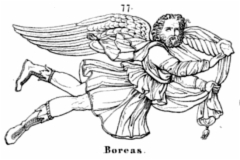
Boreas is the Greek god of the north wind, a mighty deity renowned for his savage and stormy ways: his very name means ‘devouring one.’ The son of Eos, goddess of the dawn, and the Titan Astraeus, he is one of the four cardinal wind-gods, or anemoi. Boreas is the bringer of winter and is often depicted with purple wings, a shaggy beard and billowing clothes. He carries a conch shell through which he blows out icy blasts of air that freeze the land and strip it bare.
 Phosphorescent wood - Credit: highlatitude
Phosphorescence — the process by which an object emits the energy it has absorbed in the form of an unearthly glowing light — is a characteristic not of the decaying wood itself but rather the mycelium which likes to colonize it. Certain species of honey fungus, ghost fungus, bitter oyster and the jack-o’-lantern mushroom are all possessed of this witchy property. The light they emit is green in color and, though usually dim, can sometimes be bright enough to read by. In folk usage, it is referred to as fox-fire or fairy-fire and was supposed to issue from the spirits of the dead who wished to lead unwary travellers astray.
Henry David Thoreau, the transcendentalist author, was a friend of Hawthorne's. In The Maine Woods (1864), he excitedly recounts discovering a piece of phosphorescent wood for the first time. Read the relevant extract here.
The time-lapse footage below shows bitter oyster fungus changing from its day to its night apparel.
 Glowing jack-o'-lantern mushroom - Credit: Noah Siegel
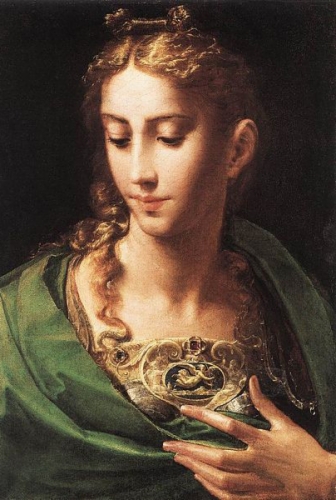 Minerva, the Roman goddess of wisdom (c.1539) - Credit: Parmigianino
This is a reference to a parable that appears in the Book of John. When Jesus’ disciples, concerned that he is not eating, urge him to get some nourishment, he replies that he has his own means of sustenance of which they are unaware. “Say not ye, There are yet four months, and then cometh harvest? behold, I say unto you, Lift up your eyes, and look on the fields; for they are white already to harvest” (John 4:35). A harvest of grain takes four months to grow from seed; the harvest to which Christ refers is the wisdom of God which can be enjoyed immediately by those who are receptive to it.
 Golden grain ready for harvest - Credit: Charles Knowles
The victim of Hawthorne’s gleefully vicious caricature is Captain William Lee (1770-1851), who appears on the custom house register from 1812. He was the son and business partner of the collector William Raymond Lee, who created roles for him both in his mercantile firm William R. Lee and Co. and at the custom house. He was, Hawthorne suspected, a key agent behind his ejection.
 Royal purple - Credit: Patrick Hoesly
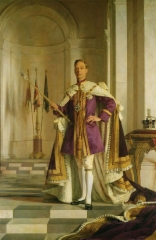 King George VI wearing purple robes - Credit: Gerald Kelly
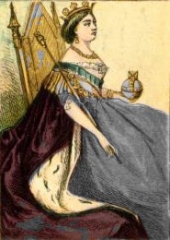 A queen wearing a purple robe to signify her royal status - Credit: Joseph Martin Kronheim
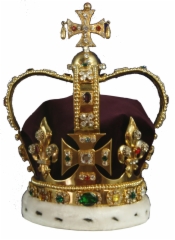 purple crown - Credit: dbking
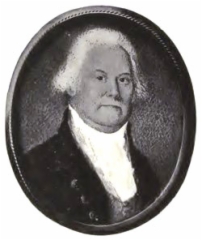
During the Revolutionary War of 1775-83, William Raymond Lee (1745-1824) had presided over the 14th Continental Regiment, famed as the finest in the entire Continental Army. His descendant Thomas Amory Lee chronicled his exploits in Colonel William Raymond Lee of the Revolution (c.1911). See below for an history of the Revolutionary War.
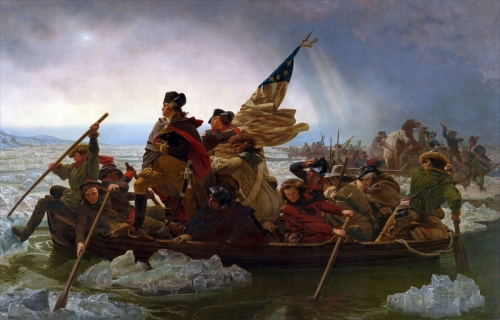 The 14th Continental Regiment carry Washington over the Delaware River during the Revolutionary War - Credit: Emanuel Leutze
 A large group of children follow their sibling's funeral procession - Credit: August Gaul
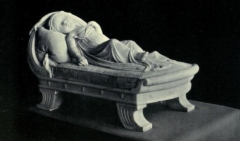 Effigy of a dead child - Credit: William Scoular; photo by James Calford
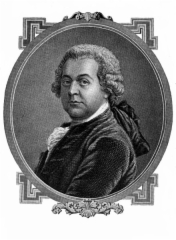
John Adams (1735-1826), one of the American Founding Fathers, was the second President, serving from 1797 to 1801. The Adams were a highly political family and his son, John Quincy Adams (1767-1848) would also serve as President from 1825 to 1829.
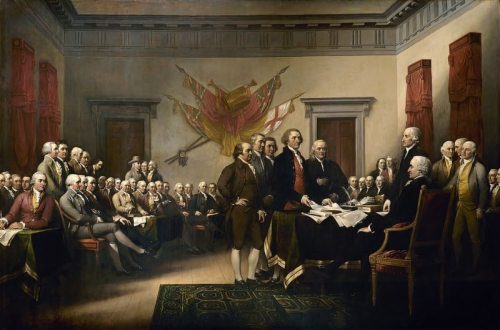 John Adams was one of the five men who drafted the Declaration of Independence. In this painting, he stands closest to the table. - Credit: John Trumbull
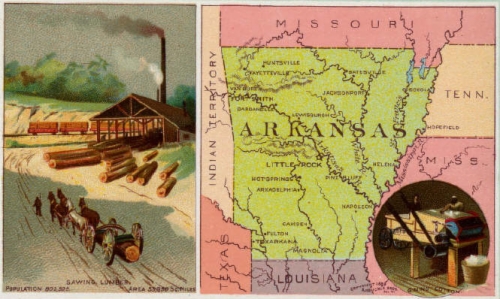 Territory of Arkansas (1889) - Credit: Arbuckle Bros.
In the six years between leaving the army and taking up the position of collector at the Salem custom house, James Miller served as governor of the newly-formed Arkansas Territory. Created from part of the Missouri Territory, the land was still rugged frontier and a subsistence economy prevailed. The territory expanded as lands were acquired from the Cherokee, Choctaw and Quapaw, and these boundaries were formalized when Arkansas officially became a state in 1836.
Find out what life was like in the Arkansas Territory when Miller was governor from Thomas Nuttall's Journal.
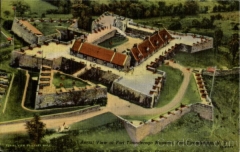 Aerial view of Fort Ticonderoga - Credit: Fort Ticonderoga Museum
Fort Ticonderoga was built by the French and Canadians between 1754-7 in New York State at the intersection of the water highway that connected New France and the British American territories. Because of its position, it was of vital strategic importance, serving as the key to the entire continent. It was captured by the British in 1759 at the Battle of Ticonderoga and then by the Americans in 1775, making it the first American victory in the Revolutionary War. The fort ceased to be of military value after the war and gradually fell into ruin. It was restored in the early twentieth century and now serves as a popular tourist attraction. Find out more about it here.
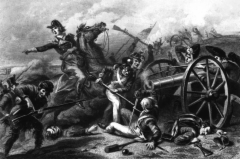 James Miller at the Battle of Chippewa - Credit: U.S. National Archives
Gathered underneath this umbrella, and known personally to Hawthorne, were the Transcendentalists. Believing a new era was at hand, they held that the goodness inherent in humanity was to be achieved through the rejection of society and its institutions. The movement’s leader, Ralph Waldo Emerson, expounded self-realization through the harmonious relationship between the individual and her environment. Other prominent members, including Henry David Thoreau, Margaret Fuller, Bronson Alcott and Hawthorne's sister-in-law, Elizabeth Peabody, pursued educational reform, the advancement of women and the eradication of slavery through an understanding of life as a spiritual process. Hawthorne maintained friendships with these luminaries and flirted with the philosophies they espoused. Ultimately, though, he was unable to reconcile their utopianism with his own darker view of the human heart.
Joel Myerson's Transcendentalism: A Reader contains extracts from a wide selection of key texts. Leaf through below.
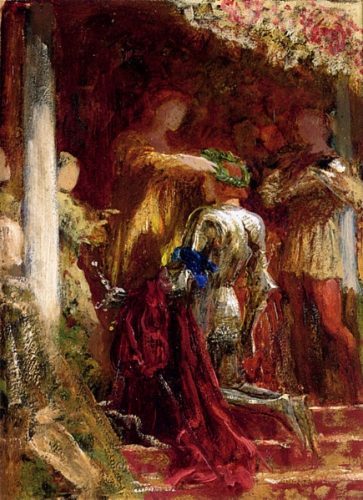 Victory, A Knight Being Crowned With A Laurel-Wreath - Credit: Frank Dicksee
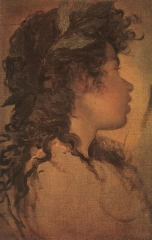 Study of the head of Apollo, showing the god wearing a wreath of bay laurel (1630) - Credit: Diego Velázquez
Wearing a wreath of bay laurel leaves to symbolize victory is a tradition that has its roots in Ancient Greece. According to legend, the god Apollo turned chaste Daphne into a laurel tree after she begged him to spare her from his carnal advances. As a tribute to her, he vowed to wear a crown made from the leaves from that day forth and, when he created the Pythian Games, winners were awarded a similar wreath. A parallel tradition flourished in Ancient Rome, where military leaders wore laurels to signify their triumphs.
 Bay laurel - Credit: James Gaither
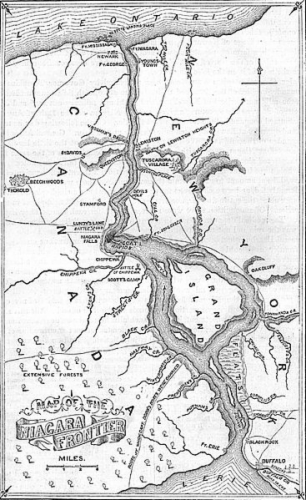 Map of the Niagara Frontier (1869) - Credit: Benson J. Lossing
The Niagara frontier, part of Western New York State, encompasses the area to the east of the Niagara River and south of Lake Erie.
 Niagara frontier - Credit: Lone Primate
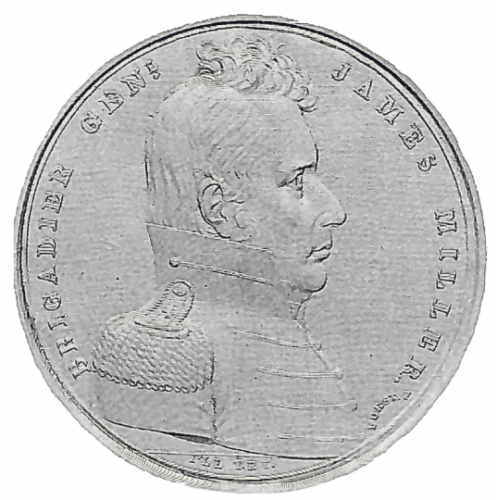 James Miller's gold medal - the legend "I'll try" is inscribed at the bottom
This was Miller’s famous response to General Jacob Jennings Brown’s order to storm a battery of seven British canons at the Battle of Lundy’s Lane during the War of 1812. In the event, Miller’s 21st U.S. Infantry Regiment succeeded in driving the British back from their hilltop site and repelling a counter-attack. His words quickly took on legendary status: they emblazoned the flag flown from the barge that Miller took to Arkansas and the medal he received for his bravery. To this day, the 5th Infantry Regiment (which incorporated the original 21st) retains them as its motto.
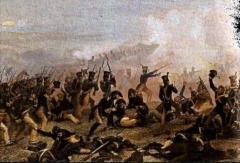
This man is Zachariah Burchmore, the son of a custom house inspector who nominally held the post of clerk but in practice served as chief officer. A conservative Democrat, he was dismissed from his post at the same time as Hawthorne and the two remained life-long friends. Despite Hawthorne’s description of him as an astute businessman, he was nevertheless a rather rough character whose post-custom house years were marked chiefly by alcoholism. Hawthorne's wife, Sophia, disapproved heartily of their association.
Read a facsimile of one of Hawthorne’s letters to Burchmore here.
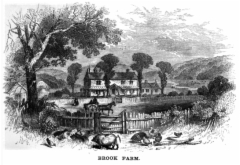
Brook Farm was a utopian community established in 1841 by Unitarian minister George Ripley and his wife Sophia in West Roxbury, Massachusetts. Envisioning a heaven on earth where sects and social divisions would be replaced by harmonious equality, the Ripleys strove to create a self-sufficient society in which labor and intellectual pursuits were intertwined. Members were required to devote themselves to an equal amount of farming, schooling or domestic work according to their preference, with each receiving equal pay. Hawthorne was a founding member of Brook Farm and one of its earliest inhabitants, though his motivations were more financial than ideological: infactuated with Sophia Peabody, he aimed to save enough money to be able to marry her. The self-sufficient life did not suit Hawthorne, who was accorded the honor of shovelling the dung-heap. Writing to Sophia that “labor is the curse of the world, and nobody can meddle with it, without becoming similarly brutified,” he left after around six months. Suffering financial set-backs that the cerebral community was temperamentally ill-equipped to deal with, the project was closed down in 1847.
Hawthorne later satirized his experiences at Brook Farm in The Blithedale Romance (1852). Read it below.
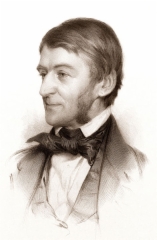 Ralph Waldo Emerson (1878) - Credit: Stephen Alonzo Schoff & Samuel Worcester Rowse
Ralph Waldo Emerson (1803-82), nicknamed ‘the Concord Sage,’ was the leader of the Transcendentalist movement and one of the foremost intellectuals of his generation. In a series of essays, he espoused a philosophy based on the direct experience of God through nature, individualism, non-conformity and freedom. He and Hawthorne became acquainted when the latter moved to Concord to take up residence in the Old Manse in 1842. Each had reservations about the other’s work but admired the intellect and talent from which it sprang, and they attended meetings and took long nature walks together where they would discuss their ideas.
Read Emerson's essays here.
 Boating on the Assabet - Credit: Bill Comstock
 The Assabet River at Concord - Credit: Barbara L. Slavin
The Assabet River is a 20-mile stretch of water than begins in the swamps of Westborough and ends in Concord, where it merges with the Sudbury River. Hawthorne loved this wooded, romantic area, declaring in ‘The Old Manse’ that “a more lovely stream than this... has never flowed on earth.” He often took boats out upon it with Channing and Thoreau for summer fishing expeditions; during the winter, its frozen surface was perfect for their ice-skating jaunts.
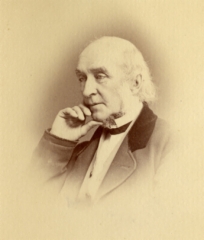
William Ellery Channing (1818-1902) was a Transcendentalist poet with whom Hawthorne struck up a friendship at Concord. A drifting, eccentric character, he was nonetheless the social center of the Transcendentalist movement, the force of his brilliant, if erratic, intellect drawing together its more celebrated members. He was married for a time to Ellen Fuller, the sister of iconic feminist Margaret, and is best remembered today as Thoreau’s first biographer.
Read Thoreau: The Poet-Naturalist (1873) here.
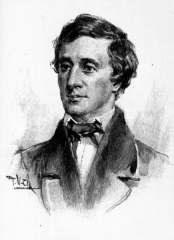
Henry David Thoreau (1817-62), besides being a leading light of the Transcendentalist movement, was an author, philosopher, abolitionist, freemason, historian and advocate of civil disobedience. Born in Concord, he spent almost all of his life in that woodsy town. The theme of humanity’s relationship with nature was central to his writing, and Hawthorne’s journals describe a man attuned to the vibrations of every plant and animal. “Nature,” he wrote, “seems to adopt him as her especial child, and shows him secrets which few others are allowed to witness.” Native American culture was another of Thoreau’s enduring fascinations, one to which he introduced Hawthorne during their regular hunts for arrowheads and other relics in the nearby woodlands. In fact, the last word he uttered on his death-bed is reputed to be “Indian.”
Visit an excellent online resource, including Thoreau's essays and letters, here.
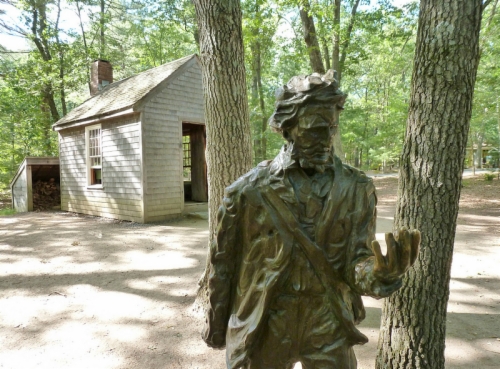 Replica of Thoreau's cabin at Walden, complete with his statue - Credit: Lorianne DiSabato
Thoreau’s commitment to Transcendentalism led him to live for two years in a cabin he built himself in the woods at Walden Pond near Concord. Eschewing human companionship and material comforts as far as possible, he sought to live frugally and self-sufficiently, believing that to do so would afford him a keen, elemental understanding of nature, society and his own place within each. Whilst there, he recorded his experiences in his most famous work, Walden (1854). Listen to a reading by Gord Mackenzie below.
 Walden Pond - Credit: Girish Kulkarni and Nishita Desai
George Stillman Hillard (1808-79) was a Boston-based lawyer and author. He was a founding member of literary group the Five of Clubs and, along with Brook Farm's creator George Ripley, edited the Christian Register. He rented rooms out to Hawthorne in 1837 while the author was employed at the Boston custom house and the two remain solid friends thereafter. When Hawthorne’s position at the Salem custom house was in jeopardy, Hillard, despite being on the opposite side of the political fence, threw all his effort into trying to ensure he was retained. When this failed, he set out on a fund-raising mission to ensure the indigent author and his family were financially supported.
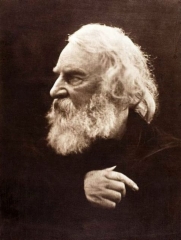 Henry Wadsworth Longfellow (1868) - Credit: Julia Margaret Cameron
Henry Wadsworth Longfellow (1807-1882) was revered as the greatest American poet of his generation and his writings are still much-admired today. His best-known works — such as The Song of Hiawatha (1855) and Evangeline (1847) — bring myth and legend to life and are imbued with an urgent sense of rhythm and a romantic sensibility. He and Hawthorne attended Bowdoin College together, marking the beginning of what would be a lifelong friendship. When Hawthorne died in 1864, Longfellow composed a poem that was less a eulogy than a desolate cry of loss, heart-rending in its dignified simplicity. Read it below.
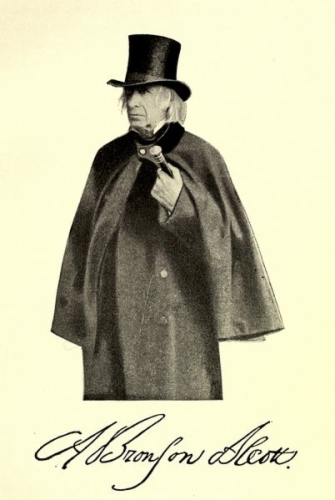
Amos Bronson Alcott (1799-1888), a teacher, philosopher and writer, perhaps went furthest in introducing Transcendentalist ideals into public life. An educational reformer, he established progressive schools that taught then unheard-of subjects such as art, nature studies and music using the Socratic method. His liberal attitudes — he questioned the literality of the Bible and took on an African American pupil during this time of widespread racial intolerance — went down badly with his contemporaries, but his cooperative, holistic approach to learning had a strong influence on subsequent educationalists. In later life, he co-founded Fruitlands, a utopian society which took the ideals of Brook Farm to a more radical level.
Though Alcott and Hawthorne met regularly, they seem to have had a certain ambivalence towards each other. Alcott features in an unfinished manuscript of Hawthorne’s, Doctor Grimshawe’s Secret, as Colcord, an idealistic pedagogue of whom Hawthorne remarks,“gentle and mild regard... was his warmest affection; and the warmest, too, that he was capable of exciting in others” (p. 67). Alcott, for his part, seems to have hoped for a closer relationship only to find himself baffled by Hawthorne’s shy remoteness. This sense of frustration comes through in Concord Days (1872) in which Hawthorne appears as a bashful maiden who can “only be won by some cunning artifice” (p. 194).

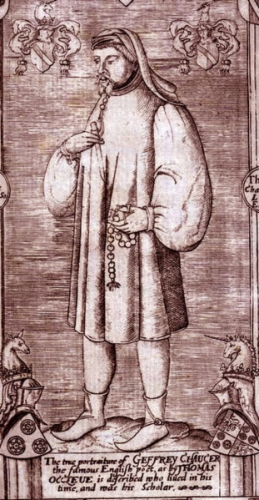
Writers whose reputations have weathered the centuries tend to be so intimately connected with their literary output that the idea of them having a prosaic, work-a-day job seems surreal, but this is completely true. The “ploughman poet” Robert Burns (1759-96) trained as a gauger so as to have a back-up plan if, as happened, his farming endeavours failed. He became excise officer to Greenock custom house in 1789 and would remain so until his death. Though he worked surprisingly diligently, he could be persuaded to deviate from his duties with bribes of whiskey.
During his employment, Burn's wrote ‘The Deil's awa wi' th' Exciseman’ about a town's rejoicing when Satan carts the officer off to hell. Listen to a reading below.
By contrast, custom house employment was a family tradition for Geoffrey Chaucer (c.1343-1400). He himself entered into it in 1374 when Edward III appointed him controller of export tax and subsidies on wool, sheepskin and leather for London. Being otherwise occupied seems to have stimulated Chaucer’s creative faculties, and the twelve years of his tenure were also his most productive, seeing him pen Troilus and Criseyde, The House of Fame and a translation of Boethius’ Consolation of Philosophy. Though Hawthorne’s own muse was stifled by official duties, Ellery Channing was fond of referring to him as New England's Chaucer.
John D. Howard was appointed Naval Officer by James K. Polk in 1846 and worked alongside Hawthorne until both were fired in 1849. He greatly admired Hawthorne’s writing and wrote to him to praise The Scarlet Letter and to thank him for his own favorable mention in its pages. Read the letter in full in Julian Hawthorne’s biography, Nathaniel Hawthorne and his Wife (1884), at page 364-6.
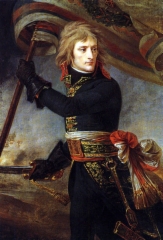 Bonaparte at the Bridge of Arcole (c.1801) - Credit: Antoine-Jean Gros
Napoleon Bonaparte (1769-1821), who ruled as the Emperor of France from 1804-14, conquered most of Europe during the Napoleonic Wars and is heralded as one of history’s greatest military generals. The internet is awash with information about him: a directory to some of the best resources is available here.
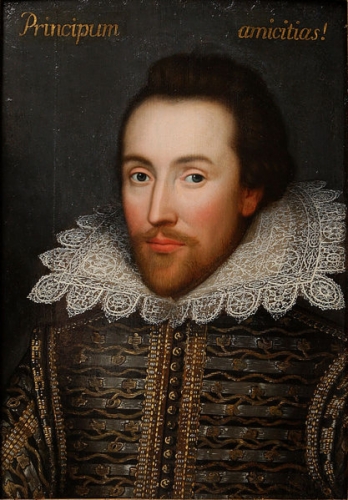
William Shakespeare (c.1564-1616) is widely considered the greatest English-language writer the world has ever seen. Amongst his best-regarded plays are Hamlet (1603), King Lear (1603-6) and Twelfth Night (1601-2). The “Shakspeare” spelling that Hawthorne uses here was then standard; “Shakespeare,” with the additional e, did not come into vogue until later in the nineteenth century. If John Howard wished to enlarge his knowledge of the bard then he would be well advised to visit this website, which collates first folio editions and vital research materials alongside Shakespearean insult-generators, parodies and recipes.
 Annatto seed pod - Credit: Phuong Tran
 Wool dyed with annatto - Credit: Knitting Iris
Anatto, or annatto, is a yellow-orange dye made from the pulpy substance that surrounds the seeds of the achiote tree. Originally used as a body paint, it can be utilized to color fabric, leather, cosmetics and food.
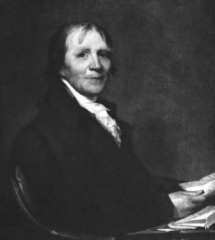
After Elias Hasket Derby died in 1799, William Gray (1750-1825) succeeded him as Salem’s foremost shipping merchant. Prior to the War of 1812, he owned a fleet of 60 vessels, employed around 300 men annually and was New England’s richest citizen. He was among the first American merchants to trade with India, China and Russia, and served as the ninth lieutenant-governor of Massachusetts. A detailed biography is available here.
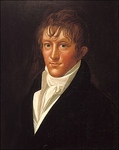
Simon Forrester (1748-1823), another wealthy Salem shipping merchant, had family ties to Hawthorne. A native of Cork, Ireland, he met Hawthorne’s grandfather Daniel Hathorne whilst in Liverpool and travelled with him to Salem in 1767. Nine years later, he married Hathorne’s daughter Rachel, making him Hawthorne’s uncle.
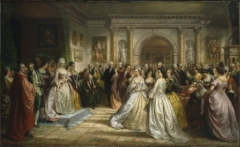 American aristocracy (c.1861) - Credit: Daniel Huntington
Ralph Waldo Emerson recorded in his diary in 1843 that, “In Salem, the aristocracy is of the merchants, even the lawyers are a second class.” The families Hawthorne is referring to therefore include the Derbys, Grays and Forresters, together with the descendents of other prominent merchants such as Philip English, Jerathmiel Peirce and Aaron Waite.
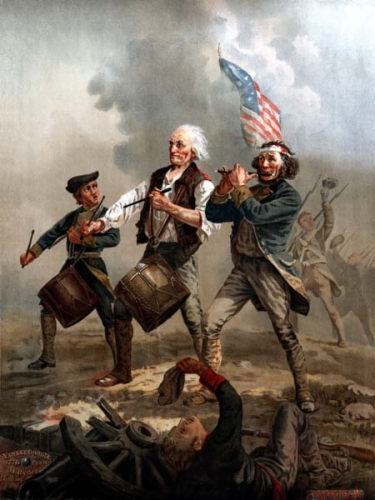 Spirit of '76, one of the most famous images of the Revolutionary War - Credit: A.M. Willard
The American Revolution arose as escalating tensions between the settlers and Britain reached crisis point. Whilst the empire relied on hierarchies and aristocracy, her American charges, influenced by Enlightenment ideals, turned more and more towards republicanism and liberalism, and increasingly resented the impositions of colonial rule. Events came to a head with the Stamp Act of 1765, a tax that was to be levied by the British Parliament directly on the colonies. America balked at this, declaring that taxation without representation was unconstitutional, and manoeuvred to boycott taxed British imports and expel royal representatives. They also formed governmental institutions within each of the thirteen colonies. Though they were still essentially under the rule of the empire, Britain was incensed by the move towards independence and sent in troops to regain direct rule. The conflict, which began in 1775, lasted for over eight years. In the end, America defeated the British forces and gained independence, with the thirteen colonies combining to become the United States of America.
Watch a dynamic documentary on the American Revolution below.
This is a reference to an incident occurring in 1776 at the start of the Revolutionary War. Having been victorious in the Battles of Lexington and Concord, the British forces held control of Boston but found themselves closely besieged by George Washington’s Patriots. The future first president ordered his artillery commander to bring a cannon to Dorchester Heights, which he duly did, dragging the hefty ordnance across miles of snow-covered, roadless ground. The Patriots worked secretly through the night to establish their weaponry and, when the British awoke to see the entire of Boston essentially under the domination of their enemies, they and their supporters had no choice but to evacuate. Halifax, Nova Scotia, was the place to which they fled.
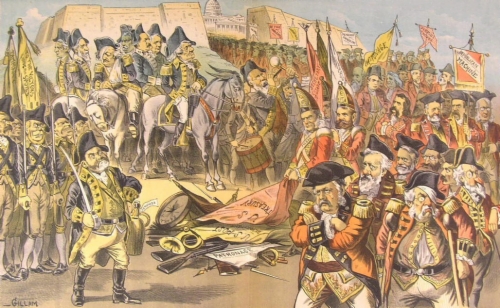 British forces being compelled to evacuate (1885) - Credit: Bernhard Gillam
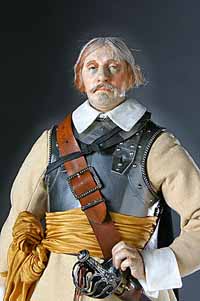 Oliver Cromwell - Credit: George S. Stuart
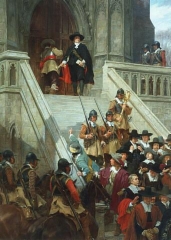 Cromwell dissolving the Long Parliament - Credit: Andrew Carrick Gow
The Protectorate was a brief period in British history when the Commonwealth of England was governed by a Lord Protector. Oliver Cromwell (1599-1658), the first lord protector to hold such powers, was in post from 1653 up until his death. He was succeeded by his son, Richard Cromwell (1626-1712), who, however, was incapable of keeping control of either the military or parliament, and was elbowed out of power by the Rump Parliament’s Committee of Safety in 1659.
 Arrow-heads used for hunting fish and birds - Credit: Texas history
Native Americans used bows and arrows both for hunting and in warfare. Arrow-heads were carved from stone, or occasionally bone or antler, before being attached to wooden shafts. Feathers were fastened to the end to make them more aerodynamic. Such articles could be found in abundance around Concord, the site of an old Native American village. Under Thoreau’s guidance, Hawthorne learned to identify and collect them, an experience he describes in ‘The Old Manse’: “You see a splinter of stone, half hidden beneath a sod; it looks like nothing worthy of note; but, if you have faith enough to pick it up — behold a relic!” (p. 8).
 Native American arrow-heads - Credit: David R. Ingham
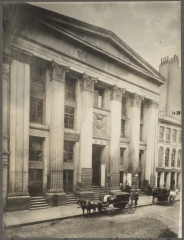 Boston Merchants' Exchange - Credit: Boston Public Library
Change is an abbreviation for the Boston Merchants’ Exchange, the center for all the city’s financial and business activities. During Hawthorne's time, this was located on State Street in a building designed by Isaiah Rogers (1800-69).
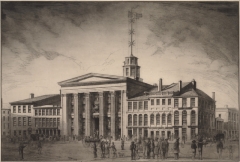 View of the Merchants Exchange, State Street and adjacent buildings, 1842 - Credit: Boston Public Library
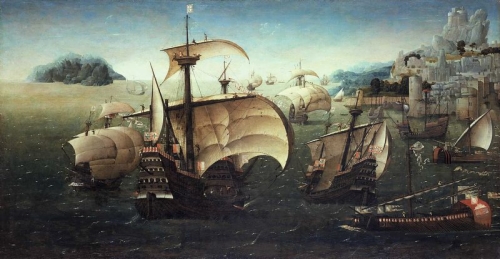 Spice trading vessels off the coast of India (c.1540) - Credit: Circle of Joachim Patinir
During Salem's golden age of sail, Elias Hasket Derby became the first American to establish trade links between India and the New World, paving the way for the city's other powerful shipping magnates. To this day, Salem retains the motto “Divitis Indiae usque ad ultimum sinum” (“To the farthest port of the rich Indies”).
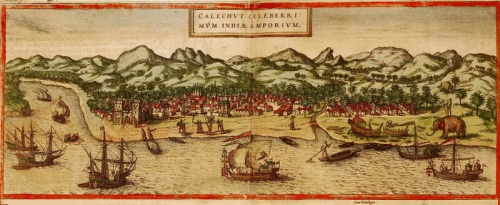 Maritime trade in India - Credit: Georg Braun and Franz Hogenberg