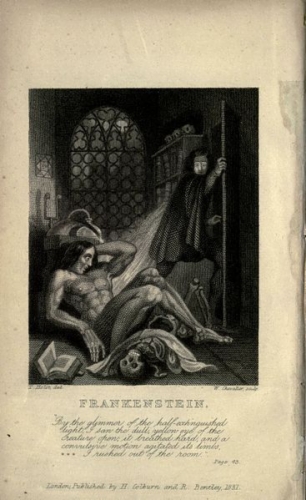
This framing device, whereby the narrative is presented as a story within a story, is a common feature of gothic literature. Mary Shelley’s Frankenstein (1818) — the inspiration for which came from a ghost-story competition hosted by Lord Byron in a setting similar to that which James depicts here — is presented through a series of fictional letters; Ann Radcliffe’s The Italian (1797) purports to be a translation of a mysterious manuscript handed to one of its characters; The Necromancer (1794) by Ludwig Flammenberg (Carl Friedrich Kahlert) is introduced as an exchange between two reunited friends. These devices encourage readers to suspend their disbelief by authenticating the improbable, but also point to the highly reflexive nature of gothic fiction, which often concerns the act and art of weaving a story as much as the contents of the tale itself.
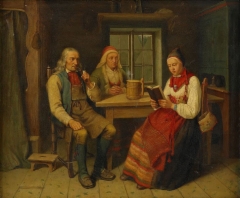
 Communal story-telling was a popular recreation - Credit: Per Eskilson
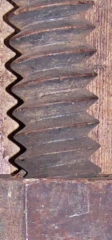
 A Turn of the Screw - Credit: Rasbak
It also provides a key to understanding the governess's role in what ensues: if turning the screw is a metaphor for an author's manipulation of the reader, then the governess's own later use of the expression is an indication that we as readers should be alert to the creative contrivances she uses to delude both herself and us.

 A beautiful hand - Credit: Kaushik Narasimhan
Readers interested in finding out what their own handwriting is supposed to reveal might like to try this online test.

 An 1887 caricature of Edward Benson from Vanity Fair - Credit: Leslie Ward
Trinity is one of the University of Cambridge’s 31 colleges (24 in 1898). Founded by Henry VIII in 1546, it has a reputation for both academic excellence and aristocratic standing — numerous members of the Royal Family have passed through its hallowed doors. Boasting courts, cloisters, a fountain and a library designed by Christopher Wren, its architecture is as stately and grand as its students.
It was a Trinity scholar, Edward Benson, the Archbishop of Canterbury, who gave James the original idea for The Turn of the Screw. The preface to volume 12 of the New York Edition tells how Benson, during an evening round the fire very much like this one, recalled a lady who once described a vaguely remembered experience of hers. It concerned "a couple of small children in an out-of-the-way place, to whom the spirits of certain ‘bad’ servants, dead in the employ of the house, were believed to have appeared with the design of ‘getting hold’ of them". Douglas, then, is a fictionalized version of Benson, and the narrator is James himself.
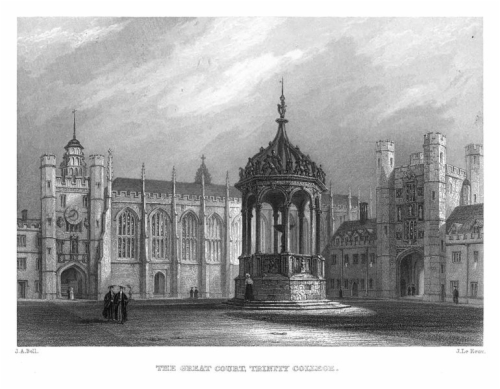 c.1840 engraving of the Great Court at Trinity College - Credit: John Le Keux

 Beech trees in spring - Credit: Malene Thyssen
The beech tree, a native of the south of England, is an ancient Celtic symbol for the written word. In a ghost story which explores the idea of textual productions as spectral entities that haunt both their characters and their readers, it is highly apposite that the tale is first relayed in the shadow of these majestic trees.
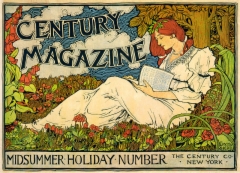 Promotional poster for Century Magazine - Credit: Louis John Rhead
Serialized fiction, whereby full-length novels were published in short, continuous sections either independently or in periodicals, was hugely popular during the 19th and early 20th centuries. The vogue for this approach was spearheaded by Charles Dickens, whose monthly Pickwick Papers (1836-7) were eagerly anticipated by a hooked public.
Many of Henry James’s novels were first published in serial form, with The Europeans (1878) and The Portrait of a Lady (1881) appearing in Atlantic Monthly, Washington Square (1880) in Cornhill Magazine, The Bostonians (1886) in Century Magazine and The Ambassadors (1903) in the North American Review. The Turn of the Screw was first published in weekly instalments in Collier's magazine between 27th January 1898 and 16th April 1899. An interesting essay on the Collier's version by Peter G. Beidler can be read here.
 Masthead illustration from Collier's publication of 'Turn of the Screw' - Credit: John La Farge
The first chapters of Washington Square in Cornhill Magazine:
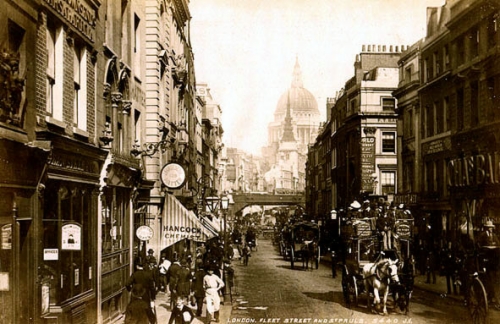 Fleet Street, c.1890 - Credit: James Valentine
London, England’s capital and the seat of the British Empire, was the largest city in the world between 1831 and 1925. Attracting immigrants from the colonies and poorer areas of Europe, its population ballooned during the 19th century from 1 million at its inception to 6.7 million in its final years. This incredible growth was accompanied by problems of overcrowding, poor sanitation, disease, pollution and a marked divide between wealth and impoverishment. For this reason, the governess's interviewer believes the countryside a fitter place for bringing up children.
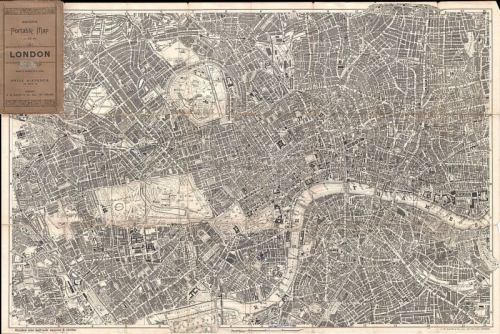 Bacon's Portable Map of London, c.1899 - Credit: Geographicus Rare Antique Maps
Rudyard Kipling’s In Partibus (1889) portrays the chaos and pollution of turn-of-the-century London. Read it here.
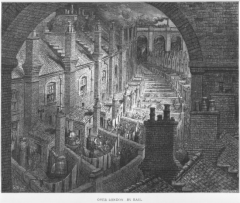 Over London - By Rail (c.1870) - Credit: Gustave Doré
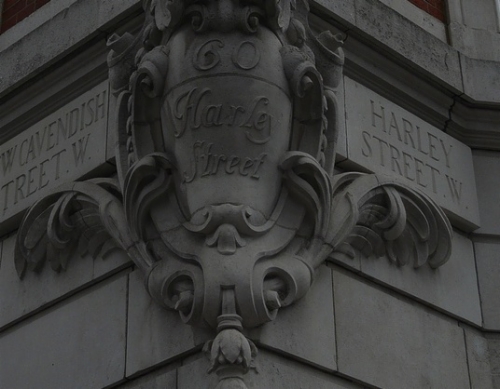 Harley St - Credit: Loz Pycock
Harley Street, in the City of Westminster, is a prestigious London street owned by the de Walden family. It has long been associated with medical and surgical practices, and the area around Harley Street now has a high concentration of medical facilities, with over 3,000 people employed in related professions. However in the period of the novella, this tradition was only just starting to take root, with fewer than 20 doctors in the area in 1860.
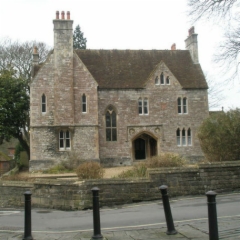 A former vicarage in Romsey, Hampshire - Credit: Basher Eyre
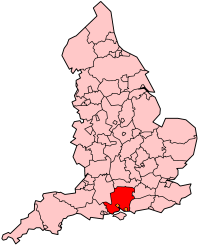 Location of Hampshire - Credit: Airunp
Hampshire is a county on the southern coast of England. It takes its name from the great port of Southampton.
A predominantly agricultural region, Hampshire was, in contrast to London, barely touched by the Industrial Revolution and is hence associated with a simpler, less sophisticated way of life.
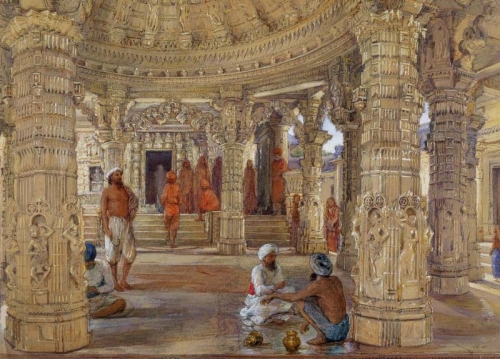 This painting of the interior of the Neminath Temple reflects 19th century British romanticized views of India - Credit: William Carpenter
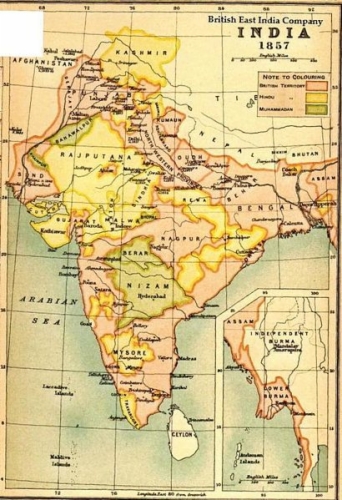 1857 map of India. Even those areas designated Hindu or Muhammadan were still indirectly controlled by the British - Credit: British East India Company
India had been under the control of the British Raj since 1858. This meant Britain depended on India for many of its raw materials and foodstuffs, and numerous British soldiers and officers were deployed there to protect those interests.
British views of India at the time were highly romanticized, with art and literature portraying it as a place of sensual exoticism. However, regular outbreaks of cholera in India claimed millions of lives during the 19th century and it may well have been this that carried off our young bachelor’s parents.
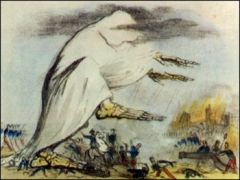 Cartoon portraying the deadly spread of cholera - Credit: National Library of Medicine photographic archive
Several critics have remarked on the suggestiveness of the name of the house in which the governess takes up her post. Bly hints both at blithe and blight, thereby evoking the ambiguity with which the novella is laced. At the same time, bly is an established — albeit uncommon — word in its own right, meaning resemblance. Although it's not known whether James was familiar with this term which, in his own lifetime, existed only as a rare British dialect usage, it is a fitting name for an arena in which appearances, and their potential to mislead, are centre stage.
This seemingly innocuous sentence, which the reader first interprets unequivocally as "she had provided for them quite beautifully", is an early instance of James's masterful technique of creating unease by probing the ambiguities of language. As the novella progresses, we begin to wonder if "done for" did not perhaps imply that the former governess had doomed the children to destruction.
Other words which initially appear to afford a straightforward interpretation also become riddled with uncertainty. "Charmed", which the governess repeatedly uses to describe her delighted adoration of Miles and Flora, carries undertones of bewitchment. Meanwhile, Mrs Grose's assertion that Quint used to "spoil" Miles is laden with suggestions of moral corruption. The culminative effect of this subtle toying with polysemy is to present language as a medium which is itself haunted; where each word is accompanied by a vague dark shadow of ulterior meaning.
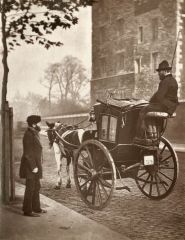
 The hansom cab pictured is a type of fly - Credit: John Thomson
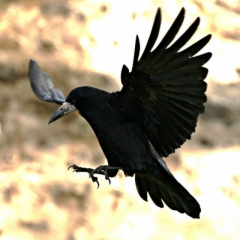 Rook - Credit: ufopilot
Rooks, along with other members of the corvid family, are considered to be birds of ill omen and their presence strikes a note of unease in this otherwise welcoming scene. Their diet of carrion and their predeliction for haunting sites of slaughter means that they are strongly associated with death. Often they will circle ailing prey as though predicting its imminent demise. Their flocking about Bly heralds the catastrophes to come.
 State bed - Credit: tethys925
State beds, though part of the bedroom furniture, were not actually used for sleeping. Rather, these grand structures, curtained by a canopy without visible supports, were used for receiving important guests. They came into fashion in the second half of the 17th century and were a feature of royal and aristocratic homes.
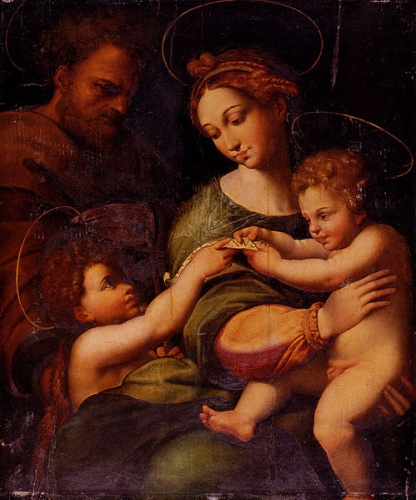 Holy Family With Saint John The Baptist - Credit: Raphael
Raphael — or Raffaello Sanzio da Urbino, to give him his full name — was an Italian Renaissance painter and architect. His enormously productive career began in early childhood when he was apprenticed to the Umbrian artist Pietro Perugino. So precocious was his talent that he was considered to be a fully-trained ‘master’ by the age of 18.
His style, which displays the influence of Perugino and the Florentine School, was widely admired for its lucidity and the grandeur and dignity it bestowed on its subjects. His work includes church altarpieces, the ‘Stanze’ or ‘Raphael Rooms’ of the Vatican and many commissioned portraits. He ran what may well have been the largest workshop of a master painter, a group of 50 pupils and assistants.
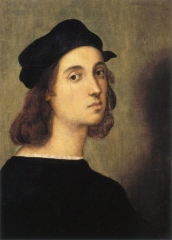 Self-portrait - Credit: Raphael
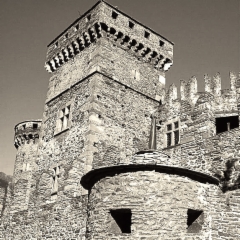 A machicolated tower - Credit: Ilario
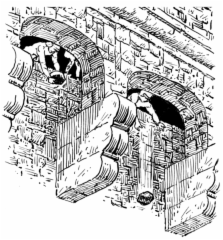 Illustration of machicolations in use - Credit: Pearson Scott Foresman
Machicolations are projecting galleries on top of a castle wall. The floors are perforated with holes through which defenders could drop missiles or boiling liquid on attackers below.
By equipping Bly with such features, James establishes it as a scene of deadly conflict.
Sprites – a vague category of supernatural entities that includes elves and fairies – are capricious creatures, equally capable of helping or hindering mortals. Puck, the “merry wanderer of the night” in Shakespeare’s A Midsummer Night’s Dream (c. 1590-96), also known as Robin Goodfellow, exemplifies their mischievous, elusive, prank-loving race.
Fairy-folk were beloved by the Victorians and inspired the paintings of genre artists such as Richard Dadd, Richard Doyle, John Anster Fitzgerald and Joseph Noel Paton. The aura of enchantment with which these artists imbue their subjects clearly influences the governess’s perception of Flora – but, as we shall see, she gradually comes to align the children with an altogether more demonic class of supernatural beings.
 Puck and the Fairies (from Midsummer Night’s Dream) (1840) - Credit: Richard Dadd
In the time of Mrs Grose's childhood, long before the introduction of the Elementary Education Act of 1870, education was a personal arrangement for which private establishments charged fees. Consequently it was a privilege accorded mainly to wealthy urban males who, it was believed, would obtain greater value from the knowledge conferred on them. Across England, average female literacy rates were around 50 per cent in the 1840s (which, we can deduce from the details Douglas gives us in the opening section, is the narrative present of the manuscript). The picture would have been worse in Essex, which had some of the lowest literacy rates in England and where most villages lacked day-schools.
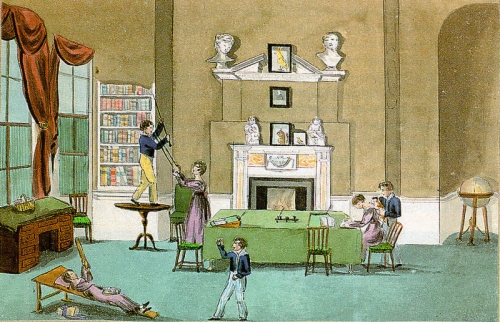
We can get a sense of what a typical schoolroom in a Victorian English country house looked like from this watercolour sketch. A globe, books and busts of historical figures line the walls. Whilst the illustration is entitled The Schoolroom in the Absence of the Governess, the antics of the children are not dissimilar to those in which Miles and Flora engage even when their elder is present.


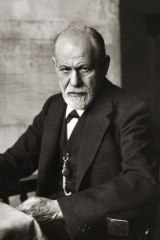 Sigmund Freud - Credit: Ferdinand Schmutzer
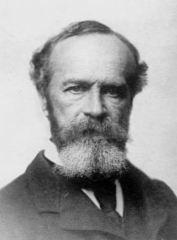
The governess's rather inappropriate rapture at Miles's sweetness and beauty smacks of what psychoanalytic literature terms 'displacement'. This concept derives predominantly from Freud, who wrote of it from the late 1880s onwards, but it has antecedants in earlier works — including, intriguingly, that of William James, Henry's brother, who is regarded as the American founding father of psychology. It describes an involuntary defence mechanism whereby inadmissable feelings are buried deep in the unconscious mind and redirected to a safe, neutral object. In this case, it seems the governess, aware that she is breaching the bounds of acceptability by harbouring a desire for her socially superior employer, diverts her adoration towards his nephew.
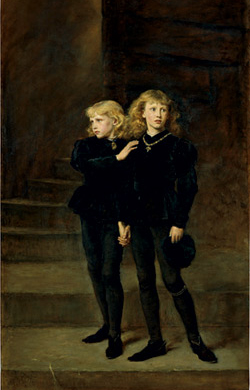 The Princes in the Tower (1878) - Credit: John Everett Millias
A prince of the blood is a legitimate male descendant of a country’s ruling monarch. The governess’s elevation of her young charges to the ranks of royalty reflects a subliminated anxiety regarding her own social position.
The idea of a pair of young princes enclosed in a towered building they cannot leave is reminiscent of Richard III's treatment of Edward V and Richard, Duke of York. After the death of their father, Edward IV, his brother Richard III was instated as the boys' legal protector, a role he fulfilled by having them incarcerated in the Tower of London and acting to prevent their succession. Both disappeared and, though no evidence was found, it was widely assumed they had been murdered. The governess's choice of simile suggests that, far from being the children's protector, she is actually their jailer - and perhaps worse.