
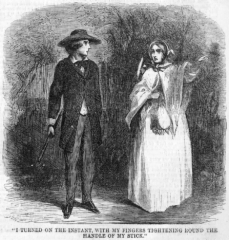
The Woman in White first appeared as a serial in Charles Dickens's periodical All The Year Round, beginning with the issue dated Saturday 26 November 1859 and ending with the issue dated Saturday 25 August 1860. The story was published simultaneously in New York in Harper's Weekly. The serialised version is an exact version of the original publication, including printing errors. You can read each episode at The Wilkie Collins Pages, with illustrations by John McLenan.

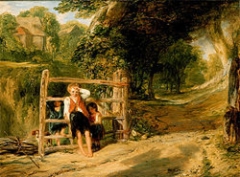
Collins's father, William Collins, was a drawing master, painter and member of the Royal Academy. He was elected an associate member of the RA in 1814 and became a full member in 1820. Wilkie Collins wrote a biography of his father in 1848.
A number of paintings by William Collins have been auctioned in recent years, including Scene from the Caves of Ulysses at Sorrento; an 1822 oil sketch of The Landing of George IV at Leith; and Children on the Shore.
In 1849 Wilkie and his brother Charles showed pictures in the summer exhibition. Wilkie’s picture was entitled The Smuggler’s Refuge. Charles’s was called The Empty Purse. The brothers were listed in the catalogue as living at 38 Blandford Square, Regent’s Park.

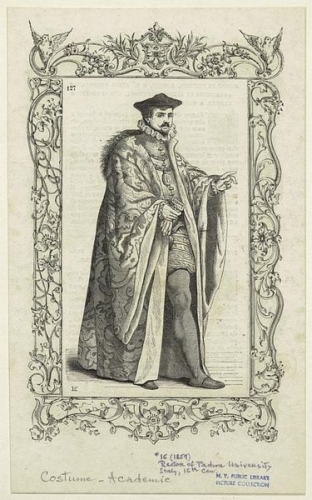
 Rector of Padua University, 16th Century - Credit: New York Public Library
The University of Padua was founded in 1222. It is the second oldest university in Italy, after the University of Bologna, and was one of the most prominent universities in early modern Europe.
From the 15th to the 18th centuries, the university was renowned for its research, particularly in medicine, astronomy, philosophy and law. It played a leading role in the identification and treatment of diseases and ailments, specializing in autopsies and the inner workings of the body. The protection of the Republic of Venice enabled the university to maintain some freedom and independence from the Roman Catholic Church.
Today, it continues as one of Italy’s leading universities.
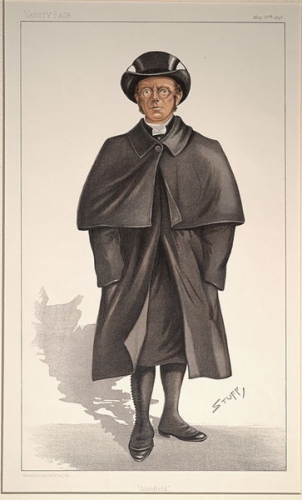 Bishop of Lichfield in gaiters, 1897 - Credit: Vanity Fair
Gaiters are garments worn over the shoe, reaching from the instep to above the ankle or to mid-calf or knee. Traditionally they were made of leather, wool or cotton.
Gaiters formed a part of the everyday clerical clothing of bishops and archdeacons of the Church of England until the middle part of the twentieth century. Ecclesiastical gaiters were made of black cotton, wool or silk, and buttoned up the sides, reaching to just below the knee where they joined with black breeches.
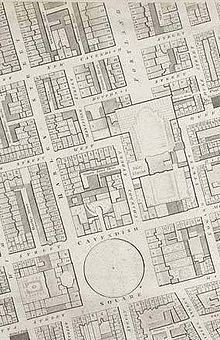 Portland Place is the wide street at the top of this 1790s map - Credit: Robert Horwood's map of London
Portland Place is a street in the Marylebone district of central London.
It was laid out for the Duke of Portland in the late 18th century. It originally ran north from the gardens of a detached mansion called Foley House. The street is particularly wide, at 33 metres. Apparently it was designed this way so as not to interfere with Lord Foley’s views to the north.
Today Portland Place still contains many spacious Georgian terraced houses, as well as some early 20th century buildings, and houses a number of company headquarters, professional bodies, embassies and charities.
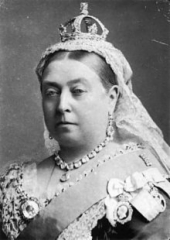 Queen Victoria, 1882 - Credit: Alexander Bassano
Victorians were believers in 'self-help'. This convenient philosophy meant that they could refuse help to the poor, whom they believed could become successful through sheer hard work and thrift. Many Victorians (not all) felt that the poor were to blame for their own poverty. They were thus not unfortunate, but had chosen to be indolent and poor. This is why the workhouse was intended to be as unpleasant as possible, to discourage people from asking for help from the state.
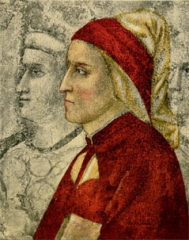 Dante Alighieri, in the chapel of the Bargello palace in Florence - Credit: Giotto di Bondone, 14th century


Such an encounter was recorded by John Millais in his biography of his father, a close friend of Wilkie Collins. Millais's father and Collins were walking together through the then semi-rural North London, when a woman darted across their path, her white robes gleaming in the bright moonlight. While Millais reflected on her beauty, Collins took up the chase. The young woman eventually became his mistress, Caroline. Caroline and Wilkie never married, but they lived together for some 30 years.
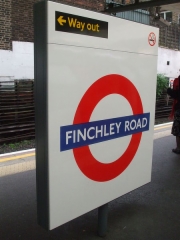
 Finchley Road tube sign - Credit: Sunil060902
Finchley Road is one of north London’s major thoroughfares.
It was built as a toll road in the late 1820s/early 1830s to provide a by-pass to the existing route north from London, which went through Hampstead. The Hampstead route contained two steep hills, either side of Hampstead Village, and was difficult for horses with carriages to negotiate when muddy.
The new road was built at the same time as Regent's Park was created. It started from what was then called the 'New Road' (now Euston Road and Marylebone Road) and ran north. As the road crossed the boundary of Finchley it became Regent's Park Road. It ended where it joined the Great North Road as Ballards Lane. There was a tollgate at Childs Hill.
Many grand houses were built along the road.
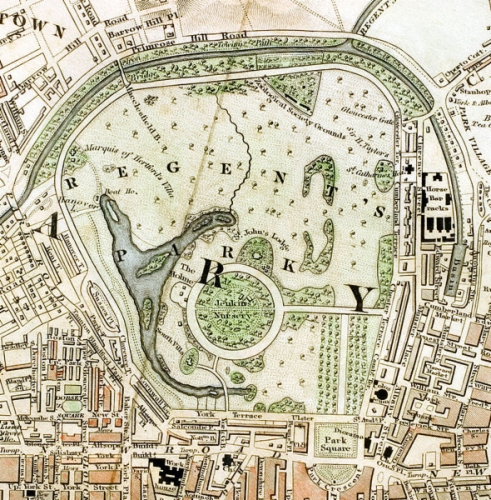 Regent's Park London, 1833 map - Credit: W. Schmollinger
Regent's Park is one of London’s Royal Parks. It is located in north-central London, and includes Regent’s College and London Zoo.
The land was appropriated by Henry VIII during the Dissolution of the Monasteries. At first, it was set aside as a hunting park, known as Marylebone Park. From 1649 it was let out in small holdings for hay and dairy produce.
In 1811, the Prince Regent commissioned architect John Nash to develop a masterplan for the area. It was developed as a park, surrounded by terraces of houses. The park was first opened to the general public in 1835 - initially for just two days a week.
 Photograph of a hansom cab, From 'Street Life in London', 1877 - Credit: John Thomson (1837-1921)
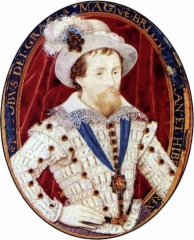 Portrait of James I of England, 1603-09 - Credit: Nicholas Hilliard
Baronet is a hereditary title awarded by the British Crown. The practice of awarding baronetcies was originally introduced in England in the 1300s, although it was little used until the 1600s.
The present hereditary Order of Baronets in England dates from 1611, when King James I granted the first Letters Patent to 200 gentlemen of good birth with an income of at least £1000 a year. The baronets formed the sixth division of the aristocracy, after the five degrees of the peerage, but above the knights. They paid for the honour – each man had to contribute funds to cover the upkeep of thirty soldiers for three years, which amounted to £1095 (a huge sum in 1611).
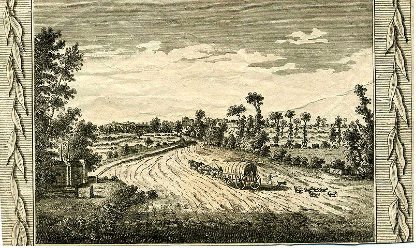
Turnpikes were introduced in the 18th century to raise local funds to improve the road system. Parliament gave bodies of local trustees powers to levy tolls and these trusts remained active for most English trunk roads until the 1870s.
The place where Walter meets the woman in white is now the junction of Finchley Road, Frognal Lane and the top part of West End lane.