



 Moosehead Lake from Little Spencer Mountain - Credit: Bob Flavin
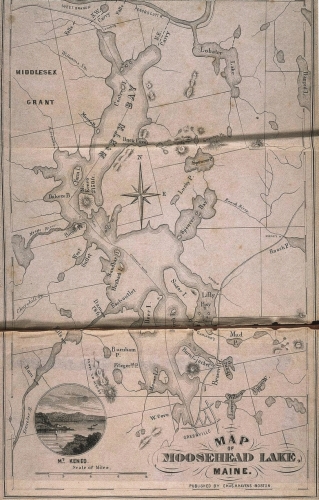
 Map of Moosehead Lake, 1870 - Credit: Maine Historical Society
The setting for much of Tinkers is West Cove, a small town on the southern shore of Moosehead Lake in northern Maine.
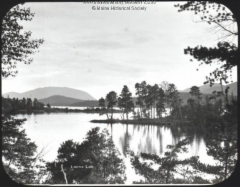 View of Moosehead Lake and Mountains Beyond, 1900 - Credit: Maine Historical Society, Vintage Maine Images
This was – and still is – a remote area of New England. Moosehead Lake is the largest mountain lake in the eastern United States, with 400 miles of shoreline and a long, legendary history.
This illustrated 1880 guidebook by Charles Alden John Farrar – Moosehead Lake and the North Maine Wilderness – is a window into the character of this area of Maine in the mid-19th century.

 Maine Map with Moosehead Lake Region Highlighted - Credit: National Atlas of the United States
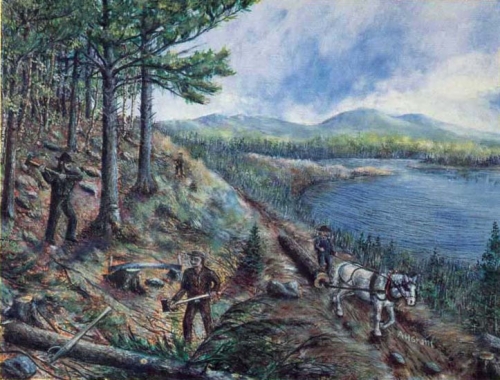 Cutting and Twitching Off a Hillside, Alden Grant, 1987 - Credit: Rangeley Lakes Region Logging Museum
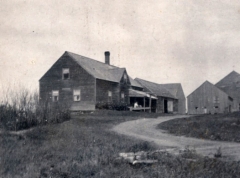 Shaw Place, East of Farm Island-Moosehead Lake Region - Credit: Moosehead Historical Society
During this period, Maine’s economy was based on natural resources: fish, granite, ice and logging. The hard physical labor it demanded was seasonal and often harsh. The long winters could be particularly difficult; old-time Mainers claim they have only two seasons – July and Winter. Small subsistence farmers like Howard relied on lumbering, hunting and fishing (and tinkering) for cash, and farmed only to meet their family’s needs.
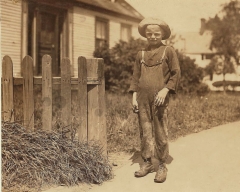 Wilfred Clark,10 years old, from Eastport Maine, 1911 - Credit: Library of Congress
The “regional tradition of self-sufficient small farming” in the early 20th century is recorded in this 1930 film – Rural Life in Maine – by Elizabeth Woodman Wright. It captures daily life at her family’s summer farm, Windy Ledge.
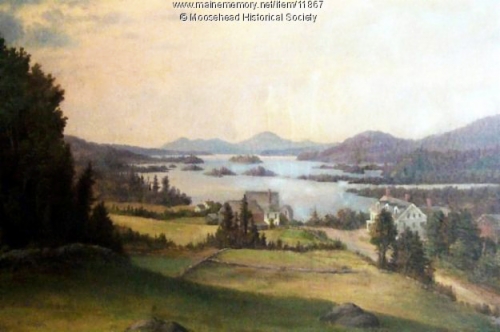 View From Indian Hill-Greenville, Seth Wyman Steward, 1897 - Credit: Moosehead Historical Society
Greenville – situated at the southern-most end of Moosehead Lake – most closely resembles Harding’s fictional West Cove, where Howard lived and George grew up. In the 1870 Map of Moosehead Lake, West Cove is just west of Greenville (an area currently known as Greenville Junction).
The earliest settlers were farmers and loggers. Nathaniel Haskell was one of the first settlers in the area, he purchased good farmland and built his house in 1827. In 1836, the present Village of Greenville was incorporated.
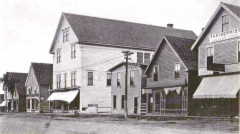 Village of Greenville, 1850's - Credit: Moosehead Historical Society
The first store in town was opened in 1845, and in 1846, a small steamboat was built to transport rafted logs on Moosehead Lake.
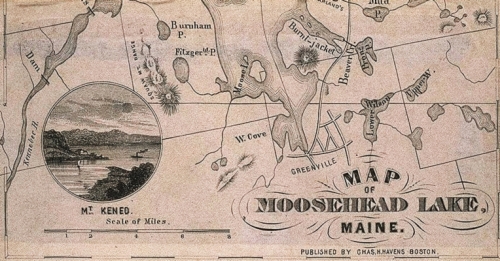 Moosehead Lake Map-West Cove and Greenville, 1870 - Credit: Maine Historical Society
By 1886, the village and surrounding area had grown to over 775, and was becoming the starting point and base of supplies for lumbermen, explorers, fishing parties, hunters and tourists. This would have been around the time that Howard was a boy.
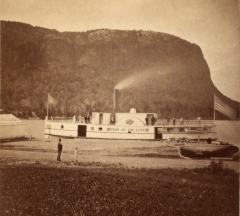 The Steamboat Fairy of the Lake, Mt. Kineo, Moosehead Lake, 1870 - Credit: Robert N. Dennis Collection
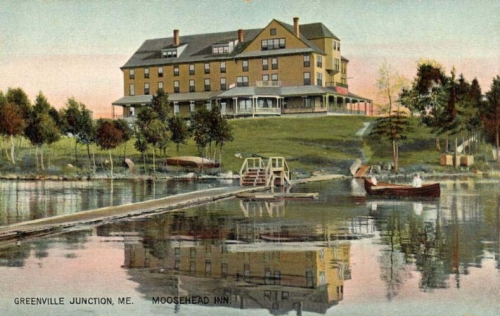 The Moosehead Inn in Greenville Junction, Maine, 1908 - Credit: Postcard, Hugh C. Leighton Company, Portland, Maine
By the 1870s, a “romantic” Maine began to emerge as visitors re-discovered Maine through the writings and paintings of transcendentalists, and as entrepreneurs began to promote the Moosehead Lake region for hunting, fishing and camping. The Boston & Maine Railroad advertised this area as “The Great Fishing and Hunting Grounds of New England”, and summer tourists from Portland, Boston, and New York came, seeking recreation and relief from urban pollution.
The introduction to Lucius L. Hubbard’s “Guide to Moosehead Lake and Northern Maine”, published in 1893 begins: “To the care-worn business man and overworked student, no relaxation from the constant wear of their respective callings is so grateful as that which comes while camping in the woods.” Hubbard also wrote “Woods and Lakes of Maine” in 1884, chronicling his trip from Moosehead Lake to New Brunswick in a birch-bark canoe.
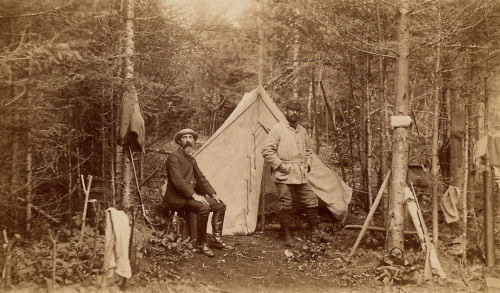 Camp Russell, a Hunting Camp North of Moosehead Lake in Maine - Credit: John W. Dunn
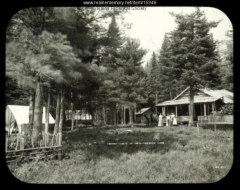 Smith's Camp, Northeast of Greenville, 1900 - Credit: Maine Historical Society
Some of the dialogue in Tinkers reflects what’s often called “downeast” character and wit: the stubborn logic of the backwoods women as they argue with Howard about soap (p. 13), and the half-told limerick shared between George and his son, Sam (p 53).
The recorded jokes and reminiscences of Bert Call, a professional photographer from the mid-1880’s to 1944 in Dexter Maine, are particularly good examples of old-time Maine humor and storytelling.
Before the Civil War began in 1861, a few adventurous travelers – including transcendentalist writers Henry David Thoreau and James Russell Lowell, and the artist Frederic Edwin Church, among others – came searching for spiritual renewal in the pristine wilderness of north woods Maine.
Frederick Church’s painting of Mt. Katahdin, “Twilight in the Wilderness” reflects the Hudson River School’s romantic view of nature. The School’s founder, Thomas Cole, is said to have remarked, “Nature has spread for us a rich and delightful banquet. Shall we turn from it?..We are still in Eden.”
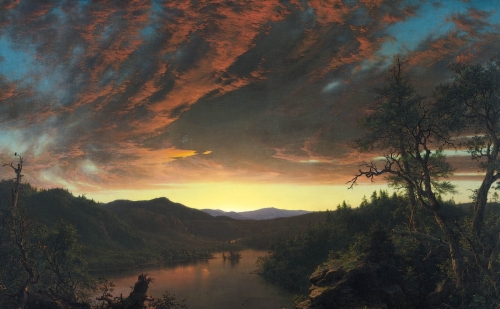
“The Maine Woods” is a journal that Henry David Thoreau kept during three trips to the Maine north woods from 1846 to 1857. In it, he observes and reflects on history, geography and the nature and the human condition. In a May, 1851 journal entry, Thoreau wrote, “How important is a constant intercourse with nature and the contemplation of natural phenomena to the preservation of moral and intellectual health!”
Time, space, consciousness and memory continue to intrigue philosophers, artists, scientists, mathematicians and poets. In the 20th century, Albert Einstein, whose special and general theories of relativity changed our view of traditional time-space relationships, famously quipped: “The only reason for time is so that everything doesn’t happen at once”.
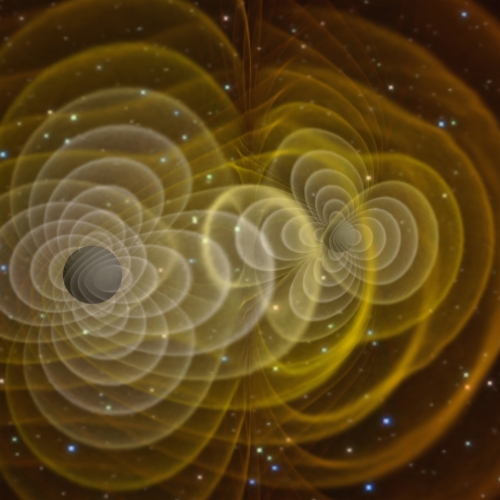 What Einstein Envisioned: Simulation of General Relativity Theory and Merging Black Holes - Credit: Original Work of NASA
Some art historians speculate that the surrealist Salvador Dali’s famous paintings – The Persistence of Memory (1931) and The Disintegration of the Persistence of Memory – represent a meditation on the collapse of our notions of a fixed cosmic order in Einstein’s universe.
David Eagleman continues this exploration. An assistant professor of neuroscience at Baylor College of Medicine, he is fascinated with time and human consciousness. Eagleman feels that “clocks offer at best a convenient fiction… They imply that time ticks steadily, predictably forward, when our experience shows that it often does the opposite: it stretches and compresses, skips a beat and doubles back”.
Harding’s writing is deeply influenced by music. “Having been a drummer, I write by ear, I write by rhythm” – 2009 interview.
“Sometimes you get the rhythm before you get the meaning of the sentence, the rhythm leads you to the meaning of the sentence and it feels simultaneously subjective but also objective. You know when there’s a beat too long in that sentence somewhere, where is it? Then you drop it and get the rhythm right and suddenly the meaning is revealed.” – Interview with Carlin M. Wragg, Editor, OpenLoopPress, January 2010
Harding is a great admirer of the master drummer, Elvin Jones. Jones spent much of the 1960s playing with John Coltrane’s band, and was known for his complex rhythmic juxtapositions and superimpositions. In this video, Jones demonstrates polyrhythm: the simultaneous sounding of two or more independent rhythms, different time signatures played over top of each other.
“Each passage, each phrase is structured by a specific number of tempos, pauses, beats; it sounds like a certain note, to stay in the theme. Everything I write seems like improvised music at the start.” – Vogue interview with Stefania Cubello, February 21, 2011
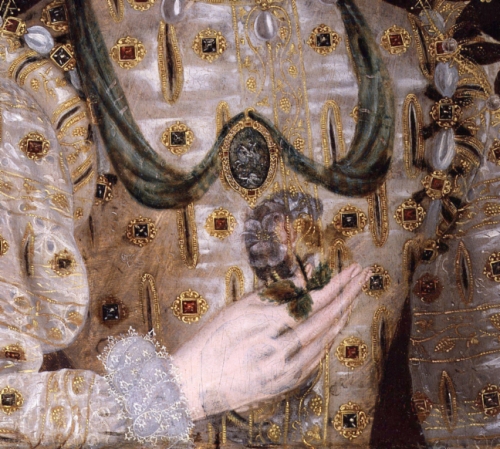 Pentimento Detail in Portrait of Queen Elizabeth I - Credit: National Portrait Gallery
Harding’s prose is intensely visual; his story, woven with multiple layers. A word he has used to explain this visual layering is the term pentimento. The word is derived from the Italian pentirsi, meaning to repent or regret, and is used in the art world to describe underlying traces of the artist’s previous work, still visible in the final painting. This portrait of Queen Elizabeth I in London’s National Portrait Gallery is a classic example of pentimento.
This word has a dual meaning in Tinkers: it reflects George’s regret that he had not reconciled with his father before his death. It also describes the story’s composition and George’s layered memories.
The author and playwright Lillian Hellman explained her choice of the title “Pentimento” for her 1973 book in this way: “Old paint on a canvas, as it ages, sometimes becomes transparent. When that happens it is possible, in some pictures, to see the original lines: a tree will show through a woman's dress, a child makes way for a dog, a large boat is no longer on an open sea. That is called pentimento because the painter "repented," changed his mind. Perhaps it would be as well to say that the old conception, replaced by a later choice, is a way of seeing and then seeing again. That is all I mean about the people in this book. The paint has aged and I wanted to see what was there for me once, what is there for me now”.