
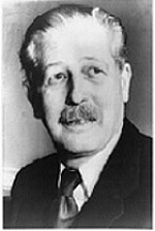
What Macmillan actually said was: "Let us be frank about it: most of our people have never had it so good". This has been commonly paraphrased as 'You never had it so good.' The echo of the phrase in the title of the book is partly ironic - the boy and his family are not well off - and partly literal, for the author remembers the period as largely a happy time, one in which people were wont to say, 'We made our own enjoyment.'

The characters in the family are fictional, but the author admits to drawing on some of the history and characteristics of his real-life family.
The father, Frank, is loosely based on the author's father Ellis (1914-79) who was a miner all his working life, and enjoyed his pint at the weekend.
The mother, Bella, is loosely based on the author's mother Alice (1914-88) who, like most of the pitmen's wives in those days, was a full-time housewife.
The eldest sister Sally is an amalgam of the author's two oldest sisters Shirley and Olwen.
The middle sister Rose is loosely based on the author's sister Joyce, though she was actually a nurse rather than a factory worker (Shirley and Olwen both had spells working in a local factory). Rose's boyfriend Vince is based on Joyce's boyfriend Gordon, a miner and occasional horse-keeper, whom she subsequently married (and they are married still).
The youngest sister Jeannie, hardly more than a baby in the stories, would be about the same age as the author's youngest sister Susan.
The oldest brother Eddie is loosely based on the author's oldest brother Eric. Like Eddie, Eric left home to join the Royal Navy.
The middle brother Malcolm, a couple of years older than David in the stories, is loosely based on the author's brother Kevin. In real life Kevin went to the Grammar School, unlike Malcolm in the book. Like Eric, he also later joined the Royal Navy.
Here are some family pictures. You may be able to spot some of the models for the characters in We Never Had It So Good.
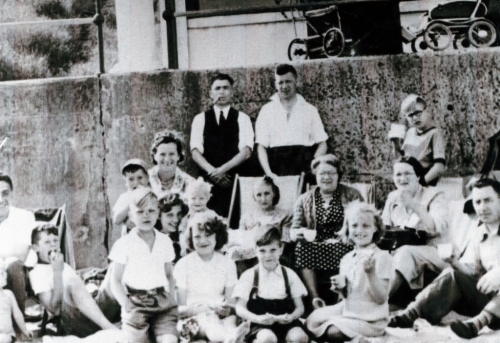
 Some of the extended family, Newbiggin beach, early 1950s - Credit: The Williams family
 The nuclear family, Olwen's wedding, late 1950s - Credit: The Williams family
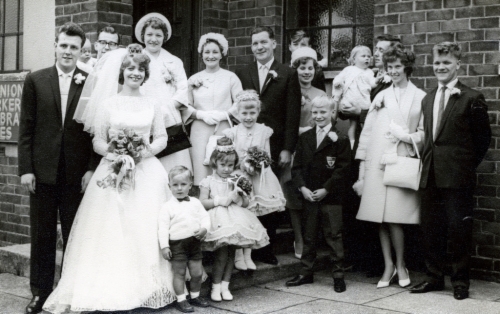 The family with spouses, Joyce's wedding, early 1960s - Credit: The Williams family
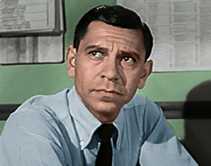 Jack Webb - Credit: Terry Guntrip
Dragnet, created by and starring Jack Webb, ran from 1951 to 1959 after earlier popularity on American radio. Over succeeding decades the series was remade three times - the 1960s, the 1980s and the 2000s. It was a very realistic series for its time, with many of the stories being pulled from the files of the Los Angeles Police Department. Often, some of the people involved in the original cases were given walk-on parts in their story.
Here's the intro to the original TV series.
All of the stories in this collection are set in and around the author's real childhood home of Ashington.
Ashington owed its existence to the coal mines, and was once said to be "the world's largest mining village". Sadly, not one deep mine now operates anywhere in the North East.
The father in these stories, like the majority of men in the community, works as a miner in one of the local pits, as does Rose's boyfriend, Vince. The reason for the large number of working men's clubs is that after a week's work down the mine most would slake their thirst heavily in the clubs that sold their members cheap beer. (See also bookmark p.149 on the drinking culture.)
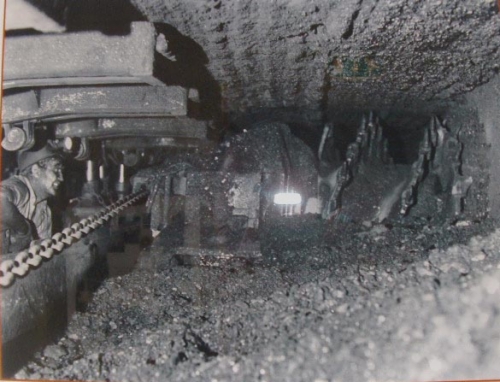
The pictures below illustrate the conditions for men working underground at about this time.
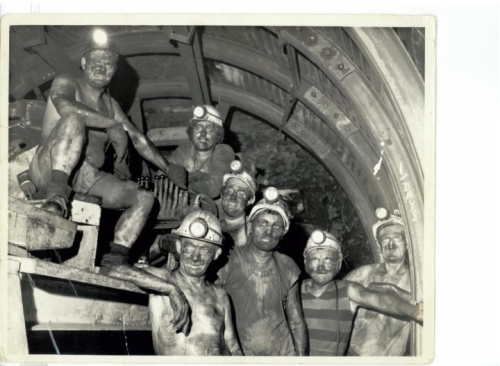 Miners1 - Credit: Pete C
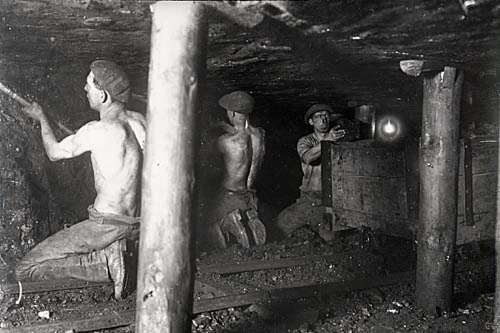 Miners2 - Credit: Pete C
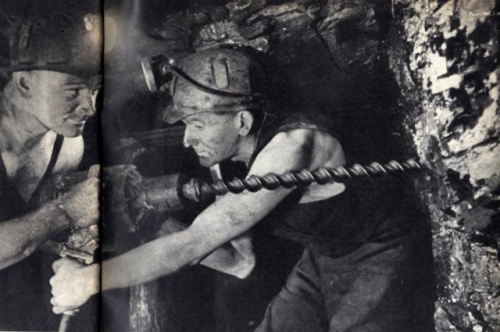 Miners - Credit: Pete C
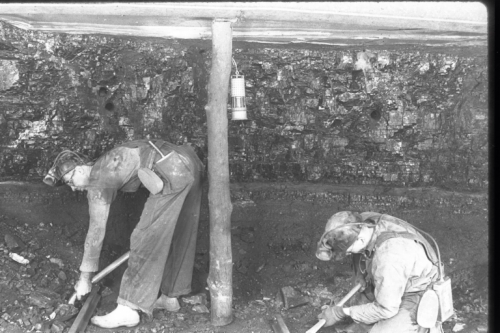 Mining coal - Credit: Pete C
 Miner 1 - Credit: Pete C
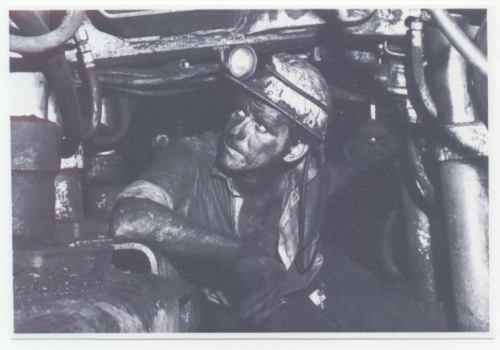 Miner2 - Credit: Pete C
 Penny for the guy - Credit: Paddy Patterson
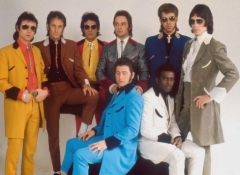 Teddy boys - Credit: Paul Townsend
Teddy boys were a common sight in Britain in the late 1950s. They wore distinctive Edwardian-style clothes, bootlace ties, drainpipe trousers and 'beetle-crusher' shoes. They danced to the music of both British and American rock 'n' roll. Heroes included Elvis Presley, Gene Vincent, Eddie Cochrane, Little Richard and Jerry Lee Lewis.
Here's a montage of 1950s teddy boys and girls, accompanied by some rockabilly music.
The 'tanner' was a slang term for sixpence in pre-decimal currency. See bookmark p.27 for an extensive note on the currency used in Britain in the late 1950s.
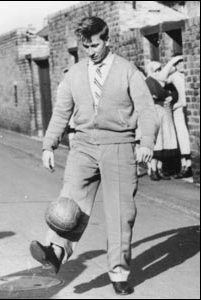 Bobby Charlton in the back street near his old home - Credit: Newcastle Chronicle & Journal Ltd
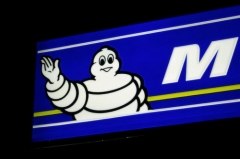 The Michelin Man - Credit: Caffeina
The Michelin Man also known as Bibendum, is the distinctive symbol of the Michelin tyre company. It is one of the oldest trademarks in the world, having been introduced in 1894. The name of the plump tyre-man has entered the language to describe someone obese or wearing comically bulky clothing.
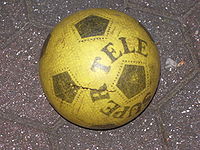
 Penny floater - Credit: Andrew Lawson
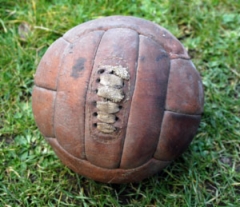
 The old leather 'caser' - Credit: Mateer
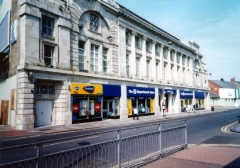 Ashington Co-op - Credit: ian56
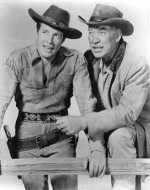 Ward Bond and Bob Horton on Wagon Train - Credit: Terry Guntrip
Wagon Train theme on Spotify: Lawrence Welk – Wagon Train
Here's the orginal TV intro (contemporaneous with the story):
And here are the intro and closing credits of the early 60s colour version (look out for a famous name in the credits):
Charlie Chaplin's heyday as a screen star was long past, but he could still be seen in the old movies, and his trademark walk was much copied. There's a reminder of it in the clip below.
A real shop in Ashington. In those days, long before 24 hour stores, it could be a blessing to find a shop open after 5pm, and on Sunday. If you ever wanted an emergency purchase in the evening, Rodways general dealers was the place to go. It was a small corner shop, but seemed to contain everything. The kind of northern corner shop Rodways represents was affectionately lampooned several years later by Ronnie Barker as Arkwright and David Jason as Granville in the BBC TV comedy Open All Hours.
Here's a clip from that programme.
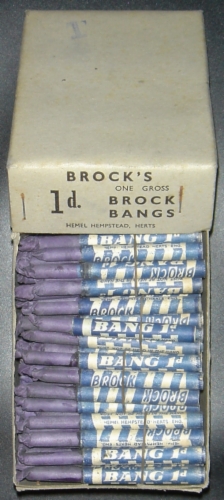 Box of Brocks Bangers - Credit: Martin Weselby
In the 1950s, British kids could buy loose fireworks, including bangers, from the corner shop. Bangers would be used as weapons in street play long before Bonfire Night.
 Benwell penny banger - Credit: Martin Weselby
 Rainbow Mighty Midget Banger - Credit: Martin Weselby
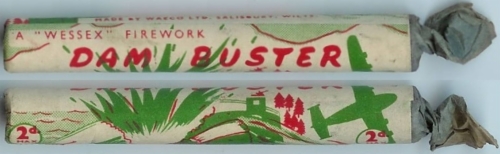 Bigger Dam Buster Banger - Credit: Martin Weselby