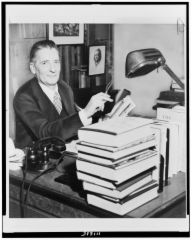
 Maxwell Perkins, 1943
The Old Man and the Sea is dedicated to two of Hemingway's friends:
Charlie Scribner was Charles Scribner III, also known as Charles Scribner Jr., who served as president of Charles Scribner's Sons from 1932 until his death in February 1952. The Old Man and the Sea, which was first published in Life magazine in September 1952, was therefore dedicated to him posthumously.
Max (or Maxwell) Perkins served as Hemingway's editor from the publication of his first major novel, The Sun Also Rises, through The Old Man and the Sea. Perkins also served as editor for Thomas Wolfe and F. Scott Fitzgerald.
You can see photos of the first edition of the book here.
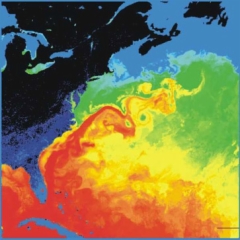 The Gulf Stream; warmer water is red, colder is blue. NASA image.


Salao is a Latin American slang term for "jinxed." See discussion here.
Note repeated references to "defeat" and "undefeated" throughout the novel. For example, on page 10 Hemingway writes, "Everything about him was old except his eyes and they were the same color as the sea and were cheerful and undefeated."
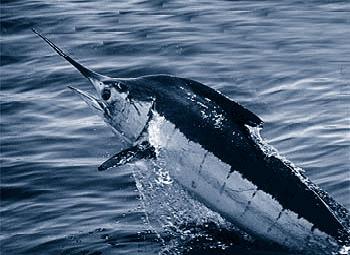 Atlantic blue marlin
The Atlantic blue marlin can reach almost twenty feet in length. Marlin "are incredibly fast swimmers, reaching speeds of about 110 kilometres per hour (68 mph)."
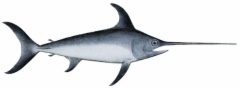 Swordfish
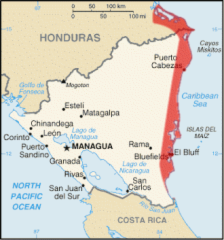
 The Mosquito Coast (in red) - Credit: Anonymous
"Turtle-ing" is a reference to hunting for sea turtles.
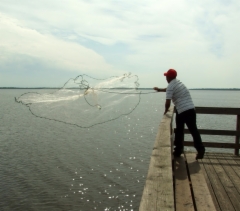
 Fisherman using a cast net. - Credit: Euku
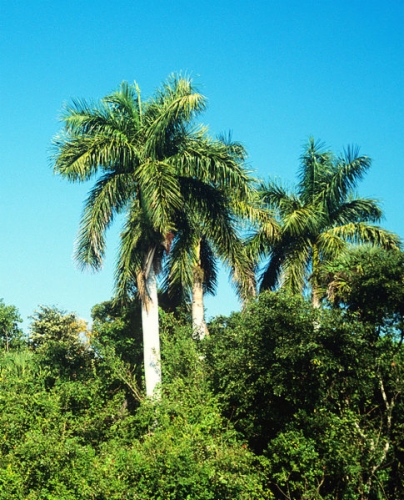 Royal palm (Roystonea regia)
The royal palm (Roystonea regia) is a species of palm tree indigenous to the Caribbean, generally growing 15-20 meters (approximately 50-65 feet) in height.
On the other hand, "in Spanish-speaking countries, guano is a common name applied to Coccothrinax species" of palm tree, which is characterized by fan-shaped leaves that are often used for thatch in buildings.
Hemingway mistakenly conflates the two types of palm trees in this sentence. Apparently he wasn't sure who his fronds were.
 Coccothrinax argentea - Credit: Scott Zona
Regarding "budshields," according to the EDIS, University of Florida IFAS Extension, "the growing point of the palm [from which all leaves originate] . . . is often called the bud or heart." The leaves or fronds that grow from it are called "budshields" and are used as building material in poverty-stricken areas in the Caribbean.
For a helpful discussion of Hemingway's obscure references in this sentence, see WordReference.com.
Here is how to thatch a palm frond roof. You can see a roof made of guano palm leaves here:

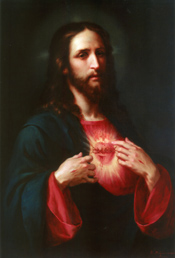 Depiction of "the Sacred Heart of Jesus"
The Sacred Heart of Jesus "is a devotional name used by some Roman Catholics to refer to the physical heart of Jesus Christ as a symbol of Divine love."
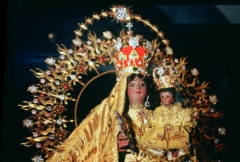 Our Lady of Charity, also known as Our Lady of Cobre - Credit: Francisco Javier Arbolí
According to sacred-destinations.com, the Virgin of Cobre, also known as the Virgin of Charity, dates back to 1608: "two Indians and a slave boy were gathering salt on the coast near El Cobre [Cuba] when they saw something floating in the water. It was a small statue of the Virgin Mary, carrying the Christ child and a gold cross. She floated on a board bearing the inscription, Yo soy la Virgen de la Caridad, 'I am the Virgin of Charity.' . . . Today, the Virgin of Charity in El Cobre continues to receive streams of visitors and stacks of votive gifts."
 Joe DiMaggio, 1937
Here Santiago and Manolin discuss their hero, New York Yankees center fielder Joe DiMaggio, and Santiago thinks of him more than once while he is out fishing. Clearly both have a strong interest in professional American major league baseball.
Joe DiMaggio began playing for the New York Yankees in 1936. He never played for any other professional team. By the early 1950s, when The Old Man and the Sea was written, he was a living legend among baseball fans. With him on the team the Yankees won the World Series in 1936, 1937, 1938, 1939, 1941, 1943, 1947, 1949, 1950, and 1951. He retired from baseball after the 1951 season because he was "full of aches and pains."
According to joedimaggio.com, “DiMaggio was a beautiful hitter with a classic swing. He had an exceptionally wide stance that gave him a controlled short stride, strong wrists that generated enormous power, and the ability to wait until the last instant before lashing into a pitch.” He was also an outstanding fielder and base runner. No wonder the old man always refers to him reverently as "the great DiMaggio."
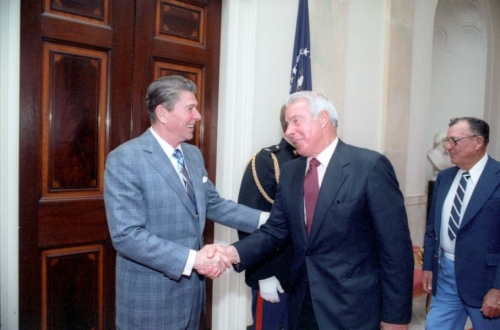 Joe DiMaggio shakes hands with President Ronald Reagan, 1981
According to Wikipedia, DiMaggio remarked on his retirement in December 1951: "I was full of aches and pains and it had become a chore for me to play. When baseball is no longer fun, it's no longer a game, and so, I've played my last game." Born in 1914, DiMaggio died of complications related to lung cancer on March 8, 1999.
Santiago want to buy a lottery ticket that ends in 85: eg XXXXXX85
In parts of Latin America, if your ticket corresponds with the winning number in at least these last numbers you win a small prize.
This oft-quoted line refers to the fact that "the great [large] fish come" in September, the month during which the novel takes place; smaller fish are plentiful in May. Thus it takes greater strength, skill, and endurance to be a fisherman in September than in May.
Hatuey beer was a popular Cuban beer bottled by the Modelo Brewery starting in 1948. Manolin means he returns the bottles when they are empty to receive some money back on them.
Hatuey beer is making a comeback.
 The original Yankee Stadium in the year it opened, 1923
The American League and the National League are the "two leagues that make up Major League Baseball in the United States and Canada."
Since we know the story takes place in September and the year is probably 1951 (the book was published in 1952, and 1951 was DiMaggio's last season), below is the Yankees' schedule for September 1951. (Their entire 1951 schedule can be found here.)
We might even attempt to determine the exact day of the story, based on Manolin and Santiago's talk about teams on page 17 and the fact that the Yankees "lost today."
|
Game |
Date / Box Score |
Opponent |
Score |
Decision |
Record |
|
128 |
09-01-1951 |
at Washington Senators |
4-0 |
W |
81-47 |
|
129-I |
09-03-1951 |
at Philadelphia Athletics |
3-1 |
W |
82-47 |
|
130-II |
09-03-1951 |
at Philadelphia Athletics |
2-3 |
L |
82-48 |
|
131 |
09-05-1951 |
vs Boston Red Sox |
2-4 |
L |
82-49 |
|
132 |
09-07-1951 |
vs Washington Senators |
4-2 |
W |
83-49 |
|
133 |
09-08-1951 |
vs Washington Senators |
4-0 |
W |
84-49 |
|
134-I |
09-09-1951 |
vs Washington Senators |
7-5 |
W |
85-49 |
|
135-II |
09-09-1951 |
vs Washington Senators |
2-0 |
W |
86-49 |
|
136-I |
09-11-1951 |
vs St. Louis Browns |
3-4 |
L |
86-50 |
|
137-II |
09-11-1951 |
vs St. Louis Browns |
3-6 |
L |
86-51 |
|
138 |
09-13-1951 |
vs Detroit Tigers |
2-9 |
L |
86-52 |
|
139 |
09-14-1951 |
vs Detroit Tigers |
5-2 |
W |
87-52 |
|
140 |
09-15-1951 |
vs Detroit Tigers |
4-7 |
L |
87-53 |
|
141 |
09-16-1951 |
vs Cleveland Indians |
5-1 |
W |
88-53 |
|
142 |
09-17-1951 |
vs Cleveland Indians |
2-1 |
W |
89-53 |
|
143 |
09-18-1951 |
vs Chicago White Sox |
1-7 |
L |
89-54 |
|
144 |
09-19-1951 |
vs Chicago White Sox |
5-3 |
W |
90-54 |
|
145 |
09-20-1951 |
vs Chicago White Sox |
5-4 |
W |
91-54 |
|
146 |
09-21-1951 |
at Boston Red Sox |
5-1 |
W |
92-54 |
|
147 |
09-22-1951 |
at Boston Red Sox |
0-5 |
L |
92-55 |
|
148 |
09-23-1951 |
at Boston Red Sox |
6-1 |
W |
93-55 |
|
149 |
09-26-1951 |
vs Philadelphia Athletics |
1-4 |
L |
93-56 |
|
150-I |
09-28-1951 |
vs Boston Red Sox |
8-0 |
W |
94-56 |
|
151-II |
09-28-1951 |
vs Boston Red Sox |
11-3 |
W |
95-56 |
|
152-I |
09-29-1951 |
vs Boston Red Sox |
4-0 |
W |
96-56 |
|
153-II |
09-29-1951 |
vs Boston Red Sox |
3-1 |
W |
97-56 |
|
154 |
09-30-1951 |
vs Boston Red Sox |
3-0 |
W |
98-56 |
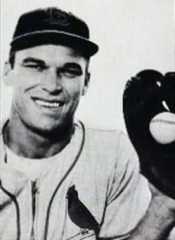 Dick Sisler, 1953
Dick Sisler was a first-baseman and left-fielder who played for the Philadelphia Phillies from 1948-51.
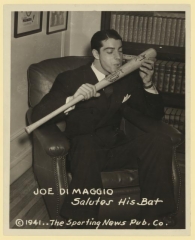 Joe DiMaggio salutes his bat (1941)
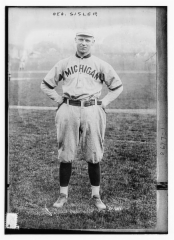 George Sisler at the University of Michigan, early 1900s
Dick Sisler's dad was "Gentleman George" (or sometimes "Gorgeous George") Sisler. He played professional baseball from 1915 to 1930. He was born in 1893, which means he started "playing in the big leagues" when he was about twenty-two. It seems unlikely that Manolin is that old.
"Before the mast" means to serve "as a common sailor, because the sailors live in the forecastle, forward of the foremast."
According to Wikipedia, "Square rig is a generic type of sail and rigging arrangement in which the primary driving sails are carried on horizontal spars which are perpendicular, or square, to the keel of the vessel and to the masts." Below is a video of the lovely French square-rigged ship Belem sailing into Boston Harbor in 2008.
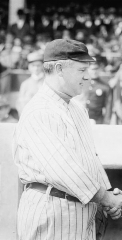 John J. McGraw, 1912
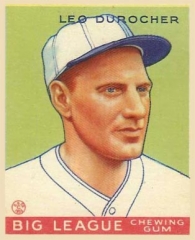 Leo Durocher baseball card from 1933
According to Wikipedia, "Durocher still ranks tenth in career wins by a manager."
 Dolf Luque, 1911
"Dolf Luque, in full Adolfo Domingo Luque Guzman, byname the Pride of Havana or Papá Montero (born Aug. 4, 1890, Havana, Cuba—died July 3, 1957, Havana), Cuban professional baseball player and manager who was the first player from Latin America to become a star in the U.S. major leagues. . . . Although he was an outstanding player in the major leagues, Luque’s most important legacy to baseball is his career in Cuba. He played more than half of his 23 Cuban seasons with Almendares, the team he debuted with in 1914. Luque had 93 wins and 62 losses in official Cuban League games, but he also barnstormed throughout the island, hiring himself out to several sugar mill teams. He managed eight Cuban League championship teams between 1919 and 1947 and was elected to the Cuban Baseball Hall of Fame in Havana in 1958" (britannica.com).
 Mike González with the New York Giants, 1920
During the day, because the land is warmer than the ocean causing the air above it to rise faster, a sea breeze blows in from the ocean. Overnight the land cools down faster than the sea, so the direction of the wind reverses. Click here for a helpful animation of the process.

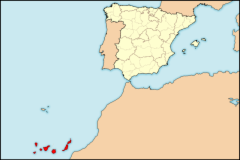 Canary Islands (in red) - Credit: HansenBCN