


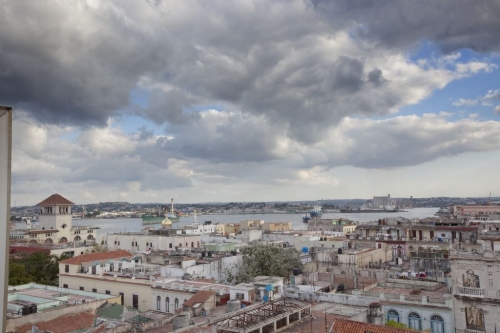
The port city of Havana, Cuba, is repeatedly referenced in The Old Man and the Sea. Its official name in Spanish is Ciudad de La Habana. It is the capital of Cuba.
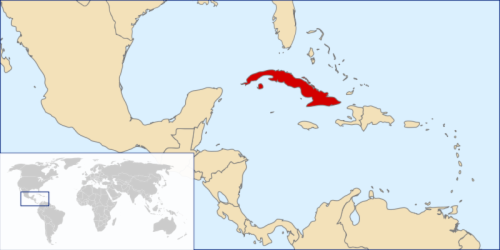
 Cuba lies in the Caribbean Sea, east of the Yucatán Peninsula and south of Florida - Credit: Vardion
Cuba in the 1950s was quite different than today. It was a popular tourist destination. Although often corrupt, the government was democratically elected. It was not until 1959 that Fidel Castro took control and turned the island into a Communist nation.
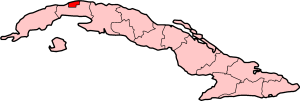 Havana, Cuba (in red) - Credit: Morwen
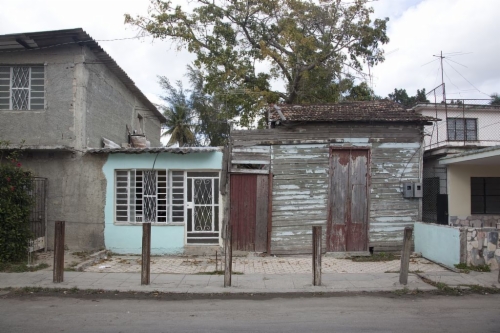
Santiago's village is not named in the novel but Cojimar likely served as Hemingway's model; it is located on the northern coast of Cuba, near Havana, and is on a harbor. In 1952, when Life magazine was planning to publish The Old Man and The Sea, the editors sent photographer Alfred Eisenstaedt to Cuba to meet with Hemingway and get shots to illustrate the work. They went to the village of Cojimar, which was just "a few minutes from the author's home." Surprisingly, when the article was published, the photos were not included; an artist's illustrations were used instead. However, Life has now put Eisenstaedt's photos online, and I highly recommend viewing them to get a sense of place for Santiago's village. They are available here.
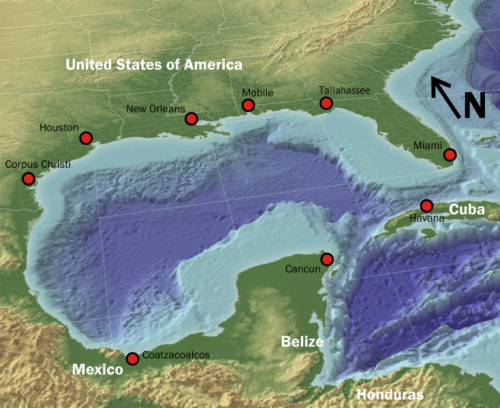
 Gulf of Mexico, 3D image
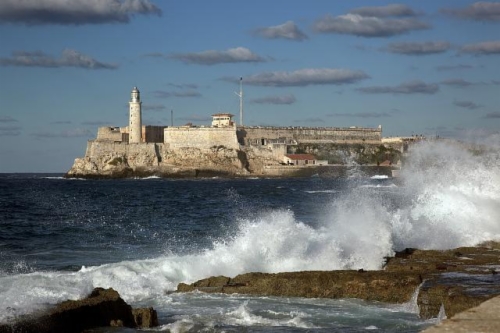 Morro Castle on Havana Bay, off the Gulf of Mexico
The Gulf of Mexico is actually considered to be a sea. According to gulfbase.org, it “is bordered by the United States to the north . . ., five Mexican states to the west . . , and the island of Cuba to the southeast.” It’s roughly 900 kilometers (over 550 miles) from north to south and 1,600 kilometers (over 990 miles) from east to west. It is home to rich petroleum deposits and some of the most productive fisheries in the world.