

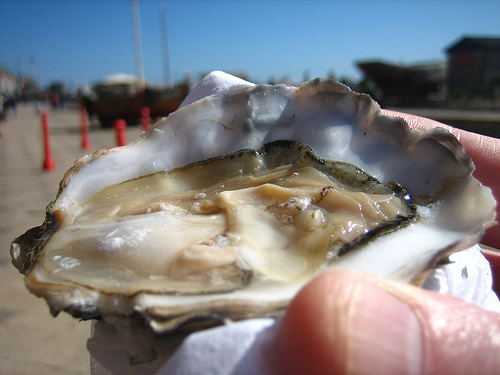
 An oyster, close-up - Credit: Jeremy Keith, Flickr
The Oyster Girl was a popular nineteenth century song.
There seem to be various versions of the lyrics, although none include a reference to Bishopgate Street.
Bishopsgate is a road in the City of London.
Listen on Spotify to one version of The Oyster Girl
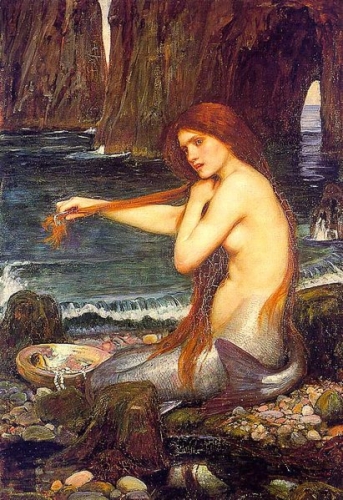
 'A Mermaid' - Credit: John William Waterhouse (1849-1917)
A mermaid is a mythological, female marine creature, possessing the head and torso of a woman and the tail of a fish.
In folklore and literature, mermaids sometimes have a malign influence on human beings; sometimes, a benign influence.

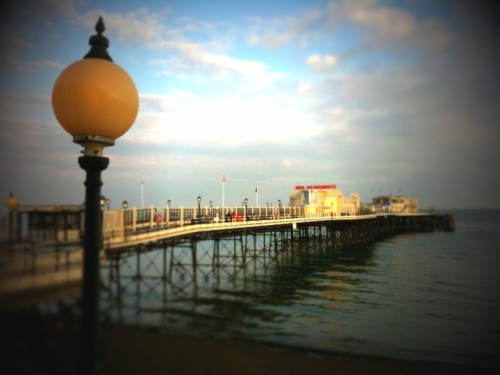
 Worthing Pier - Credit: Earldelawarr, Wikimedia Commons
During the Victorian era, many fashionable British seaside resorts built pleasure piers – long, narrow cast-iron and wood structures, extending out into the sea.
Their initial purpose was for people to walk and benefit from the sea air, but they quickly developed into amusement areas, often incorporating a theatre. They were also used as landing-stages for paddle steamers.
At the beginning of the 20th Century, there were over a hundred pleasure piers in Britain; today, there are about half that number. However, attempts are being made to restore and preserve those piers that still exist.
Take a walk along the Morecombe sea-front in 1901, and note the advertisement for the entertainment on the West End pier:
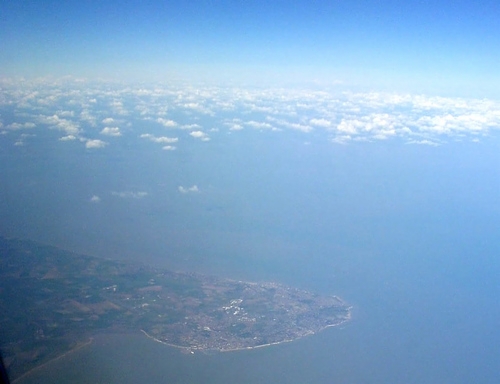 Aerial view of the Isle of Thanet - Credit: Matt Boulton, Flickr
Broadstairs is a seaside town in East Kent, situated between Margate and Ramsgate on the Isle of Thanet.
Morphodite is a comic pronunciation of the the word hermaphrodite. It is used twice, for example, in Chapter 8 of Harper Lee's book To Kill a Mockingbird.
Morphodite, morphydite or moffie (in South Africa) are also sometimes used as a slang words for a homosexual.
Hermaphrodite (used as a noun and an adjective) is the name given to an organism (plant or animal) which has both male and female reproductive organs.
The situation with oysters is complex: they are dichogamous, protrandrous hermaphrodites; this means they have the ability to be both male and female, although not at the same time; they start life as male and become female later on.
 Board illustrating the development of an oyster - Credit: Ben+Sam, Flickr
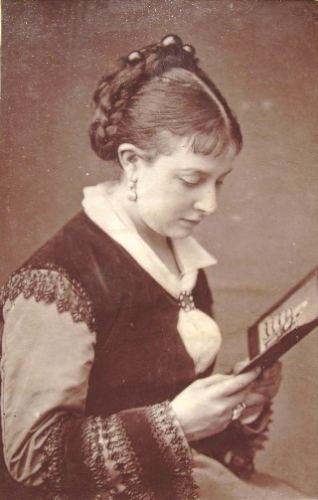 Nelly Power - Credit: Lock & Whitfield
Bessie Bellwood (1856-1896), whose real name was Catherine Mahoney, was also a Music Hall performer, particularly well known for her rendition of the song What Cheer Ria;
Jenny Hill (1850-1896) was another Music Hall star, known by the nickname The Vital Spark;
Jolly John Nash (1830-1901) was a Music Hall singer and comedian; he was famous for his laughing songs, such as The Nice Old Maids and The Little Brown Jug, and was an accomplished player of the cornet and concertina.
Follow this link to see a portrait of Bessie Bellwood
A line from the chorus of a song entitled My Wife's Relations, written in 1876, with music and lyrics by Arthur Lloyd.
Arthur Lloyd (1839-1904) was an extremely well known Scottish-born Music Hall singer-songwriter and comedian; he produced a popular variety entertainment known as Two Hours Genuine Fun and gave several performances for members of the Royal Family.
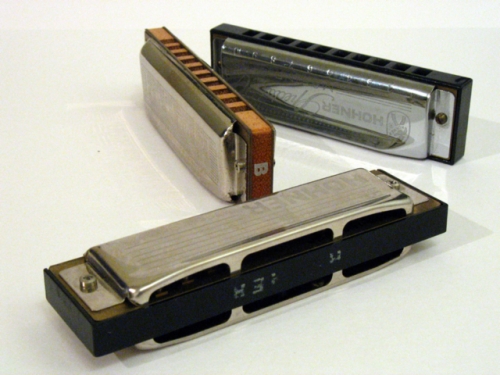
 Harmonicas - Credit: cralize, wikimedia
A harmonica is a musical instrument, commonly known as a mouth organ. Other names for it include French harp and blues harp.
It has been a prominent feature of American folk, blues, jazz and country music; Bob Dylan, for example, is famous for using both harmonica and guitar in his songs.
The harmonica was a popular instrument in numerous countries, including Britain; it is said that in 1887, 5.4 million harmonicas were imported to the U.K. from Germany.
Contemporary British-based musicians who specialise in the harmonica include Brendan Power and Rory McLeod.
Listen on Spotify to Brendan Power playing The Drunken Landlady on the harmonica.
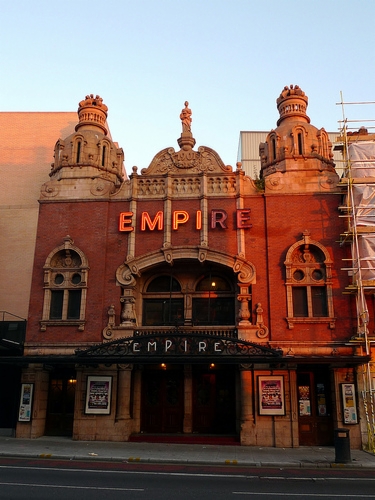 The Hackney Empire, London - where Marie Lloyd performed - Credit: Ewan Munro, Flickr
The Boy I Love is Up in the Gallery was a song written in 1885 by George Ware for Nelly Power; it was popularised by Marie Lloyd (1870-1922), another well-known star of the late 19th and early 20th Century Music Hall.
Chorus:
The boy I love is up in the gallery,
The boy I love is looking now at me,
There he is, can't you see, waving his handkerchief,
As merry as a robin that sings on a tree.
Listen on spotify to The Boy I Love is Up in the Gallery
Listen to Helen Shapiro singing 'The Boy' in the 1968 documentary film about the British Music Hall: A Little of What You Fancy.
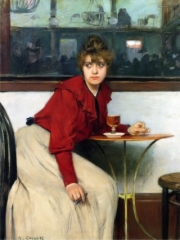 Who is 'The Coffee Shop Girl'? - Credit: Ramon Casas
Information about The Coffee Shop Girl is sparse on the internet.
There is some suggestion, however, that the song may be linked to one of the Music Hall male impersonators who was also a tap dancer and who may have spent part of her life at a house called The Hermitage in Streatham.
A popular comic song known as The Coffee Shop at Pimlico was composed by Frank Bell in 1864.
The term Coffee House features in this dictionary of Victorian sexual slang, where it is noted as slang for a necessary house (old fashioned word for toilet or privy).