
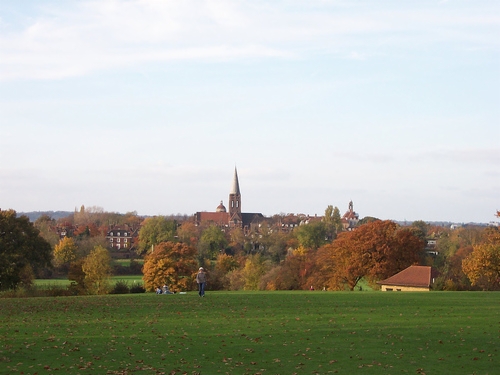
 Hampstead Heath - Credit: Loz Pycock, Flickr
Hampstead is an affluent area of London, situated in the London Borough of Camden.
It has traditionally been seen as the stamping ground of literary, musical, and artistic figures; intellectuals; and middle-class liberals.
One of the main attractions of the area is the large open space known as Hampstead Heath.
Paddington is an area of London famous for its railway station, the terminus for trains from the West Country and South Wales.

 Painting of Paddington Station (c.1862) - Credit: William Powell Frith
Dulwich is an affluent district in South London. It consists of three areas: East Dulwich, West Dulwich and Dulwich Village.
Peckham is an area of South London, situated in the Borough of Southwark; it forms part of the constituency of Camberwell and Peckham, which is one of the most deprived in the country.
The Peckham Palace of Varieties was on Southampton Street (fomerly Rainbow Lane; now Southampton Way); it is said to have been part of a pub known as the Rosemary Branch.
The Britannia Theatre, Hoxton, referred to in bookmark, p.146.
 Roast goose - Credit: Jürgen Howaldt, Wikimedia Commons
Founded in 1867 by Auguste Kettner, chef to Napolean III, it has a long and colourful history; Oscar Wilde is said to have taken rent boys there, and its patrons have included King Edward VII, his mistress Lillie Langtry, Agatha Christie and Bing Crosby.
During the Victorian period, goose was the preferred choice for Christmas dinner in the south of England, whilst beef was the favourite up north; it was only towards the end of the 19th Century that turkey became popular.
Capri is an island in the Tyrrhenian Sea, just off the southwest coast of Italy.
 Compton Mackenzie (1914) - Credit: Alvin Langdon Coburn
Compton Mackenzie wrote a satirical novel about the 1920s lesbian community on Capri, entitled Extraordinary Women (1928).
 Magazine featuring 'The Picture of Dorian Gray' - Credit: Adasta, Wikimedia Commons
Dorian Gray is the young male protagonist of a novel by Oscar Wilde entitled The Picture of Dorian Gray.
Initially published in a magazine, it was first published in book form in 1891.
The novel is generally described as gothic horror fiction, with a Faustian theme.
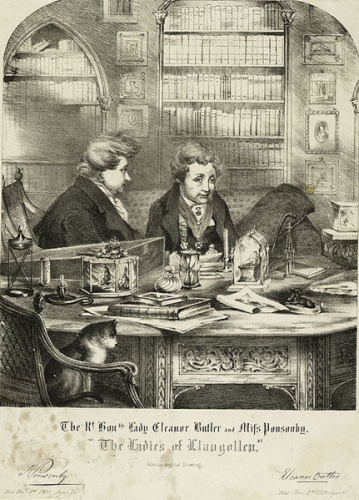
The Ladies of Llangollen was the name given to two Anglo-Irish women: Lady Eleanor Charlotte Butler (1739-1829) and the Honourable Sarah Ponsonby (1755-1832).
Brought up in the same area of Ireland, they became friends in 1768 and scandalised society by running away together in 1778.
They eventually set up home at Plas Newydd near Llangollen in north east Wales, where they became a magnet for all kinds of illustrious visitors, including William Wordsworth, Percy Bysshe Shelley, the Duke of Wellington and Josiah Wedgewood.
Plas Newydd is now a museum.
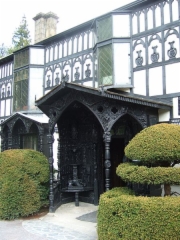 Plas Newydd doorway - Credit: Andy Dingley, Wikimedia Commons
 Queen Anne and her consort - Credit: Charles Boit
Happily married to Prince George of Denmark, she experienced extraordinary misfortune in pregnancy and childbirth: thirteen of her pregnancies ended in miscarriage or stillbirth; four of her children died before the age of two; and the only child who survived beyond infancy (her son William) died aged eleven.
Consequently, Queen Anne was the last monarch of the House of Stuart.
 Queen Christina - Credit: David Beck (1621-1656)
 Ebba Sparre - Credit: Sébastien Bourdon
Queen Christina (1626-1689) ruled Sweden in her own right as queen regnant (as opposed to queen consort) betwen 1632 and 1654.
She is often described as having had an intimate relationship with her lady-in-waiting, Ebba Sparre, although it is not clear whether they were lovers.
In 1654 she abdicated in order to convert to Catholicism, and spent the latter years of her life in France and Italy. She is buried in St. Peter's Basilica in Rome.


 Artemis (Roman copy of Greek original) - Credit: Marie-Lan Nguyen
In Roman mythology, Diana was goddess of the hunt as well as of the moon. Along with Minerva and Vesta, she was one of the three maiden goddesses, and a symbol of chastity.
In Greek mythology, her equivalent was Artemis, who was goddess of the hunt, wild animals, wilderness, childbirth, virginity and young girls.
 Diana the huntress - Credit: Bartolomeo Passerotti
 Bust of Antinoüs - Credit: RyanFreisling, Wikimedia Commons
When Antinoüs was drowned in the River Nile (possibly through voluntary religious sacrifice), Hadrian was distraught with grief.
Antinoüs was deified after his death, and numerous statues were erected to his memory in all parts of the Roman Empire.


The toga was a bulky garment (made from up to 6 metres of fabric) worn by Roman men; Nan's costume would probably be better described as a tunic.
A tunic was a light, short sleeveless garment cinched at the waist with a belt.
The belt (known as a cingulum) was an important item of Roman men's clothing; it was often very ornate and might have various items attached to it, including weapons in the case of soldiers. A zone is an archaic word for a belt or girdle.

 Reconstruction of a Roman centurion's cingulum - Credit: Wolgang Sauber, Wikimedia Commons
The lotus, Nelumbo nucifera (also known as the Indian lotus, the sacred lotus, or the bean of India), is an aquatic plant with fragrant flowers which is native to India and Bangladesh; it is India's national flower.
It is of sacred significance in many Eastern religions and symbolizes sexual purity and non-attachment, perfection, beauty and grace.
 Nelumbo nucifera - Credit: T. Voekler, Wikimedia Commons
 Dutch Tableau Vivant, c1898 - Credit: Tropenmuseum of the Royal Tropical Institute
A tableau vivant is generally a group of unmoving, silent people posed in such a way as to represent an event or theme; they were particularly popular during the 19th Century. Such representations could be viewed live or photographed for wider distribution.
As censorship laws permitted some nudity on stage so long as there was no movement, female actresses were sometimes posed in this way as a form of erotic titillation.
 Marie Anoinette in prison (1793) - Credit: Alexandre Kucharski
 Marie Antoinette and her children (1785-86) - Credit: Adolf Ulrich Wertmüller
Louis was deposed during the French Revolution and executed in January 1793; his wife was also tried and convicted of treason before being guillotined in October of the same year.

 German version of 'Psychoapthia Sexualis' - Credit: Krafft-Ebing (H.-P. Haack, Wikimedia Commons)
Most probably Psychopathia Sexualis (1886) by Richard Freiherr von Krafft-Ebing.
The book consisted of a series of case studies of human sexuality; it included discussions of sadism and masochism, two terms which were coined by Krafft-Ebing.
With a Latin title and partly written in Latin, the book was intended for a professional audience, but it became a bestseller amongst the general public. It was translated into English in 1892.
The seraglio (or harem) was the name given to the women's living quarters in a Turkish muslim household in which the man had several wives and concubines*.
Men were not allowed into the seraglio, which might also house female relatives and odalisques (female slaves who were assistants or apprentices to the wives and concubines).
* women who co-habit with a man without being married to him.
 The fortune teller in the harem (pre 1908) - Credit: Alfred Chataud
Listen on Spotify to Mozart's Die Entfuhrung Aus Dem Serail (The Abduction from The Seraglio).
 Hadrian's Wall at Housesteads - Credit: Mlm43, Wikimedia Commons
Publius Aelius Hadriannus (73-138AD), generally known as Hadrian, was a Roman emperor and philosopher.
Hadrian's Wall, the fortification which marked the northernmost limit of the Roman Empire in Britain, was built during his reign.
Hadrian was also responsible for building the city of Antinopolis in Egypt, close to the spot where his beloved Antinoüs (see bookmark, p.308) drowned.
 Bust of Hadrian - Credit: Sébastien Bertrand, Wikimedia Commons
 Relief of Cerberus (Berlin Zoo) - Credit: Sebastian Wallroth, Wikimedia Commons
Hades is guarded by Cerberus, a multi-headed dog.