
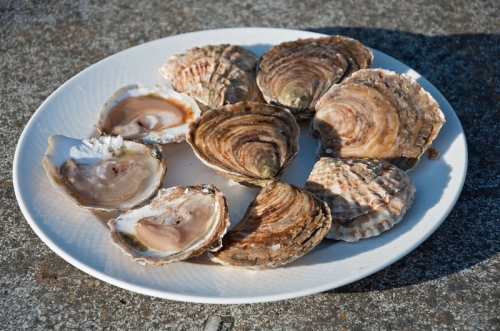
 Ostrea edulis (the native Whitstable oyster) - Credit: Myrabella, Wikimedia Commons
This striking opening line refers to a type of oyster that has been collected in the seas off Whitstable since Roman times.
The traditional Whitstable oyster is Ostrea edulis; the local name for members of this species is natives. Today, Whitstable oyster is a protected title which may be used to describe both natives and other species of oyster grown in local waters; the oysters are raised in hatcheries before being transferred to offshore oyster beds.
The Whitstable oyster industry declined substantially between the 1920s and the late 1970s, but is now undergoing a revival; the annual oyster festival, which has long been a feature of the town, continues to be held in late July, the traditional holiday period of the oyster dredgers.
Whitstable lies on the north coast of Kent, a county in southeast England.


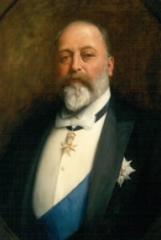
 King Edward VII by Luke Fildes - Credit: Luke Fildes
Born in 1841, Edward was Prince of Wales for most of his life, during which time he led a leisured and hedonistic lifestyle.
He married Alexandra, daughter to the King of Denmark, in 1862, but had numerous affairs; one affair was with Alice Keppel, a married woman.
Alice Keppel (1868-1947) was the great grandmother of Camilla Parker Bowles (now the Duchess of Cornwall and wife of Prince Charles) and the mother of Violet Trefusis, the lover of Vita Sackville-West.
Given Edward VII's alleged tastes, it may be of interest to note that oysters reputedly have aphrodisiac qualities.
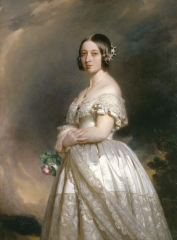 The young Queen Victoria (c.1842) by Winterhalter - Credit: Franz Xavier Winterhalter (1806-1873)
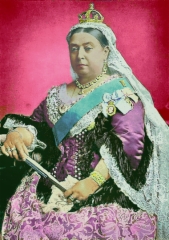 A postcard of Queen Victoria (c.1887) - Credit: unknown
The 'old Queen' is Queen Victoria (1819-1901) who reigned from 1837 until her death in 1901.
She was also known as Empress of India from 1876 onwards.
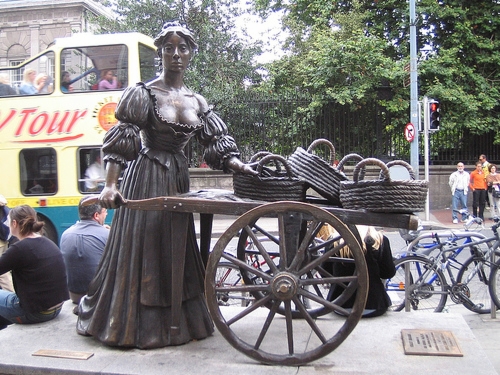 Statue of Molly Malone on Grafton Street, Dublin - Credit: William Murphy, Flickr
Molly Malone is the title of a popular song which tells the story of a young woman who sells cockles and mussels on the streets of Dublin.
The music and lyrics were composed by James Yorkston of Edinburgh and were published for the first time in 1883.
Although it has been suggested from time to time that Molly Malone was a real person, there does not appear to be any evidence for this theory. However, she is represented in statue form on Grafton Street, Dublin.
Listen on Spotify to Molly Malone sung by Bryn Terfel
Listen on Spotify to Molly Malone sung by Sarah Moore
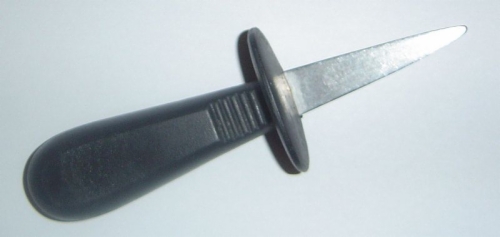 Oyster knife - Credit: David Monniaux, Wikimedia Commons
An oyster knife is especially designed for opening (or shucking) oysters. It usually has a triangular blade and a thick, non-slip handle.
Special gloves are worn to protect the hands from the sharp edges of the oysters' shells.
Click here for instructions on how to shuck an oyster.
Dredging smacks were the fishing boats used to trawl the oysters from the seabed.
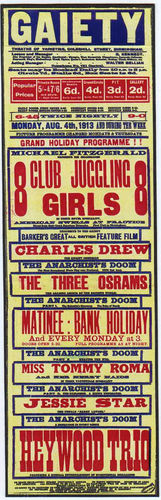
 1913 poster for the Gaiety Music Hall, Birmingham - Credit: Malcolm Drew, Flickr
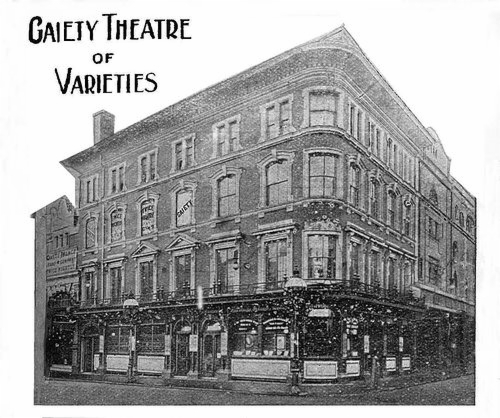 Gaiety Music Hall, Birmingham c.1907 - Credit: Malcolm Drew, Flickr
Music hall is a type of theatrical entertainment combining singing, dancing and speciality acts (such as magicians, ventriloquists and puppeteers). It is known in America as vaudeville.
It was popular in Britain between 1850 and 1960, and was an extension of the 'musical saloons' held in pubs and taverns in the early decades of the 19th Century. When special venues, known as music halls, were built for this kind of entertainment, the tradition of serving alcohol and sometimes food was retained.
The popularity of music halls reached its peak during the First World War, when they became associated with patriotic songs such as We Don't Want to Lose You and Keep the Home Fires Burning.
Listen to some music hall songs on Spotify: Champagne Charlie (1867)
Down at the Old Bull and Bush (1903)
Nellie Dean (1905)
Keep the Home Fires Burning (1914)
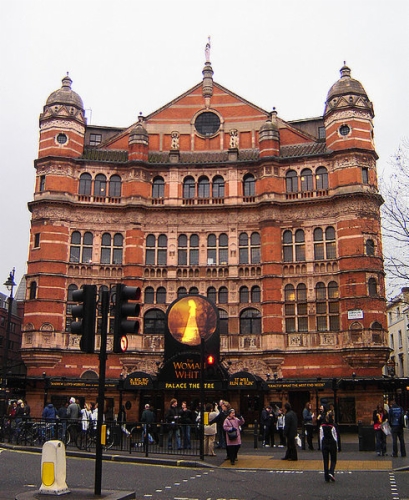 The Palace Theatre, Soho - originally The Palace Theatre of Varieties - Credit: Tarquin Binary, Wikimedia Commons
The names Palace of Varieties, Theatre of Varieties or Palace Theatre of Varieties were often given to 19th Century music halls.
The West End theatre at Cambridge Circus known today as the Palace Theatre began life in 1891 as the Royal English Opera House but was converted shortly afterwards into the Palace Theatre of Varieties.
Other music halls with the same name were the Tottenham Palace Theatre of Varieties on Tottenham High Road in northeast London, and the Euston Palace Theatre of Varieties in the King's Cross area of London.
It is not clear whether there was actually a Palace of Varieties in Canterbury, Kent, although interestingly the first purpose-built music hall in London, established in Lambeth in 1852, was the Canterbury Music Hall; it was later re-built and named the Canterbury Theatre of Varieties.
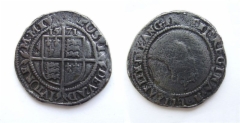 Elizabeth 1st. sixpences (1571) - Credit: Anakin 101, Wikimedia Commons
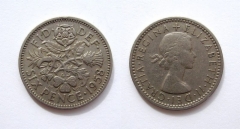 Elizabeth 2nd. sixpences (1958) - Credit: Anakin 101, Wikimedia Commons
The sixpence was a British coin minted between the 16th Century and decimalisation of United Kingdom coinage in 1971. It was worth the equivalent of 2.5 new pence.
Until 1920, sixpences were made entirely of sterling silver, but the use of silver was later phased out; from 1947, sixpences were made of cupro-nickel.
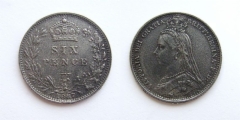 Victorian sixpence - Credit: Anakin 101, Wikimedia Commons
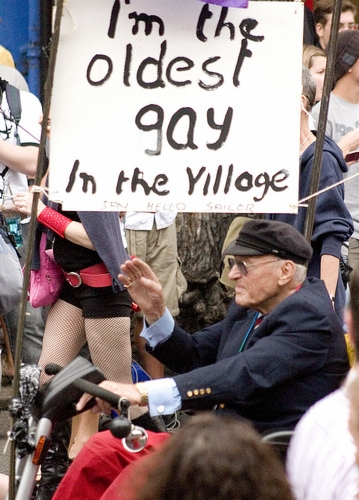 Brighton Pride Parade, 2009 - Credit: Dominic Alves, Flickr
Although the word gay was occasionally used from the late 19th Century onwards to mean homosexual (in a pejorative sense), its most common meaning until the 1980s was bright, carefree or happy. However, during the last three decades, gay has become the most common and accepted word for homosexual, both as a noun and an adjective.
The word is used frequently in its old-fashioned sense in Tipping the Velvet, although generally in contexts where it is possible to see some ambiguity in its meaning.
It has been suggested that there are precedents to this ambiguous use of the word gay in Gertrude Stein's novel Miss Furr and Miss Skeene (1922), and in some of Noel Coward's lyrics, such as the following lines from Green Carnation (1929):
And as we are the reason
For the "Nineties" being gay,
We all wear a green carnation.
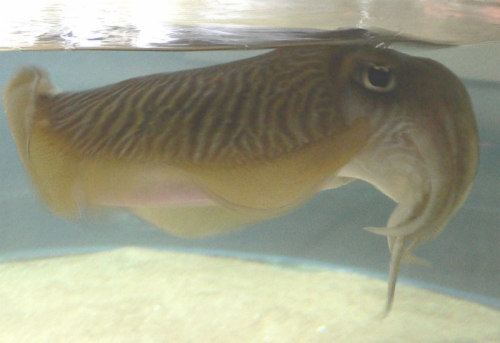
 A cuttlefish - Credit: Raul654, Wikimedia Commons
Living cuttlefish are not bleached. The reference is to the cuttlebone, the brittle internal structure of gas-filled chambers used for buoyancy control. Cuttlebones wash up on beaches, white, bleached and frequently blemishless.
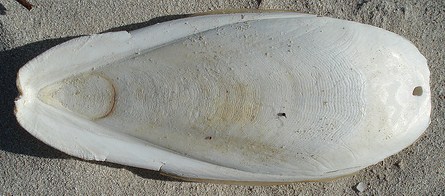 Cuttlebone - Credit: Paul J. Morris
 Diana and Cupid by Batoni (1761) - Credit: Pompeo Batoni (1708-1787)
Cupid, in Roman mythology, is the god of erotic love. He is traditionally depicted with wings and a bow and arrow, an image that has now come to symbolise romantic love on items such as Valentine's Day cards. His Greek equivalent is Eros.
The term cupids (plural) is sometimes used, not quite accurately, to describe putti or cherubs – the plump winged babies that populate later Renaissance art.
 Putti from the Sistine Madonna - Credit: Raphael
A crab is a ten-legged crustacean;
 A crab - Credit: Jacob, Wikimedia Commons
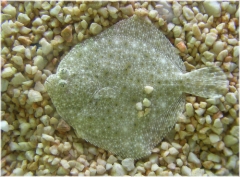 A turbot - Credit: Jose Luis Cernados Iglesias, Flickr
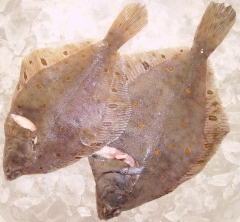 Plaice - Credit: Garitzko, Wikimedia Commons
plaice and turbot are types of flatfish;
herring are oily fish.
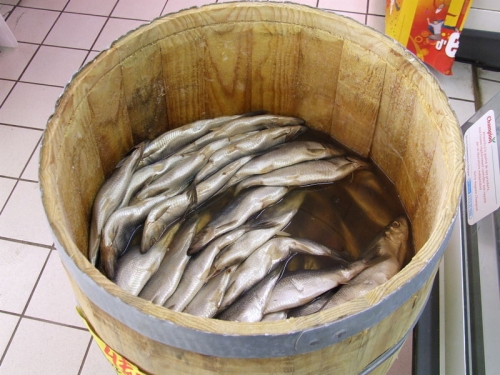 Herring - Credit: Claus Ableiter, Wikimedia Commons
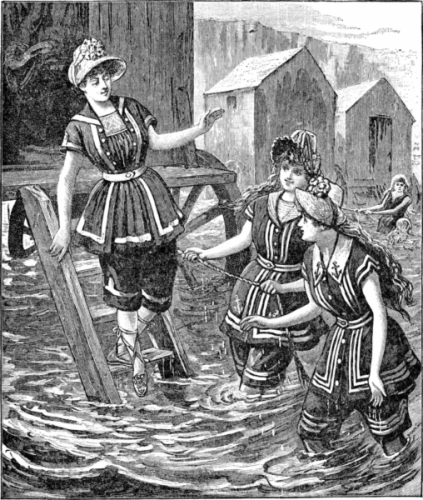 Advertisement for bathing costumes (1887) - Credit: from 'Lady's World' magazine (author unknown)
This is a real song, referred to by Christopher Pulling in a 1952 book entitled They were Singing and What they Sang About. The opening lines are:
All the girls are lovely by the seaside,
All the girls are lovely by the sea.
It is one of many 19th and early 20th Century music hall songs about girls at the seaside and about the seaside in general. In James Joyce's Ulysses, there is reference to one called Those Lovely Seaside Girls, which was written in 1899; another song, written in 1907, with the title Oh, I Do Like To be Beside the Seaside is still well known today.
Listen on Spotify: Oh, I Do Like To be Beside the Seaside.
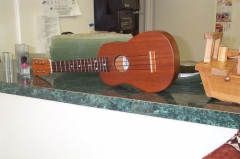 ukelele - Credit: stu_spivack, Flickr
The ukelele is a four-stringed musical instrument belonging to the guitar family. It originated in Hawaii in the late 19th Century but was adopted by American Jazz musicians in the 1920s.
In the inter-war period in Britain, the ukelele (particularly a version of it known as the banjo ukelele) was popularised by the music hall singer and comedian George Formby (1904-1961).
Listen to George Formby play the ukelele and the banjo ukelele:
Soft-shoe dancing is a type of tap dancing performed using soft shoes rather than the metal-plated shoes of traditional tap.
Soft-shoe dancing: Traditional tap dancing:
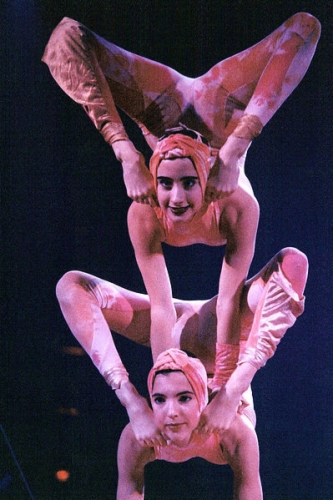
There does not appear to be any record of a Dover theatre named the Phoenix. However, Phoenix was a popular name for theatres and cinemas during the 20th Century.
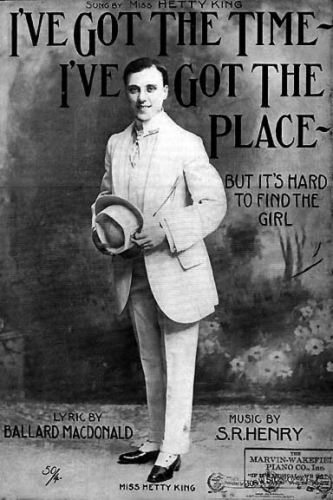
In current English, masher is a slang term for a man who forces his unwanted attentions on a woman; in 19th century England, particularly in the world of the Music Hall, a masher was a male impersonator, or any woman who dressed as a man.
Faversham is a small market town in Kent, close to Whitstable.
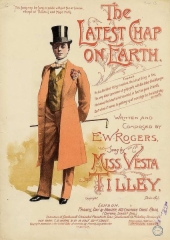 Poster featuring male impersonator, Vesta Tilley - Credit: unknown
The origins of females impersonating males can be traced to late 17th and early 18th Century British theatre, when women started playing male characters – roles which were known as breeches parts. Later, the concept became known as playing en travesti.
In the 19th Century, male impersonation by women became a feature of music hall acts; cockney urchins, men-about-town and uniformed soldiers were particularly popular roles played.
Amongst the best known male impersonators of the period were Vesta Tilley, Ella Shields and Hetty King.
Today, a male impersonator is sometimes known as a drag king, the female equivalent of a drag queen.
 Nelly Power - Credit: Lock and Whitfield
She was well known for her impersonations of George Leybourne (1842-1884), who was known by the nickname, Champagne Charlie, which was the title of one of his songs.
The graves of Nelly Power and George Leybourne are next to each other in the Abney Park Cemetery in Stoke Newington in North London.
There is no reference to any song with the title The Last of the Dandies on the internet.
Does anybody know whether such a song existed?
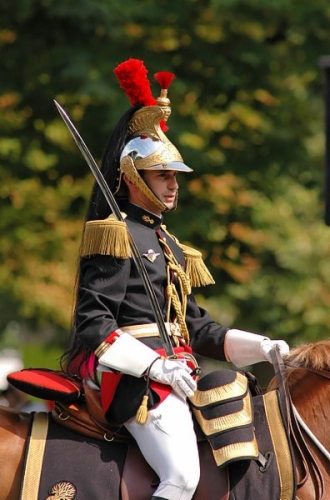 French Republican Guard uniform with bullion fringe epaulettes - Credit: Jastrow, Wikimedia Commons
Bullion fringe is a heavy corded fringing usually used to trim curtains, cushions, upholstered furniture, lampshades and so on.
It may also be used for epaulettes on soldiers' uniforms.
Follow this link for various types of bullion fringe.
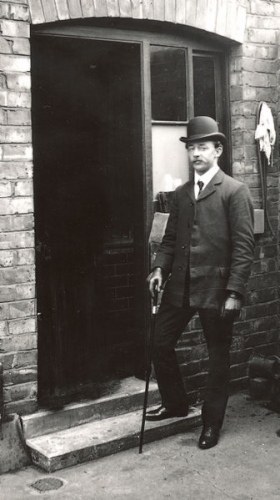 Example of a cane and billycock hat - Credit: Albert Edwin Roberts (1878-1964)
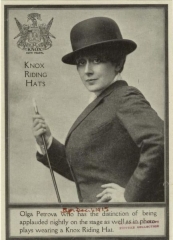 The actress, Olga Petrova, wearing a billycock as a riding hat (1915) - Credit: unknown
A cane is an old-fashioned word for a walking stick.
A billycock hat is any round, low-crowned, felt hat, an example of which would be the hat commonly known as a bowler.
Gilbert Hastings MacDermott (1845-1901) was a singer, theatrical agent and music hall manager; he was particularly well-known for his spirited rendering of a song called the Jingo War Song.
There does not appear to be any information on the internet about the song Drink Up, Boys!
 Treble clef - Credit: Adam Arredondo, Wikimedia Commons
Sweethearts and Wives (also known as A New Sea Song), an undated sea-shanty, starts like this:
Our bosun calls out for his bold British heroes:
Come listen a while to what I do sing.
Let every man toss off his full bumper,
And drink a good health unto George our king.
And drink a good health to Suke, Moll and Kitty;
With mirth and good liquor we’ll lead merry lives.
We will not be afraid to kiss or to venture
On Saturday night to our sweethearts and wives.
Listen on Spotify to Sweethearts and Wives (A New Sea Song)
There do not appear to be any references on the internet to an actual music hall artist called Gully Sutherland.
This character reappears later in Tipping the Velvet, in tragic circumstances. As Sarah Waters generally uses the names of real performers throughout the text, it is quite likely that a performer of this name did exist.
Does anybody have more information?
 Graffiti in Vienna in 2007 - Credit: Les Hutchins, Flickr
Queer in standard English means odd or strange.
It has also been used as a derogatory slang word for a male homosexual, particularly in the mid-20th Century.
More recently, however, the term queer has become acceptable within the Lesbian, Gay, Bisexual and Transgender communities. It may, therefore, sometimes be used as an alternative to the LGBT designation.
As with the word gay, queer is often used in Tipping the Velvet in an ambiguous way.
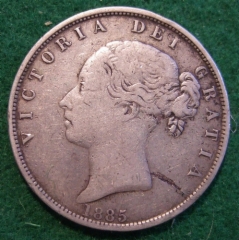 An 1885 half-crown - Credit: Jerry "Woody", Flickr
A crown was worth five shillings in Britain prior to decimalisation (25p in modern terms).
A half-crown could, therefore, be described as two shillings and sixpence, or simply as two and six.
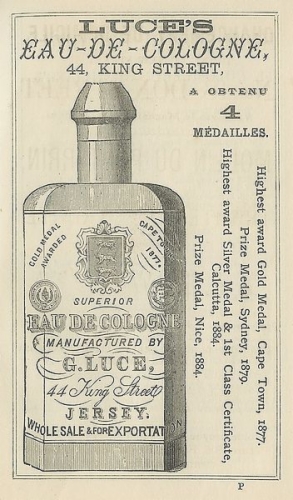
Eau de Cologne is a light perfume, first manufactured in Cologne in Germany in 1709.
Today, there are many versions of eau de Cologne, which consists of citrus and other essential oils in an ethanol base; the exact formulation of the original version remains a secret.
There are two Music Hall songs whose titles include Burlington:
the first is Burlington Bertie, which was composed by Harry B. Norris in 1900 and sung by Vesta Tilley;
the second is Burlington Bertie from Bow (1915), a parody of Burlington Bertie.
The second song is credited to William Hargreaves and was sung by his wife, the male impersonator Ella Shields.
Burlington Arcade is a fashionable shopping arcade in Mayfair, London.